Bombay Army: History and Evolution of a Presidency Force
The Bombay Army was a pivotal military force in the administration of British India, serving as one of the three primary Presidency armies. Established in 1668, it evolved from a small garrison protecting a commercial outpost into a massive professional force that projected power across the Indian subcontinent and beyond. For over two centuries, it operated under the East India Company before transitioning to the direct authority of the British Crown and eventually merging into the unified British Indian Army.
Key Facts
- Active Period: 1668–1895 as the Bombay Army; 1895–1908 as the Bombay Command.
- Allegiance: East India Company (1662–1861) and British India (1861–1895).
- Growth: Expanded from approximately 2,000 personnel in 1779 to 44,000 by 1876.
- Headquarters: Based in Pune, Pune district.
- Integration: Incorporated into the British Indian Army on April 1, 1895.
Early Development and the 18th Century
In its infancy, Bombay was viewed by the East India Company as an unprofitable and unhealthy region. Consequently, the Company maintained only a minimal garrison, focusing instead on the Bombay Marine—a local navy designed to combat piracy. By 1742, the army consisted of eight companies of European and Eurasian troops totaling 1,593 personnel.
As the Company's influence grew, so did its military needs. By 1783, the force had expanded to 15,000 men. A significant shift occurred in the 1750s when recruitment expanded to include indigenous sepoys (Indian soldiers), who were initially hired as irregulars for specific campaigns. The first regular sepoy battalions were established between 1760 and 1778, while European elements—including British, Swiss, and German mercenaries—were consolidated into the Bombay European Regiment.
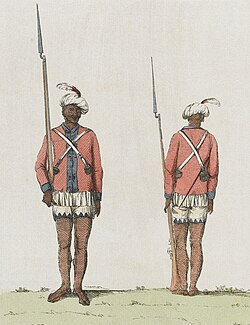
By the end of the century, the force became more structured. In 1796, the Bombay Native Infantry was reorganized into four regiments, each consisting of two battalions, and the Foot Artillery was expanded to six companies by 1797.
Expansion and Conflict in the 19th Century
The 19th century saw the Bombay Army engage in numerous high-stakes conflicts. It played a substantial role in the 1821 campaigns against the Bani Bu Ali, the First Afghan War (1838–1842), the Sind War (1843), the Second Sikh War (1848–49), and the Persian War (1856–57). The army also took on the strategic responsibility of garrisoning Aden.
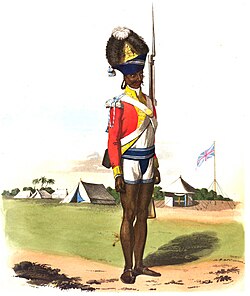
By January 1, 1842, the army's disposition was spread across several strategic divisions and brigades, including the Poona Division, the Northern Division in Ahmedabad, the Mhow Brigade, and forces stationed in Lower Scinde, Asirgarh Fort, Kharg Island, and Aden.
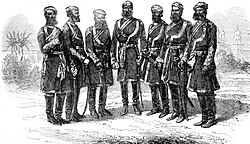
The infantry continued to grow, reaching 26 regiments by 1845. This period also saw the rise of the Bombay Light Cavalry and a specialized brigade of Bombay Horse Artillery comprising both British and Indian personnel.
Post-Mutiny Reorganization and Final Years
Following the 1857 Rebellion and the subsequent transfer of power to the British Crown in 1861, the army was reorganized. By 1864, it was structured into the Northern, Poona, Mhow, and Scinde Divisions, with various brigades and a continued garrison in Aden.
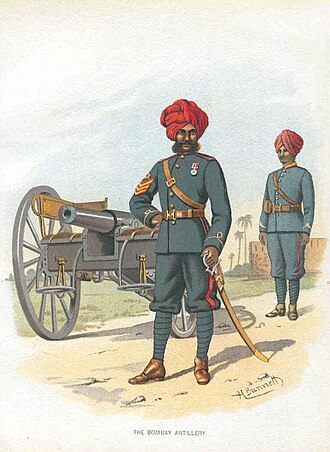
Throughout the late 19th century, the Bombay Army participated in the 1868 Expedition to Abyssinia, the Second Afghan War (1878–80), and the Third Anglo-Burmese War (1885–87).
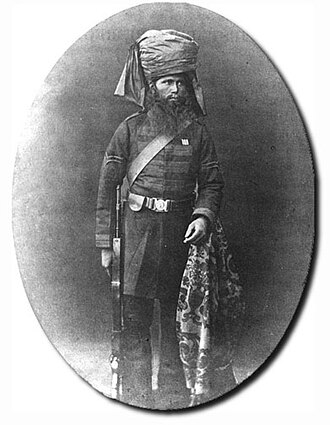
The era of the separate Presidency armies ended in 1895 when the forces began a unification process. The Army of India was divided into four commands: Bombay, Madras, Punjab, and Bengal. By 1903, the separate numbering systems were abolished in favor of a single organizational sequence, effectively ending the distinct presidency affiliations.
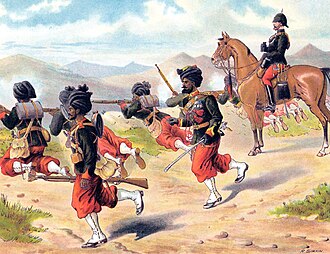
Uniforms and Regimental Dress
The Bombay Native Infantry generally followed British army regulations. Prior to 1856, officers wore coatees with gold lace, buckskin breeches, and shakos with regimental plates. In 1856, officers transitioned to scarlet tunics with light yellow facings and gold braid.
After the 1861 reorganization, many infantry regiments were converted into rifle regiments, which adopted green cloth uniforms with red facings. Specific items, such as the blue soft cap for sepoys and specialized cold-weather dress, were also utilized depending on the deployment environment.
Organizational Summary
| Component | Key Units (1856) | Key Units (1864) |
|---|---|---|
| Cavalry | 3 Regiments of Native Light Cavalry | Light Cavalry, Poona Horse, Scinde Horse, Southern Mahratta Horse |
| Artillery | Horse Artillery (4 European Troops), Foot Artillery (2 European, 2 Native battalions) | E Brigade Royal Horse Artillery, 18th & 21st Brigades Royal Foot Artillery |
| Engineers | Royal Engineers, Corps of Sappers and Miners (2 Companies) | Royal Engineers, Corps of Sappers and Miners (5 Companies) |
| Infantry | 3 European Regiments, 29 Native Infantry Regiments | 30 Native Infantry Regiments (including Belooch and Jacob's Rifles) |
| Irregulars | Poona, Guzerat, and Scinde Irregular Horse; Belooch Battalions | Candeish Bheel Corps, Rutnagherry Rangers, various Police Corps |
Frequently Asked Questions
When was the Bombay Army established and when did it end?
The Bombay Army was established in 1668. It operated as a separate entity until April 1, 1895, when it was incorporated into the British Indian Army as the Bombay Command, a designation it held until 1908.
Who controlled the Bombay Army throughout its history?
From its inception until 1861, the army was governed by the East India Company. Following the Government of India Act 1858, authority was transferred to the British Crown.
What were the primary roles of the sepoys in the Bombay Army?
Sepoys were indigenous Indian soldiers. Initially employed as irregulars for specific campaigns starting in the 1750s, they eventually formed the backbone of the regular Native Infantry and Cavalry regiments.
Which major conflicts did the Bombay Army participate in?
The army was involved in numerous campaigns, including the First and Second Afghan Wars, the Sind War, the Second Sikh War, the Persian War, the Expedition to Abyssinia, and the Third Anglo-Burmese War.
How did the uniforms change over time?
Early officers wore gold-laced coatees and shakos. By 1856, scarlet tunics with light yellow facings became standard for officers. After 1861, many units became rifle regiments and switched to green uniforms with red facings.