Blue Spruce: Characteristics, Ecology, and Cultivation of Picea pungens
The blue spruce (*Picea pungens*) is one of the most recognizable conifers in North America. Known for its striking needle color and majestic stature, this evergreen is a staple of both wild mountain landscapes and carefully manicured gardens. Whether referred to as the Colorado blue spruce or the water spruce, this resilient tree holds significant cultural and ecological value.
In its natural habitat, the blue spruce is a powerhouse of growth. While it can reach impressive heights of up to 50 meters (164 ft) in the wild, it typically settles around 30 meters (98 ft). When integrated into residential landscapes, it often grows more modestly, ranging from 9 to 18 meters (30 to 60 ft) in height with a spread of 3 to 6 meters (10 to 20 ft).
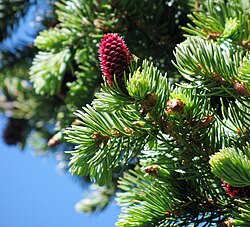
Key Facts
- Scientific Name: Picea pungens
- State Tree: Official state tree of Colorado since 1939.
- Height: Up to 50 meters in the wild; 9–18 meters in gardens.
- Distinguishing Feature: Waxy blue-gray coating on needles (in some populations).
- Root System: Dense and compact, lacking a taproot.
- Conservation Status: Listed as Least Concern (IUCN 3.1).
Physical Characteristics and Identification
Identifying a blue spruce requires a close look at its bark, needles, and cones. The trunk features scaly, gray-brown bark with a subtle cinnamon-red undertone. As the tree matures, this bark becomes more deeply furrowed and scaly, with trunk diameters potentially reaching 1.5 meters (4.9 ft).
One of the most important aspects of identification is distinguishing it from similar species like the Engelmann spruce, European spruce, white spruce, and black spruce. While the Engelmann spruce shares a similar range, you can tell them apart by their twigs: Engelmann twigs are finely hairy, whereas blue spruce twigs are usually hairless. Additionally, the cones of the blue spruce are generally larger, measuring 5–12 cm, compared to the 3–8 cm cones of the Engelmann spruce.
![The branches and cones of Picea pungens, then called Picea parryana as illustrated by Charles Edward Faxon in The Silva of North America[22]](/images/92/9b/929b845c461462cd4a522b5ca1b60ab99e236e2d8665850c73c073b5f57e2b9c.png)
Cones and Seeds
The reproductive structures of the blue spruce are distinct. The cones are substantial, with scales that extend 8–10 mm beyond the seed impression. These cones are essential for the tree's lifecycle and reproduction.
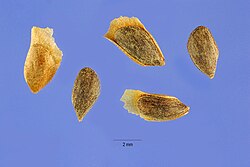
Taxonomy and Nomenclature
The blue spruce belongs to the family Pinaceae and the genus Picea. Over time, various scientific names have been applied to the species and its varieties, including synonyms such as Pinus armata and Pinus parryana. The common name "blue spruce" is used broadly for any spruce with a glaucous (waxy, bluish) coating, though in the wild, only a portion of the population exhibits this intense coloration.
| Rank | Scientific Name |
|---|---|
| Kingdom | Plantae |
| Division | Pinophyta |
| Class | Pinopsida |
| Order | Pinales |
| Family | Pinaceae |
| Genus | Picea |
| Species | P. pungens |
Ecology and Cultural Significance
The blue spruce plays a vital role in its ecosystem, providing habitat for various wildlife. For example, birds like the mountain chickadee are often found foraging within its dense foliage.
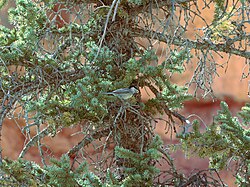
Culturally, the tree is deeply tied to the American West. It has been the state tree of Colorado since 1939. Interestingly, it also served as the state tree of Utah from 1933 until 2014, before being replaced by the quaking aspen due to the aspen's higher frequency in the state's landscape.
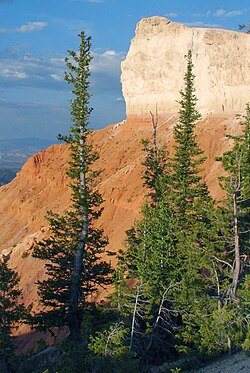
In terms of longevity, some specimens are remarkably old. A tree named "Old Blue," discovered in the Cedar Breaks National Monument, was dated to sprout in 1564, making it approximately 462 years old as of 2024.
Cultivation and Popular Varieties
Because of its aesthetic appeal, many cultivars have been developed for garden use. Some of these have even received the Royal Horticultural Society's "Award of Garden Merit."
- 'Globosa': A shrub-like variety that grows to 90–150 cm (3–5 ft) over 20–50 years.
- 'Montgomery': A slow-growing dwarf variety with tightly packed branches and silvery-blue needles, reaching heights of over 2.4 m (8 ft).
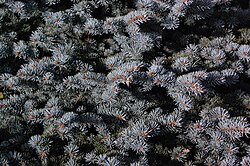
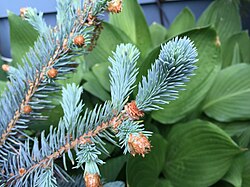
New growth in the spring often provides a vibrant display of color, as seen in the "Mission Blue" variety.
Frequently Asked Questions
How can I tell a blue spruce apart from an Engelmann spruce?
The easiest way to distinguish them is by looking at the twigs; Engelmann spruce twigs are finely hairy, while blue spruce twigs are typically hairless. You can also compare cone sizes, as blue spruce cones are generally larger.
Is the blue spruce a good choice for a garden?
Yes, it is a popular choice for parks and gardens. Depending on the cultivar, such as the dwarf 'Montgomery', it can be used for smaller spaces, or larger varieties can be used for privacy and windbreaks.
What is the meaning of "glaucous" in relation to this tree?
Glaucous refers to the waxy, blue-gray coating found on the needles of many blue spruce trees, which gives them their characteristic color.
Why was the blue spruce replaced as the Utah state tree?
The blue spruce was replaced by the quaking aspen because the aspen is significantly more common in Utah, accounting for approximately 10% of the state's tree cover.
How long do blue spruce trees live?
Blue spruces can live for centuries. One notable specimen, "Old Blue," was found to be over 460 years old.