Black Bat Flower: The Exotic Beauty of Tacca chantrieri
The Black Bat Flower (Tacca chantrieri) is one of the most visually striking plants in the botanical world. First described by Édouard André in 1901, this member of the yam family (Dioscoreaceae) is native to Southeast Asia. Known for its dark, dramatic blooms and unusual architecture, it is often referred to as the devil flower or cat whiskers.
From its deep purple-black hues to its wing-like structures, the Black Bat Flower is a marvel of nature that blends aesthetic mystery with complex biological mechanisms. Whether grown as a rare houseplant or studied for its medicinal properties, T. chantrieri continues to fascinate gardeners and scientists alike.
Key Facts
- Scientific Name: Tacca chantrieri
- Common Names: Black Bat Flower, Devil Flower, Cat Whiskers
- Native Range: Southeast Asia (including Thailand, Vietnam, and Southern China)
- Flower Size: Up to 12 inches across
- Plant Height: 50 to 100 cm
- Pollination: Primarily autonomous self-pollinating
- Growth Habit: Geophyte (contains rhizomes)
Botanical Description
The Black Bat Flower is distinguished by its rare black coloration. The plant features large bracts (modified leaves) that resemble the wings of a bat, which can span up to 12 inches. Hanging from these are bracteoles—long, whisker-like filaments reaching 8 to 10 inches in length. Some researchers suggest these bracteoles may possess photosynthetic properties, allowing them to contribute to the plant's energy production.
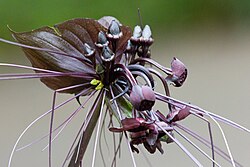
The plant typically grows between 50 and 100 cm tall. While the flowers are most famous for their black appearance, they can also exhibit shades of dark brown, purple, or occasionally green.
Geographical Range and Conservation
Tacca chantrieri possesses the widest geographical range of any species in the Tacca genus. It is found across Southeast Asia, spanning regions such as Assam, Bangladesh, Cambodia, Laos, Malaysia, Myanmar, Thailand, Tibet, Vietnam, and Hainan in Southern China.
Despite its broad distribution, the species has faced population declines. Habitat destruction, forest fragmentation, and overexploitation have reduced its presence in the wild.
The Mystery of Pollination
The Black Bat Flower employs a fascinating, albeit deceptive, strategy to attract pollinators. Its dark colors act as a carrion mimic, imitating decaying organic matter to attract flies. Insects enter the flower through an opening, guided by light through a tunnel, only to find no food reward.
Once inside, the "helmet-like stamens" make it nearly impossible for the insect to exit easily. While such extravagant floral displays usually suggest a reliance on cross-pollination to increase genetic variability, experiments show that T. chantrieri is mostly autonomous self-pollinating. Pollen bundles on the stigmas indicate that pollination often occurs before the flower even opens. This has led to theories that the plant may have once relied on a now-extinct pollinator or previously possessed a foul scent to attract insects.
Cultivation and Care
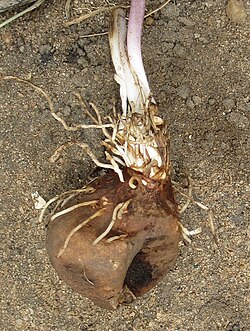
As a geophyte—a plant with underground storage organs—the Black Bat Flower grows from rhizomes (horizontal underground stems). It thrives in moist, tropical environments with nutrient-rich soil, similar to the requirements of orchids.
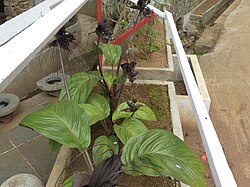
For successful growth, consider the following guidelines:
- Light: Prefers low to medium light levels.
- Humidity: Requires high humidity; indoor plants should be misted regularly.
- Watering: Keep the soil moist and tropical.
- Maintenance: Do not cut the flowering parts, as this causes the flower to decline quickly.
- Pests: Generally resistant to most pests, though slugs and snails should be monitored.
The plant typically flowers from April to July, often blooming up to eight times in a single growing season, provided at least two leaves have grown first. Propagation can be achieved through seeds, tuber division, or rhizome division.
Medicinal Uses and Chemical Properties
In traditional Chinese medicine, the rhizomes of T. chantrieri are highly valued. These root stalks contain potent medicinal compounds, including saponins and diarylheptanoids.
These extracts are used to treat a variety of conditions, including:
- High blood pressure (hypotensive activity)
- Gastric ulcers and enteritis
- Hepatitis
- Burns
Modern pharmaceutical research has identified Taccalonolides E and A within the root extracts. These are microtubule stabilizers with cytotoxic activity, meaning they have significant anticancer properties.
| Feature | Details |
|---|---|
| Family | Dioscoreaceae |
| Flower Color | Black, Dark Purple, Dark Brown |
| Primary Pollination | Autonomous Self-Pollination |
| Key Compounds | Saponins, Diarylheptanoids, Taccalonolides |
| Ideal Environment | Moist, Tropical, Low-Medium Light |
Frequently Asked Questions
Why is it called the Black Bat Flower?
It earns its name from its unique appearance; the large, dark bracts resemble bat wings, and the long bracteoles look like whiskers hanging from a bat.
How do I propagate a Black Bat Flower?
The plant can be propagated through the division of its rhizomes or tubers, and occasionally through seeds.
Does the Black Bat Flower smell?
While some theories suggest it may have once had a foul smell to attract carrion-seeking flies, it is primarily known for its visual mimicry of decaying matter.
Can the Black Bat Flower be grown indoors?
Yes, it can be grown as a houseplant in low to medium light, provided that high humidity is maintained through regular misting.
What are the medicinal benefits of the plant?
The rhizomes are used in traditional Chinese medicine for treating high blood pressure, ulcers, and hepatitis. Additionally, compounds called Taccalonolides are studied for their anticancer properties.