Birth Certificates: Global Standards, Types, and Legal Functions
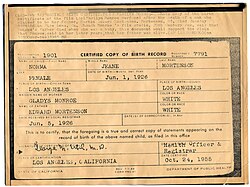
A birth certificate is a vital record that serves as the primary legal document certifying the birth of an individual. Depending on the legal jurisdiction, this term may refer to the original document detailing the circumstances of the birth or a certified copy representing the official registration of that event. These documents are essential for establishing identity, age, and citizenship.
The importance of these records extends beyond individual identity. The United Nations Sustainable Development Goal 17 (part of the 2030 Agenda) emphasizes the need for timely data regarding age, gender, race, and ethnicity—information that birth certificates are uniquely positioned to provide on a global scale.
Depending on the region, a birth record may include verification from a healthcare professional, such as a doctor or midwife, to validate the event.
Key Facts
- Legal Purpose: Used to document birth circumstances and provide official proof of identity and citizenship.
- Global Goals: Integrated into UN Sustainable Development Goals to improve global demographic data.
- Variations: Issued in various formats, including long-form (detailed) and short-form (summarized) versions.
- Verification: May require certification by medical professionals depending on local laws.
- International Use: Consular reports are used for citizens born overseas to maintain legal ties to their home country.
Types of Birth Certificates
Governments typically issue different versions of birth records based on the level of detail required for a specific legal process.
Long-Form vs. Short-Form
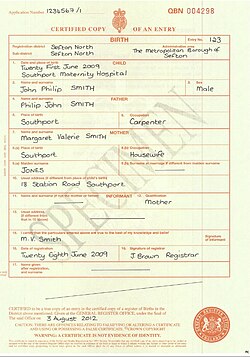
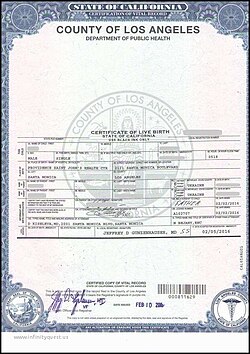
A long-form birth certificate is a comprehensive document that typically includes detailed information from the original registration, such as the parents' full names and birthplaces. In contrast, a short-form birth certificate provides a condensed version of the facts, often omitting parental details.
Specialized Certificates
- Consular Reports of Birth: Used for individuals born overseas. In the United States, these have evolved from State Department certifications (pre-1990) to certifications of report of birth (1990–2010) and finally to the current Consular Report of Birth Abroad (2011–present).
- Amended Certificates: Issued after adoption or legal name/gender changes to reflect current legal status.
- Souvenir Certificates: Non-legal documents issued for commemorative purposes.
Regional Implementation and Administration
The process of obtaining and managing birth records varies significantly by country and sub-national jurisdiction.
North America
In Canada, birth certificates are managed provincially. For example, residents of Ontario use ServiceOntario, while those in Quebec deal with the Director of Civil Status (Directeur de l'état civil). In the United States, while state-issued certificates are standard, not all government-issued versions are accepted for specific purposes, such as U.S. passport applications.
Asia and Oceania
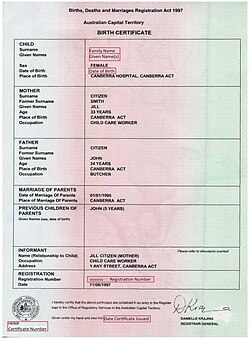
In Indonesia, the Denpasar Civil Registry recognizes several types of certificates, including the General Birth Certificate (Akta Kelahiran Umum), Delayed Birth Certificates, and certificates for children born to single mothers. Australia manages these through various state and territory registries, such as those in the Australian Capital Territory.
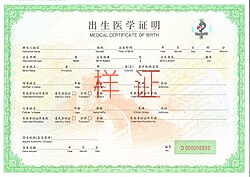
China utilizes a Medical Certificate of Birth, which has seen various editions, including the Fifth Edition used between 2014 and 2019.
Europe and Africa
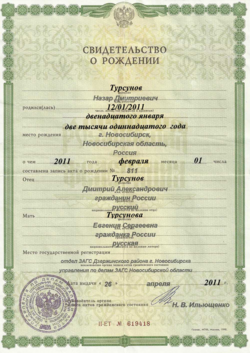
The United Kingdom maintains distinct registration authorities for England and Wales, Scotland, and Northern Ireland. In Russia, birth certificates may include specific inserts to confirm citizenship.
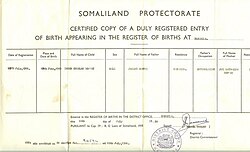
In Africa, records vary from the modern systems in Nigeria and Morocco to historical documents, such as those from the former Somaliland Protectorate.
Summary of Global Birth Record Characteristics
| Region/Country | Primary Authority/Type | Key Characteristic |
|---|---|---|
| United States | State Registries / State Dept. | Distinction between long-form and short-form; Consular reports for overseas births. |
| Canada | Provincial Agencies | Managed by province (e.g., ServiceOntario, Service NL). |
| Indonesia | Civil Registry | Specific categories for delayed registration and single motherhood. |
| United Kingdom | General Register Office (GRO) | Separate systems for England/Wales, Scotland, and Northern Ireland. |
| China | Health/Public Security Commissions | Use of Medical Certificates of Birth. |
Frequently Asked Questions
What is the difference between a long-form and short-form birth certificate?
A long-form certificate is a full copy of the original birth record, containing detailed information including parents' data. A short-form certificate is an abstracted version that lists only the essential facts about the individual.
Are souvenir birth certificates legally valid?
No, souvenir birth certificates are for commemorative purposes only and cannot be used as legal proof of identity or citizenship.
How are births handled for citizens born outside their home country?
Many countries use consular reports. For example, the U.S. State Department issues Consular Reports of Birth Abroad to certify the birth of U.S. citizens born in foreign territories.
Can a birth certificate be changed after adoption?
Yes, in many jurisdictions, an amended birth certificate is issued after a legal adoption to reflect the adoptive parents as the legal parents.
Why does the United Nations track birth registration?
The UN tracks this through Sustainable Development Goal 17 to ensure that governments have accurate data on age, gender, and ethnicity, which is vital for planning public services and protecting human rights.