Biometric Passports of South Korea: Security and Implementation
South Korea has modernized its travel documentation by transitioning from traditional machine-readable passports to advanced biometric passports. These documents integrate electronic chips to store the holder's biological data, enhancing security and streamlining border control processes globally.
Implementation Timeline
The journey toward e-passports began in April 2006 when the South Korean Ministry of Foreign Affairs established the "Committee for Promoting e-Passports." Following a revision of the passport law passed by the Parliament of Korea on February 26, 2008, the government began a phased rollout of the new documents.
Diplomats and government officials were the first to receive these passports in February 2008, followed by the general population on August 24, 2008. While the biometric chips were introduced early, the specific requirement for fingerprinting measures was implemented later, starting on January 1, 2010.
Design and Structural Changes
While the biometric passport maintains a 48-page count and looks similar to previous machine-readable versions, several internal layout changes were made. The main identification page was moved to the second page from the inside front cover, and the holder's contact information was relocated to the final page of the document.
To accommodate new identification notices and information, the space available for visas was reduced by six pages. The front page continues to feature a note from the Foreign Affairs Minister, with the bearer's signature appearing on the page immediately following the photo identification.
Advanced Security Features
To prevent forgery and tampering, the South Korean biometric passport employs a sophisticated array of security technologies. These include intaglio (a printing technique that creates a raised image) and steganography (the practice of concealing a message within another message or physical object).
- Visual Security: Holograms, ghost images, latent images, and color-shifting ink.
- Printing Techniques: Microprinting, infrared ink, and solvent-sensitive ink.
- Physical Integrity: Security threads and laser perforation of the passport number from the third page through to the back cover.
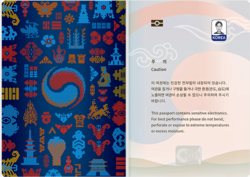
Because the passport contains a sensitive electronic chip, the first page includes a specific caution in both Korean and English, warning users not to bend, perforate, or expose the document to extreme temperatures or moisture to avoid damaging the electronics.
Key Facts
- General Release: Issued to the public starting August 24, 2008.
- Fingerprinting: Mandatory biometric fingerprinting began January 1, 2010.
- Page Count: 48 pages total, with 6 fewer pages for visas than previous versions.
- Chip Caution: Warnings are provided to prevent damage from bending or extreme environments.
- Regulatory Context: Some civil groups noted that fingerprinting exceeds the minimum ICAO (International Civil Aviation Organization) requirement of a photograph.
| Feature | Machine-Readable Passport | Biometric Passport |
|---|---|---|
| Total Pages | 48 | 48 |
| Visa Space | Standard | Reduced by 6 pages |
| ID Page Location | Original position | Second page from front cover |
| Data Storage | Printed/Machine-readable | Electronic biometric chip |
| Contact Info | Inside back cover | Last page |
Frequently Asked Questions
When did the general public start receiving biometric passports in South Korea?
The general population began receiving biometric passports on August 24, 2008.
What biometric data is stored on the South Korean passport chip?
The passports include fingerprint information, although the ICAO only requires a photograph to be recorded on the biometric chip.
How does the biometric passport differ in layout from the old version?
The main identification page moved to the second page, the contact information moved to the last page, and the number of pages available for visas was reduced by six.
What should I avoid doing to protect the biometric chip?
To ensure best performance, you should not bend the passport, perforate it, or expose it to excess moisture and extreme temperatures.
What are some of the security features used to prevent forgery?
Security features include laser perforation of the passport number, color-shifting ink, holograms, microprinting, and steganography.