Bill Bradley: The Scholar-Athlete Who Conquered the NBA and Olympics
Few athletes in history have balanced intellectual pursuit and athletic dominance as seamlessly as Bill Bradley. From the Ivy League courts of Princeton to the bright lights of Madison Square Garden and the global stage of the Olympics, Bradley redefined the image of the student-athlete. His journey was not merely about scoring points, but about a relentless commitment to self-discipline and a desire to serve in the public sphere.
Key Facts
- College Legacy: Scored 2,503 points at Princeton, averaging 30.2 points per game.
- Olympic Success: Won a gold medal as the youngest and only undergraduate on the 1964 U.S. team.
- NBA Career: Played his entire professional career with the New York Knicks, winning two championships.
- Rare Achievement: One of only two players to win a EuroLeague title, an NBA championship, and an Olympic gold medal.
- Academic Excellence: Graduated magna cum laude from Princeton and received a Rhodes Scholarship to Oxford University.
The Princeton Years: A Standard of Excellence
Despite being regarded as the top high school player in the U.S., Bradley chose Princeton University over Duke in 1961. His decision was driven by Princeton's reputation for preparing students for government and Foreign Service work. Because the Ivy League prohibits athletic scholarships and his family's wealth disqualified him from financial aid, Bradley attended without a scholarship.
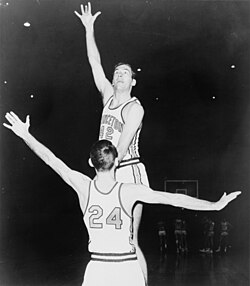
Bradley quickly became a dominant force. Wearing #42 in honor of Heisman winner Dick Kazmaier, he averaged over 30 points per game on the freshman team and once made 57 consecutive free throws. By his sophomore year, he was a varsity starter and a first-team All-American according to The Sporting News.
The Road to the Final Four
As a senior captain during the 1964–1965 season, Bradley earned the nickname "The White Oscar Robertson." He led Princeton to the NCAA Final Four, highlighted by a 40-point victory over Providence. In the consolation game against Wichita State, Bradley set a record with 58 points, earning him the Final Four MVP title.
Discipline and Academics
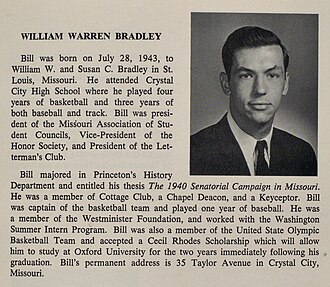
Bradley's success was rooted in extreme self-discipline. He maintained a rigorous schedule of classes, basketball practice, and up to 31 hours of studying per week. This dedication led him to graduate magna cum laude with a thesis on Harry S. Truman's 1940 Senate campaign. His academic and athletic prowess earned him the 1965 James E. Sullivan Award, making him the first basketball player to be named the top amateur athlete in the United States.
Global Ambitions and the Professional Transition
After graduating, Bradley accepted a Rhodes Scholarship to study Politics, Philosophy, and Economics (PPE) at Worcester College, Oxford. During the 1965–66 season, he commuted to Italy to play for Olimpia Milano (then known as Simmenthal), helping the team win the European Champions Cup, the predecessor to the modern EuroLeague.
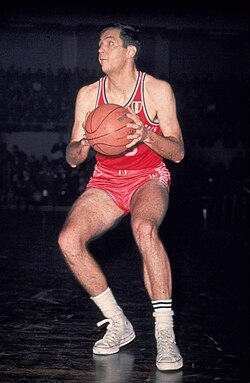
Bradley's path to the NBA was delayed by his studies and a period of service in the Air Force Reserves. He eventually joined the New York Knicks in December 1967, having been selected as a territorial pick—a rule that allowed teams first rights to local college stars.
NBA Career and the New York Knicks
Though he began his professional career in the backcourt, Bradley eventually returned to the forward position. He became a cornerstone of the Knicks' success, contributing to NBA championships in 1970 and 1973. In the 1972–73 season, he achieved his career-best scoring average of 16.1 points per game and earned his sole All-Star selection.
Over 742 games, Bradley scored 9,217 points. While known for his skill, he was also an aggressive competitor, maintaining a fierce rivalry with Jack Marin of the Baltimore Bullets. Off the court, Bradley avoided commercial endorsements, preferring to use his platform to explore social issues and teach in Harlem's street academies.
| Category | Achievement/Statistic | Context |
|---|---|---|
| Princeton Points | 2,503 | Career Total |
| NBA Points | 9,217 | Career Total (Knicks) |
| NBA Championships | 2 | 1970, 1973 |
| Olympic Medal | Gold | 1964 Tokyo Games |
| European Title | Champions Cup | Olimpia Milano (1965-66) |
Legacy and Honors
Bill Bradley retired from basketball in 1977. His contributions to the game were immortalized in 1983 when he was elected to the Naismith Memorial Basketball Hall of Fame. The New York Knicks retired his #24 jersey in 1984, marking him as one of the most influential figures in the franchise's history.
Frequently Asked Questions
Why did Bill Bradley choose Princeton over Duke?
Bradley chose Princeton because of its superior record in preparing students for careers in government and the United States Foreign Service.
What is the "territorial rule" that affected Bradley's NBA draft?
The territorial rule allowed NBA teams to claim first rights to players who attended college within 50 miles of the team's home city. This is why the New York Knicks were able to draft Bradley.
Which rare triple-crown of basketball titles did Bradley win?
Bradley is one of only two players (alongside Manu Ginóbili) to win an NBA championship, an Olympic gold medal, and a EuroLeague (European Champions Cup) title.
How did Bradley balance his academic and athletic life at Princeton?
He employed strict self-discipline, studying an average of seven hours on weekdays and up to 24 hours on weekends, while simultaneously managing a full schedule of classes and basketball practice.
What was the significance of the James E. Sullivan Award for Bradley?
By winning the award in 1965, Bradley became the first basketball player ever to be recognized as the top amateur athlete in the United States.