Bell X-1: The Rocket Plane That Broke the Sound Barrier
The Bell X-1 (originally designated as the XS-1) stands as one of the most significant achievements in aviation history. A joint venture between the National Advisory Committee for Aeronautics (NACA), the U.S. Army Air Forces, and the U.S. Air Force, this experimental rocket-powered aircraft was designed with a singular, daring purpose: to explore the unknown territory of supersonic flight.
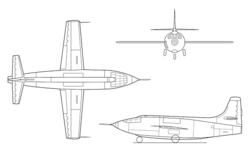
Conceived in 1944 and constructed in 1945, the X-1 was the first of the legendary "X-planes," a series of American experimental vehicles used to test cutting-edge aerospace technologies. By combining a bullet-shaped fuselage with a powerful rocket engine, the X-1 paved the way for the modern jet age.
Key Facts
- First Supersonic Flight: Achieved on October 14, 1947, by Captain Chuck Yeager.
- Top Speed (X-1): Nearly 1,000 mph (1,600 km/h) in 1948.
- Top Speed (X-1A): Mach 2.44 (approximately 1,620 mph) in 1953.
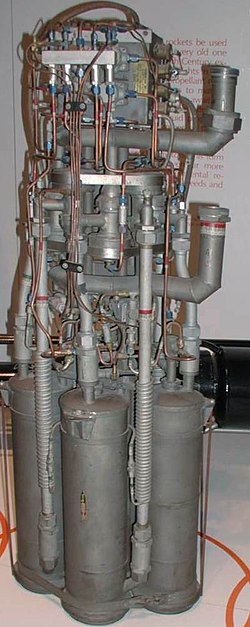
- Powerplant: Reaction Motors XLR-11 liquid-fuel rocket engine.
- Launch Method: Primarily drop-launched from a B-29 bomber.
- Total Built: 7 aircraft across various iterations.
Design and Development
The Race for Supersonic Speed
The quest to break the sound barrier was a global effort. In 1942, the United Kingdom's Ministry of Aviation worked with Miles Aircraft on the M.52, a turbojet-powered project designed to reach 1,000 mph. While the M.52 was eventually cancelled in 1946, the research reports were shared with Bell Aircraft, contributing to the American effort.
Engineering for Stability
Early supersonic research was fraught with danger. In 1946, a tail-less DH 108 jet disintegrated due to violent pitching oscillations. To avoid this, the Bell XS-1 was designed with a conventional horizontal tail to provide pitch damping—the ability to resist sudden changes in the aircraft's nose-up or nose-down movement—ensuring stability at transonic speeds.
Operational History
From Glide Tests to Powered Flight
The X-1's journey began with unpowered glide flights. On January 19, 1946, Bell chief test pilot Jack Woolams conducted the first glide over Pinecastle Army Airfield in Florida. These tests were essential for understanding the aircraft's handling before igniting the rocket engine.
Powered tests began on December 9, 1946, piloted by Chalmers "Slick" Goodlin. The aircraft accelerated so rapidly that engineers had to manage the ignition of the four rocket chambers carefully to maintain control.
Breaking the Sound Barrier
The most famous moment in the program occurred on October 14, 1947. Captain Chuck Yeager piloted aircraft #46-062, which he nicknamed Glamorous Glennis after his wife. Launched from the bomb bay of a B-29, Yeager pushed the aircraft to Mach 1.06 (approximately 700 mph), becoming the first human to exceed the speed of sound in level flight.
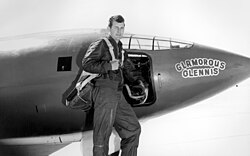
![X-1-1 #46-062 Glamorous Glennis at the National Air and Space Museum. Its color is international orange.[39]](/images/ce/22/ce2279379517b36691b752f9ee411e4064bc079d09fb861767ca169887fe06bb.jpg)
Evolution of the X-1 Series
The X-1A and X-1E
The success of the original X-1 led to several variants. The X-1A featured a larger fuel capacity and a stepped canopy for better visibility. In 1953, Chuck Yeager used the X-1A to reach a record speed of Mach 2.44 in level flight, though the aircraft later suffered a dangerous incident involving inertia coupling—a phenomenon where the aircraft's rotation on one axis triggers an uncontrolled rotation on another.
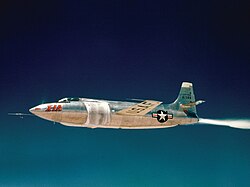
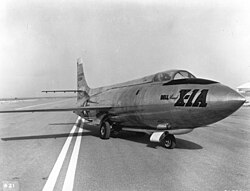
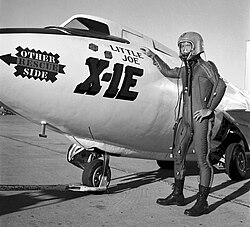
The X-1E introduced a turbopump fuel feed system, replacing the high-pressure nitrogen system to reduce metal fatigue. It reached a maximum speed of Mach 2.21 before being grounded due to structural cracks in the fuel tank.
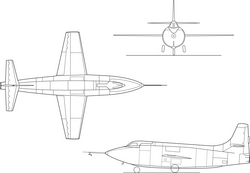
Other Variants and Losses
The program was not without tragedy. The X-1-3 exploded during de-fueling in 1951, destroying both the aircraft and its B-50 mothership. The X-1D was also lost to a fuel explosion in 1951. The X-1C, intended for munitions testing, was cancelled during the mockup stage as production jets like the F-86 Sabre made a dedicated test vehicle unnecessary.
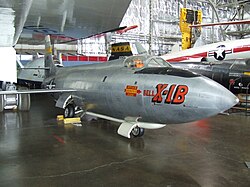
![Bell X-1-3, aircraft #46-064, being mated to the B-50 mothership for a captive flight test on 9 November 1951. While being de-fueled after this flight it exploded, destroying itself and the B-50, and seriously burning Joe Cannon. X-1-3 had completed only a single glide-flight on 20 July.[33]](/images/08/b5/08b56df953fa8fc84aa857da544006e62e6658bc0281db843bf2ab1b2f3fa6d8.jpg)
Technical Specifications Summary
| Feature | Bell X-1 (#1 & #2) | X-1A / B / D | X-1E |
|---|---|---|---|
| Length | 30 ft 11 in | 35 ft 8 in | 30 ft 11 in |
| Wingspan | 28 ft 0 in | 28 ft 0 in | 22 ft 10 in |
| Max Speed | Mach 1.06 (Initial) | Mach 2.44 | Mach 2.24 |
| Service Ceiling | 70,000 ft | 90,000 ft | 75,000 ft |
| Powerplant | XLR11-RM-3 | XLR11-RM-3 | RMI LR-8-RM-5 |
Frequently Asked Questions
Who was the first person to break the sound barrier?
Captain Chuck Yeager was the first pilot to exceed the speed of sound in level flight, achieving Mach 1.06 on October 14, 1947, while piloting the Bell X-1 #46-062.
How was the Bell X-1 launched?
The X-1 was primarily a drop-launched aircraft, carried to altitude in the bomb bay of a modified B-29 bomber before being released to begin its rocket-powered ascent.
What is the difference between the X-1 and the X-1A?
The X-1A was longer and heavier than the original X-1, featuring a larger fuel capacity for longer burn times and a stepped canopy to provide the pilot with better visibility.
What caused the X-1A to spin out of control during its record flight?
The aircraft experienced inertia coupling, a complex aerodynamic phenomenon that caused it to drop from its maximum altitude to 25,000 feet, exposing the pilot to forces as high as 8 g.
Where can the original Glamorous Glennis be seen today?
The Bell X-1 #46-062, known as Glamorous Glennis, is currently on display in the Boeing Milestones of Flight Hall at the National Air and Space Museum in Washington, D.C.