Articles/Belarus: A Comprehensive Overview of History, Culture, and Governance
Republic of BelarusMinskBelarusian historyAlexander LukashenkoEastern European geography
Belarus: A Comprehensive Overview of History, Culture, and Governance
Understanding the Republic of Belarus: History, Culture, and Modern Statehood Located in the heart of Eastern Europe, the Republic of Belarus is a nation defined by its complex history, d...
Understanding the Republic of Belarus: History, Culture, and Modern Statehood
Located in the heart of Eastern Europe, the Republic of Belarus is a nation defined by its complex history, diverse cultural roots, and its position as a unitary semi-presidential republic. From its ancient origins in the Kievan Rus' to its modern status as a sovereign state, Belarus has navigated the shifting borders of empires and the profound transformations of the 20th century.
Today, Belarus is characterized by its significant urban centers, such as the capital, Minsk, and a landscape that ranges from vast forests to serene lakes. While it maintains a unique political identity, the nation remains deeply connected to its neighbors through language, religion, and economic ties.
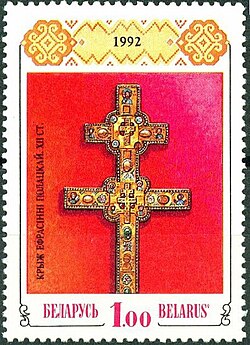
Stamp with the Cross of St. Euphrosyne by Lazar Bohsha from 1992: Stamp with the Cross of St. Euphrosyne by Lazar Bohsha from 1992
Key Facts
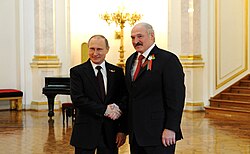
President Alexander Lukashenko shaking hands with Russian President Vladimir Putin, 2015
Capital: Minsk
Official Languages: Belarusian and Russian
Population: Approximately 9,109,280 (2025 estimate)
Currency: Belarusian ruble (BYN)
Government Type: Unitary semi-presidential republic
Major Religion: Christianity (predominantly Eastern Orthodoxy)
A Journey Through History
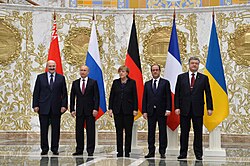
Leaders of Belarus, Russia, Germany, France, and Ukraine at the summit in Minsk, 11–12 February 2015
Early Foundations and Imperial Eras
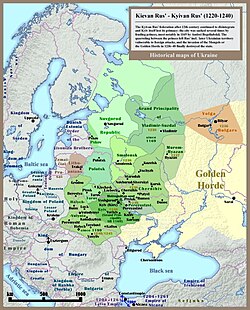
The historical roots of Belarus can be traced back to the Kievan Rus', a powerful federation of East Slavic tribes. Over the centuries, the region became a central part of the Polish–Lithuanian Commonwealth, a period that deeply influenced its cultural and political development.
Principalities in Eastern Europe before the Mongol and Lithuanian invasions: Principalities in Eastern Europe before the Mongol and Lithuanian invasions
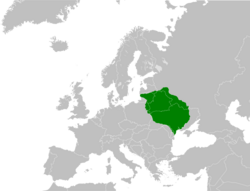
A map of the Grand Duchy of Lithuania in the 15th century prior to its union with the Kingdom of Poland. Belarus was fully within its borders.: A map of the Grand Duchy of Lithuania in the 15th century prior to its union with the Kingdom of Poland. Belarus was fully within its borders.
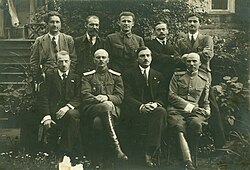
Following the decline of the Commonwealth, the territory was integrated into the Russian Empire. The early 20th century brought rapid political shifts, including the establishment of the Belarusian People's Republic in 1918, followed by the formation of the Byelorussian Soviet Socialist Republic in 1920.
The first government ("activists") of the Belarusian People's Republic (BNR, Беларуская Народная Рэспубліка), 1918.Sitting, left to right:Aliaksandar Burbis, Jan Sierada, Jazep Varonka, Vasil Zacharka.Standing, left to right:Arkadź Smolič, Pyotra Krecheuski, Kastuś Jezavitaŭ, Anton Ausianik, Liavon Zayats.: The first government ("activists") of the Belarusian People's Republic (BNR, Беларуская Народная Рэспубліка), 1918.Sitting, left to right:Aliaksandar Burbis, Jan Sierada, Jazep Varonka, Vasil Zacharka.Standing, left to right:Arkadź Smolič, Pyotra Krecheuski, Kastuś Jezavitaŭ, Anton Ausianik, Liavon Zayats.
The Impact of World War II
The mid-20th century was a period of immense hardship for the Belarusian people. During World War II, the nation suffered significantly under occupation. The conflict left deep scars on the landscape and the population, marked by the destruction of numerous localities and the loss of countless lives.
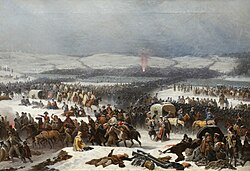
Napoleon's Grande Armée retreating after his invasion of Russia and crossing the Berezina river (near Barysaw, Belarus): Napoleon's Grande Armée retreating after his invasion of Russia and crossing the Berezina river (near Barysaw, Belarus)
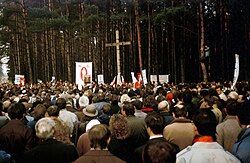
Meeting in the Kurapaty woods, 1989, where between 1937 and 1941 from 30,000 to 250,000 people, including Belarusian intelligentsia members, were murdered by the NKVD during the Great Purge: Meeting in the Kurapaty woods, 1989, where between 1937 and 1941 from 30,000 to 250,000 people, including Belarusian intelligentsia members, were murdered by the NKVD during the Great Purge
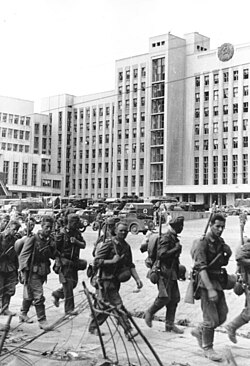
German soldiers in Minsk, August 1941: German soldiers in Minsk, August 1941
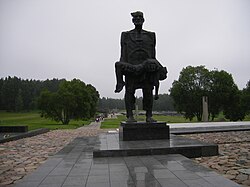
Khatyn Memorial; during World War II the German Nazis murdered civilians in 5,295 different localities in occupied Soviet Belarus.: Khatyn Memorial; during World War II the German Nazis murdered civilians in 5,295 different localities in occupied Soviet Belarus.
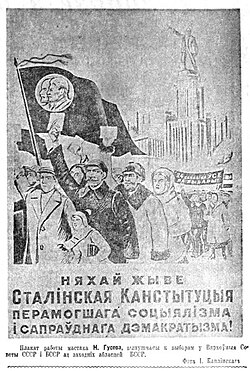
Belarusian poster where the text reads "Long live the Stalinist constitution of victorious socialism and true democracy!" (issued in 1940): Belarusian poster where the text reads "Long live the Stalinist constitution of victorious socialism and true democracy!" (issued in 1940)
Independence and the Modern Era
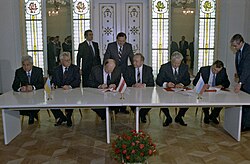
The dissolution of the Soviet Union in 1991 marked a turning point for the nation. Following the signing of the Belavezha Accords, Belarus declared independence, eventually adopting its current constitution in 1994. Since 1994, the political landscape has been dominated by the presidency of Alexander Lukashenko.
Leaders of Russia, Ukraine and Belarus signed the Belavezha Accords, dissolving the Soviet Union, 8 December 1991.: Leaders of Russia, Ukraine and Belarus signed the Belavezha Accords, dissolving the Soviet Union, 8 December 1991.
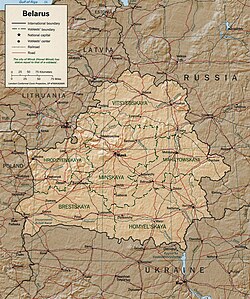
1997 map of Belarus: 1997 map of Belarus
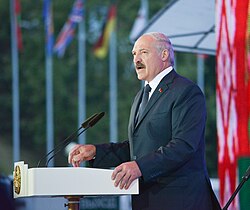
Alexander Lukashenko has ruled Belarus since 1994.: Alexander Lukashenko has ruled Belarus since 1994.
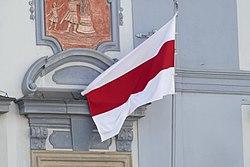
The former flag of Belarus, used in 1918, and then between 1991 and 1995, is widely used as a symbol of opposition to the government of Alexander Lukashenko.: The former flag of Belarus, used in 1918, and then between 1991 and 1995, is widely used as a symbol of opposition to the government of Alexander Lukashenko.
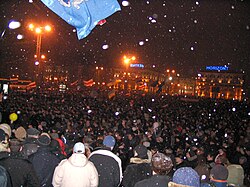
Protests at October Square in Minsk in 2006 after the 2006 Belarusian presidential election: Protests at October Square in Minsk in 2006 after the 2006 Belarusian presidential election
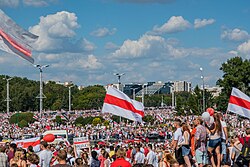
Rally against Lukashenko in Minsk, 23 August 2020: Rally against Lukashenko in Minsk, 23 August 2020
Geography and Demographics
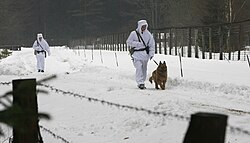
Soldiers patrol in the Białowieża Forest on the Belarusian border with Poland
Land and Population
Belarus covers a total area of 207,600 km². The population is predominantly ethnic Belarusian (84.9%), with significant Russian (7.5%) and Polish (3.1%) minorities. While Belarusian and Russian are the official languages, Polish, Ukrainian, and Yiddish are also widely used minority languages.
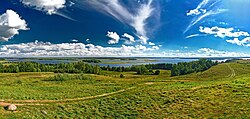
Strusta Lake in the Vitebsk Region: Strusta Lake in the Vitebsk Region
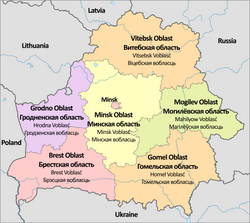
Administrative divisions of Belarus: Administrative divisions of Belarus
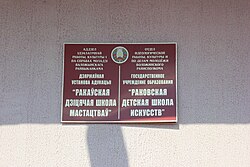
Bilingual Belarusian–Russian sign in Belarusian town Rakaw in 2014: Bilingual Belarusian–Russian sign in Belarusian town Rakaw in 2014
Urban Centers and Economy
The nation's economy is supported by various industries and Free Economic Zones (FEZ) designed to encourage investment. Major cities serve as the primary hubs for commerce and administration. Minsk, the capital, is the largest urban center, followed by Gomel, Mogilev, and Vitebsk.
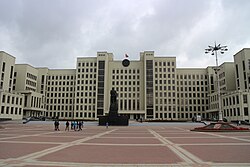
Government House, Minsk: Government House, Minsk
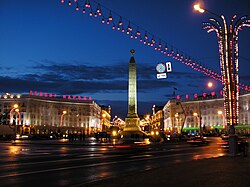
Victory Square in Minsk: Victory Square in Minsk
Change in per capita GDP of Belarus, 1973–2018.[citation needed] Figures are inflation-adjusted to 2011 international dollars.: Change in per capita GDP of Belarus, 1973–2018.[citation needed] Figures are inflation-adjusted to 2011 international dollars.
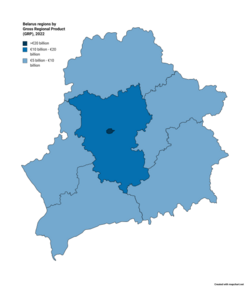
Belarus regions by gross regional product (GRP): Belarus regions by gross regional product (GRP)
Belarusian annual GDP and CPI rates 2001–2013[citation needed]: Belarusian annual GDP and CPI rates 2001–2013[citation need]
Culture and Society
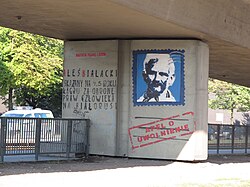
Graffiti in Gdańsk depicting Belarusian human rights activist Ales Bialiatski
Religion and Traditions
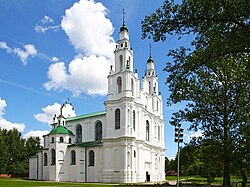
Religion plays a significant role in Belarusian life, with 91% of the population identifying as Christian. The majority follow Eastern Orthodoxy, while a smaller percentage belongs to other Christian denominations. This spiritual heritage is reflected in the country's stunning architecture, such as the baroque Saint Sophia Cathedral in Polotsk.
Saint Sophia Cathedral in Polotsk is one of the oldest churches in Belarus. Its current style is an ideal example of baroque architecture in the former Polish–Lithuanian Commonwealth.: Saint Sophia Cathedral in Polotsk is one of the oldest churches in Belarus. Its current style is an ideal example of baroque architecture in the former Polish–Lithuanian Commonwealth.
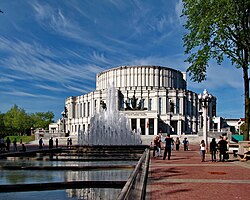
The Opera and Ballet Theatre in Minsk: The Opera and Ballet Theatre in Minsk
Cuisine and Arts
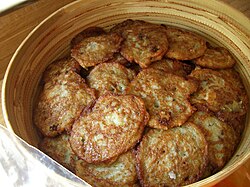
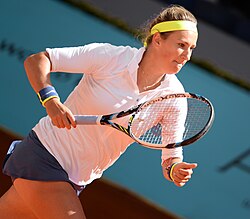
Belarusian culture is expressed through its literature, arts, and unique cuisine. A staple of the national diet is Draniki, a traditional potato pancake. The nation also takes pride in its sporting achievements, producing world-class athletes such as tennis player Victoria Azarenka.
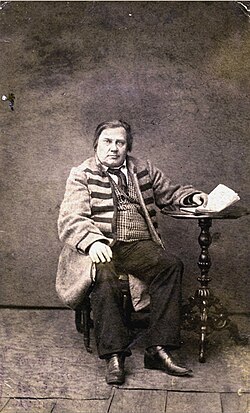
Poet and librettist Vintsent Dunin-Martsinkyevich: Poet and librettist Vintsent Dunin-Martsinkyevich
Draniki, the national dish: Draniki, the national dish
Victoria Azarenka, professional tennis player and a former world No. 1 in singles: Victoria Azarenka, professional tennis player and a former world No. 1 in singles
Summary of National Statistics
Quick Reference: Belarus Profile
Category
Details
Total Area
207,600 km²
Estimated Population
9,109,280
GDP (Nominal) 2026 Est.
$102.042 billion
HDI (2023)
0.824 (Very High)
Official Languages
Belarusian, Russian
Frequently Asked Questions
What are the official languages of Belarus?
The official languages are Belarusian and Russian. Additionally, minority languages such as Polish, Ukrainian, and Yiddish are widely used in various communities.
What is the main religion in Belarus?
The vast majority of the population is Christian, with Eastern Orthodoxy being the most prominent denomination, practiced by approximately 83.3% of the people.
What are the major cities in Belarus?
The largest city is the capital, Minsk. Other significant cities include Gomel, Mogilev, Vitebsk, Grodno, and Brest.
How is the economy of Belarus structured?
The economy includes various sectors and utilizes six Free Economic Zones (Brest, Gomel-Raton, Grodnoinvest, Minsk, Mogilev, and Vitebsk) to promote investment and development.
What is the national dish of Belarus?
Draniki, which are traditional potato pancakes, is considered the national dish of the country.
![Change in per capita GDP of Belarus, 1973–2018.[citation needed] Figures are inflation-adjusted to 2011 international dollars.](/images/ef/4e/ef4e1b0f767d576d8a3d2ddf1936b8b9f1c618baba095abe74c35da7bc434504.webp)
![Belarusian annual GDP and CPI rates 2001–2013[citation needed]](/images/c8/b7/c8b7acdcc8466194779cfcf5d7a685fd36662050aec4d0f3d35f713e9b7efc2a.jpg)