A Comprehensive Guide to Beijing Capital International Airport (PEK)
Beijing Capital International Airport (PEK) serves as a primary gateway to China, acting as a massive aviation hub for the nation's capital. Located in the Shunyi District, this public airport is operated by the Beijing Capital International Airport Company Limited and plays a critical role in both domestic and international travel.
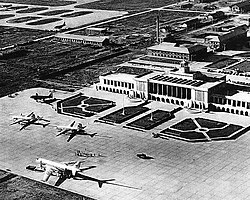
Key Facts
- IATA Code: PEK
- ICAO Code: ZBAA
- Opened: 1 March 1958
- Primary Hubs: Air China, Hainan Airlines, and SF Airlines
- Location: Shunyi District, Beijing, China
- Elevation: 116 ft (35 m) AMSL
A Rich Aviation History
Since its opening in 1958, Beijing Capital International Airport has undergone significant transformations to keep pace with China's rapid growth. In the late 1990s, the airport underwent a major expansion to mark the 50th anniversary of the founding of the PRC, which included the opening of Terminal 2 in 1999.
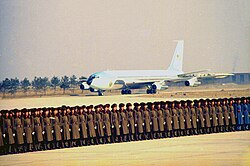
The airport's global significance surged in the early 2000s. By 2013, it handled 83.7 million passengers, ranking as the second busiest airport in the world that year. To manage the increasing demand and capacity constraints, the Chinese government approved the construction of the new Beijing Daxing International Airport, which opened in 2019. While several airlines moved to Daxing, major carriers like Air China and Hainan Airlines continue to maintain their primary operations at Capital Airport.
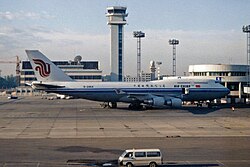
Airport Infrastructure and Terminals
The airport features a complex layout designed to handle millions of passengers and massive cargo volumes. The infrastructure is divided into several key terminal areas:
Terminal 1 and Terminal 2
Terminal 2 was introduced during the expansion in 1999. Following renovations, the original Terminal 1 (now often referred to as the Westwing Satellite Terminal) serves specific domestic and international flight requirements.
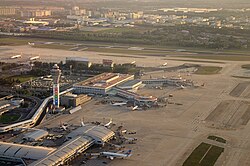
Terminal 3
At the time of its inauguration, Terminal 3 was the largest airport passenger terminal building in the world. While it later yielded the title of "world's largest" to Dubai International Airport's Terminal 3 in 2008, it remains a massive, state-of-the-art facility capable of handling large aircraft like the Airbus A380.
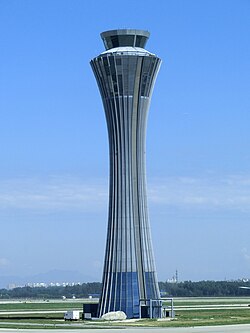
Runways and Technical Specifications
To support high-frequency aircraft movements, the airport utilizes three main runways with varying surfaces and lengths:
| Runway Direction | Length (m) | Length (ft) | Surface Type |
|---|---|---|---|
| 18L/36R | 3,810 | 12,500 | Asphalt |
| 18R/36L | 3,445 | 11,302 | Asphalt |
| 01/19 | 3,810 | 12,500 | Concrete |
Ground Transportation and Connectivity
Navigating the airport is made efficient through various specialized transportation systems designed to move passengers between terminals and into the city of Beijing.
Intraterminal and Interterminal Travel
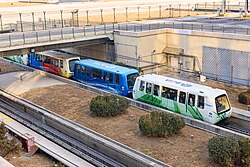
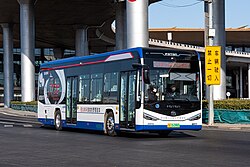
For passengers moving between different terminal areas, the airport provides an Automated People Mover (APM), a specialized rapid transit system. Additionally, landside interterminal shuttle buses are available for ground-level transit.
Public Transit and External Links
Beijing is well-connected to the airport via several modes of transport:
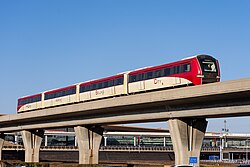
- Rail: The Beijing Subway Capital Airport Express Line provides high-speed access to the city center.
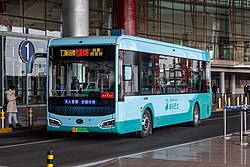
- Bus: Dedicated airport buses operate from Terminal 3 to various locations.
- Car: Extensive road networks and parking facilities serve private vehicles and taxis.
Accommodation
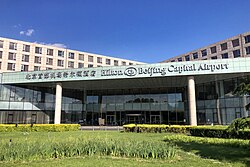
For travelers requiring proximity to the gates, facilities such as the Hilton Beijing Capital Airport are available to provide convenience for transit passengers.
Operational Statistics
The airport continues to see significant movement in both passenger and cargo sectors. Recent data shows a steady recovery and growth in operations.
| Year | Passenger Volume | Aircraft Movements | Cargo (Metric Tons) |
|---|---|---|---|
| 2018 | 100,983,290 | 614,022 | 2,074,005 |
| 2020 | 34,513,827 | 291,498 | 1,210,441 |
| 2023 | 52,879,156 | 379,710 | 1,115,908 |
| 2025 (Est.) | 70,744,000 | 442,040 | 1,550,920 |
Frequently Asked Questions
Which airlines use Beijing Capital International Airport as a hub?
The airport serves as a major hub for Air China, Hainan Airlines, and SF Airlines.
How can I travel from the airport to central Beijing?
You can use the Beijing Subway Capital Airport Express Line, various airport bus services, or taxis/private cars.
Is there a way to move between terminals without walking?
Yes, the airport utilizes an Automated People Mover (APM) to facilitate easy interterminal transportation.
What is the climate like at PEK?
The airport experiences seasonal temperature variations, with mean daily maximums ranging from approximately 3.2°C (37.8°F) in January to 32.4°C (90.3°F) in July.
Does the airport handle cargo?
Yes, the airport is a significant cargo hub, handling over 1.5 million metric tons of cargo as of 2025 statistics.