BBC Scotland: The Evolution of Scotland's Public Broadcaster
BBC Scotland serves as the primary public broadcaster for Scotland and is a key division of the BBC. Operating from its state-of-the-art headquarters in Glasgow, the organization employs approximately 1,250 staff (as of 2017) to produce a staggering 15,000 hours of television and radio programming annually. Its mission is to provide comprehensive coverage in English, Scots, and Scottish Gaelic (Gàidhlig), ensuring that the diverse voices of the nation are heard.
The broadcaster manages a wide array of services, including the Scottish variant of BBC One, the dedicated BBC Scotland channel, and the Gaelic-language service BBC Alba. On the airwaves, it operates BBC Radio Scotland and the Stornoway-based BBC Radio nan Gàidheal. As one of the four BBC national broadcasters, it plays a critical role in the UK's media landscape, producing over 880 hours of content for UK-wide networks such as BBC Two, BBC Three, CBBC, and CBeebies.
Key Facts
- Launch Date: 1 January 1923.
- Headquarters: BBC Pacific Quay, Glasgow.
- Languages: English, Scots, and Scottish Gaelic.
- Annual Output: 15,000 hours of TV and radio programming.
- Reach: Averaged 94% of Scottish audiences in July 2013.
- Current Director: Hayley Valentine (appointed October 2024).
The History of Radio and Television
The Early Days of Radio
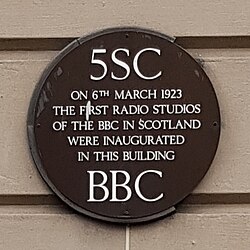
Broadcasting in Scotland began on 6 March 1923 with the launch of station 5SC in Bath Street, Glasgow. This initial service expanded quickly with the addition of stations 2BD (Aberdeen), 2DE (Dundee), and 2EH (Edinburgh). By 1927, these were consolidated into the BBC Regional Programme, which later evolved into the BBC Home Service in 1939. It wasn't until November 1978 that a dedicated BBC Radio Scotland was established.
The Rise of Television
Television services formally arrived in Scotland on 14 March 1952, broadcasting via the Kirk o' Shotts transmitter using a 405-line system. While early content was largely sourced from London, the BBC gradually increased its local "opt-out" capabilities—the ability to broadcast regional content instead of the national feed.
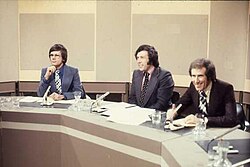
The 1960s marked a period of rapid technical growth. BBC Two launched in Scotland in 1966, upgrading to PAL colour in 1967. By 1971, Studio "A" at the Queen Margaret Drive facility in Glasgow became one of the first regional studios in Britain to transition to colour broadcasting.
Modern Services and Digital Innovation
Television Channels
In recent years, the BBC has expanded its dedicated Scottish output. On 24 February 2019, the BBC Scotland channel was launched, replacing a BBC Two opt-out. Funded with £32 million annually, the channel features a mix of new and archived programming, including the flagship news programme The Nine.


Additionally, BBC Alba provides essential Gaelic-language programming. Historically, Gaelic content was shared across BBC One and Two, but it now has a dedicated home, continuing the legacy of respected programmes like Eòrpa.
Radio and Digital Hubs
BBC Radio Scotland provides 24-hour English programming with specific opt-outs for Orkney, Shetland, and four other sub-regions. Meanwhile, BBC Radio nan Gàidheal serves the Gaelic-speaking community. To engage younger audiences, the BBC launched The Social in 2015, a digital content stream for 18–34 year olds that has won multiple Royal Television Society Scotland Awards.
Studios and Infrastructure
From Rex House to Queen Margaret Drive
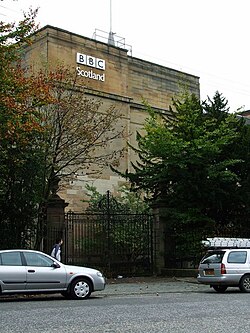
The BBC's physical presence in Scotland has shifted several times. After starting at Rex House in Glasgow and spending time in Edinburgh, the headquarters moved to the former Queen Margaret College on Queen Margaret Drive in 1936. This site served as the hub for production and administration for seven decades, housing the BBC Scottish Symphony Orchestra until 2006.
The Pacific Quay Era
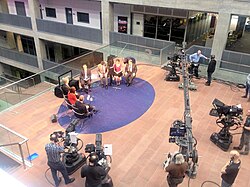
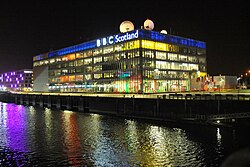
In September 2007, the BBC opened its current headquarters at Pacific Quay, Glasgow. Designed by David Chipperfield at a cost of £188 million, the facility was opened by then-Prime Minister Gordon Brown. It features three television studios, five radio studios, and the BBC's first HD newsroom.
Programming and Impact
BBC Scotland produces a diverse range of content, from flagship news like Reporting Scotland to the long-running drama River City. Its output is particularly strong in documentaries and features, with titles such as The Beechgrove Garden, Landward, and BBC Scotland Investigates covering all facets of Scottish life.
| Service Type | Key Outlets | Primary Focus |
|---|---|---|
| Television | BBC One Scotland, BBC Scotland Channel, BBC Alba | News, Drama, Gaelic Language, Local Interest |
| Radio | BBC Radio Scotland, BBC Radio nan Gàidheal | Regional News, Gaelic Language, Sports |
| Digital | The Social, Glasgow Digital Hub | Youth Engagement, Platform Engineering |
Frequently Asked Questions
When did BBC Scotland start broadcasting?
The first radio service, known as 5SC, was launched on 6 March 1923 in Glasgow.
Where is BBC Scotland headquartered?
The headquarters are located at BBC Pacific Quay in Glasgow, a facility that opened in September 2007.
What is BBC Alba?
BBC Alba is a dedicated Gaelic-language television channel that provides programming for the Scottish Gaelic-speaking community.
How is BBC Scotland funded?
It is funded via the UK licence fee. Approximately £320 million of licence fee revenue is raised in Scotland, with a significant portion dedicated to purely local content.
What is "The Social"?
Launched in December 2015, The Social is a digital content stream specifically designed to engage 18–34 year olds through comedy, music, and lifestyle content.