Bayesian Inference: Principles, Applications, and Statistical Logic
Bayesian inference is a powerful method of statistical inference that uses Bayes' theorem to calculate the probability of a hypothesis based on prior evidence. Unlike traditional statistics, which often treats parameters as fixed, the Bayesian approach allows researchers to update the probability of a hypothesis as new information becomes available. This process, known as Bayesian updating, is essential for the dynamic analysis of sequential data.
At its core, Bayesian inference uses a prior distribution—an initial estimate of probability—to derive a posterior probability after observing new evidence. This framework is widely applied across diverse fields, including science, engineering, medicine, psychology, law, and philosophy, where it is closely linked to the concept of subjective probability.
Key Facts
- Core Mechanism: Uses Bayes' theorem to update the probability of a hypothesis as more data is acquired.
- Foundational Components: Relies on a prior distribution (initial belief) and a likelihood (evidence) to determine the posterior probability.
- Versatility: Applied in fields ranging from cosmology and bioinformatics to courtroom forensics and financial trend prediction.
- Historical Roots: Named after Thomas Bayes, but formally developed and applied to celestial mechanics and medicine by Pierre-Simon Laplace.
- Key Metric: Maximum a posteriori (MAP) estimation identifies the value with the greatest probability.
The Mechanics of Bayes' Rule
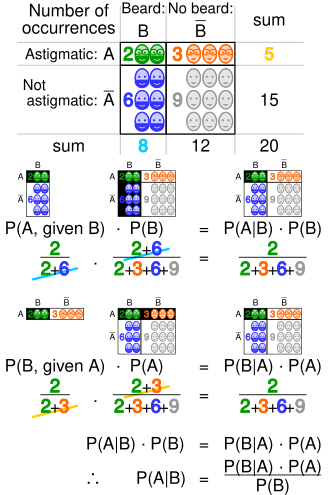
Bayes' rule provides the mathematical framework for updating beliefs. It focuses on the relationship between a hypothesis (H) and the evidence (E) that supports or violates it. When the logical negation of a hypothesis is a valid likelihood, the rule allows analysts to focus specifically on the likelihood term to determine how strongly the evidence supports the hypothesis.
A practical way to conceptualize this is through the rule of multiplication, which helps in calculating the probability of a hypothesis given specific observed evidence.
Parametric Formulation and MAP
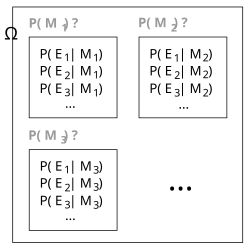
In more complex scenarios, Bayesian inference uses a parametric formulation to describe the relationship between parameters and observations. A critical outcome of this process is the maximum a posteriori (MAP) estimation, which occurs when one takes the value with the greatest probability from the posterior distribution.
Practical Applications and Examples
Probability of a Hypothesis: The Cookie Jar Example
Consider a scenario with two bowls of cookies. Bowl 1 (H1) contains 30 plain and 10 chocolate cookies. Bowl 2 (H2) contains 20 plain and 20 chocolate cookies. If a plain cookie (E) is drawn, the probability that it came from Bowl 1 is calculated as the number of plain cookies in Bowl 1 divided by the total number of plain cookies across both bowls: 30 / 50 = 0.6.
Predictive Modeling in Archaeology
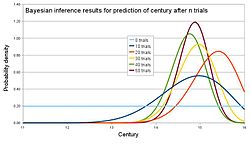
Bayesian inference is highly effective for making predictions based on fragmented data. For example, an archaeologist studying a medieval site (11th to 16th century) can use pottery fragments to date the inhabitation. By comparing the percentage of glazed and decorated pottery found against expected rates for early and late medieval periods, the archaeologist can update their confidence in the site's date as more fragments are unearthed.
In a simulation where a site was inhabited around 1420, analyzing 50 fragments can reveal that there is virtually no chance of 11th or 12th-century inhabitation, a 1% chance for the 13th century, a 63% chance for the 14th century, and a 36% chance for the 15th century. This demonstrates the Bernstein-von Mises theorem, which asserts the asymptotic convergence to the true distribution in finite probability spaces.
Broad Impact Across Disciplines
The utility of Bayesian inference extends far beyond simple probability puzzles. It is integrated into modern technology and scientific research through various specialized applications:
- Computer Science: Used in probabilistic programming and machine learning.
- Healthcare: Applied in bioinformatics and medical statistics.
- Space Science: Essential for cosmology and astrophysical parameter estimation.
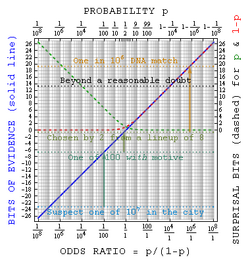
- Law: Used in the courtroom to evaluate forensic identification evidence, such as DNA profiling.
- Economics: Employed in econophysics to predict currency trends and financial quotation changes.
- Biology: Used in phylogeny and ecological studies.
| Term | Definition | Role in Inference |
|---|---|---|
| Prior Distribution | Initial probability of a hypothesis before seeing data. | Sets the baseline belief. |
| Likelihood | Probability of the evidence given the hypothesis. | Measures how well the data fits the hypothesis. |
| Posterior Probability | Updated probability of the hypothesis after seeing data. | The final result of the inference process. |
| MAP Estimation | The value with the highest posterior probability. | Provides a single point estimate. |
Historical Context
The method is named after Thomas Bayes (1701–1761), who first proved that probabilistic limits could be placed on unknown events. However, Pierre-Simon Laplace (1749–1827) is credited with introducing the formal theorem and applying it to jurisprudence, reliability, and celestial mechanics. Early Bayesian work was known as "inverse probability" because it inferred causes from effects. While frequentist statistics became dominant after the 1920s, Bayesian methods have seen a massive resurgence due to increased computing power and the rise of probabilistic programming.
Frequently Asked Questions
What is the difference between Bayesian and frequentist statistics?
Bayesian statistics treats parameters as random variables and incorporates prior knowledge to update probabilities. Frequentist statistics treats parameters as fixed and relies solely on the frequency of data in repeated trials.
What is a conjugate prior?
A conjugate prior is a specific type of prior distribution that, when combined with a particular likelihood function, results in a posterior distribution that belongs to the same probability distribution family as the prior, simplifying the mathematical calculations.
What is Cromwell's rule?
Cromwell's rule suggests that one should avoid assigning a prior probability of exactly 0 or 1 to any hypothesis, as doing so would make it impossible for any amount of new evidence to ever change that belief.
How is Bayesian inference used in the legal system?
In law, it is used to weigh forensic evidence. By establishing a prior probability of guilt or innocence and updating it with the likelihood of specific evidence (like a DNA match), experts can provide a more structured analysis of the evidence's strength.
What is the role of the Bernstein-von Mises theorem?
This theorem describes the asymptotic behavior of the posterior distribution, asserting that as the amount of data increases, the posterior distribution converges to the true distribution, regardless of the initial prior.