Battle of Culloden: The Final Stand of the Jacobite Rising
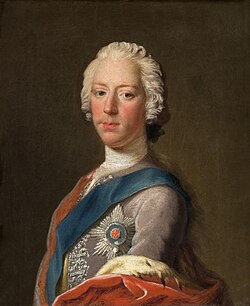
The Battle of Culloden, fought on 16 April 1746, stands as one of the most pivotal moments in British history. Located near Inverness in the Scottish Highlands, this clash saw the decisive defeat of the Jacobite army, led by Charles Edward Stuart, by the British government forces under the command of the Duke of Cumberland. This engagement did more than just end a battle; it effectively brought the Jacobite rising of 1745 to a close.
The conflict was the culmination of a campaign to restore the Stuart monarchy to the British throne. While the Jacobites relied heavily on the fierce bravery of the Highland clans, the government forces utilized disciplined infantry and superior artillery to secure a victory that would reshape the Highlands forever.
Key Facts
- Date: 16 April 1746
- Location: Culloden, Scotland
- Outcome: Decisive British Government victory
- Jacobite Leader: Charles Edward Stuart
- Government Leader: Duke of Cumberland
- Significance: The last pitched battle fought on British soil
The Road to Culloden
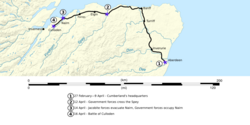
The prelude to the battle began in early April. On 12 April, the Duke of Cumberland's army forded the River Spey. The crossing was guarded by 2,000 Jacobites under Lord John Drummond, who withdrew toward Nairn—a move that would later draw significant criticism. By 14 April, the Jacobites had evacuated the town, allowing Cumberland's troops to camp just to the west.
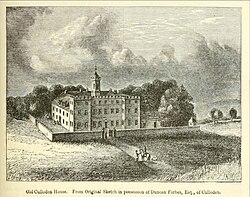
On 15 April, the main Jacobite force, numbering approximately 5,400 men, left Inverness and assembled on the Culloden estate, five miles to the east.
The Engagement: Tactics and Conflict
The Artillery Exchange
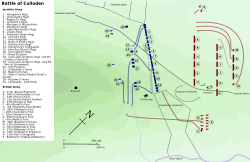
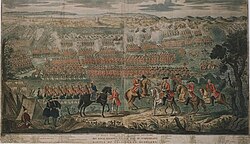
The battle commenced at 1:30 pm when the Jacobite batteries, commanded by Finlayson, opened fire. This may have been a reaction to Lord Bury, who had advanced within 100 meters of the Jacobite lines to assess their strength. A fierce exchange of artillery followed. While some Jacobite accounts claim they were bombarded for over 30 minutes while Charles delayed the advance, government records suggest a much shorter window, with some estimates as low as two to nine minutes.
The Highland Charge and Government Response
The Jacobites launched their famous charge, but the right wing was devastated by point-blank volleys. Despite this, many reached the government lines, with Lochiel's regiment leading the impact against Barrell's 4th Foot and Dejean's 37th Foot. To counter the Highland charge—a rapid, aggressive infantry assault—the government implemented a bayonet drill innovation. Instead of thrusting straight ahead, soldiers were trained to thrust at the enemy to their right, bypassing the targe (a traditional Highland shield).
![Bayonet drill innovation said to have been developed to counter the "Highland charge". Each soldier would thrust at the enemy on his right – rather than the one straight ahead – in order to bypass the targe of Highlanders.[32]](/images/b1/5c/b15c37209561d034fcb2ddeb6bcbfb96de7d82c6bbc084d682312ee414662188.webp)
John Huske, commanding the government's second line, quickly organized a counterattack using Lord Sempill's Fourth Brigade. By positioning the 20th Foot between the 25th and 37th, the government forces managed to surround the Jacobite right on three sides with five battalions, leading to a total collapse and rout of the Jacobite army.
Casualties and Aftermath
The human cost of the battle was starkly uneven. The Jacobites suffered between 1,500 and 2,000 killed or wounded, with an additional 376 captured. High-ranking officers such as Keppoch and Strathallan were among the fallen. In contrast, the Duke of Cumberland reported only 50 dead and 259 wounded.
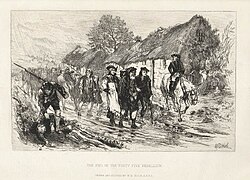
Following the defeat, the Jacobite forces split: Lowland regiments headed south to Ruthven Barracks, while Highland units moved north toward Fort Augustus. Although a potential force of 5,000 to 6,000 men remained (including those who had missed the battle), Charles Edward Stuart ordered the army to disperse until French support could arrive.
A final attempt to prolong the campaign occurred in May 1746. After receiving £35,000 in gold from French frigates at Loch nan Uamh, several Jacobite leaders attempted to rendezvous at Invermallie on 18 May. However, the effort failed as Cumberland's army moved into the Highlands, leading to the surrender of the Macphersons and the eventual dispersal of the remaining clan leaders.
Commemoration and the Modern Battlefield
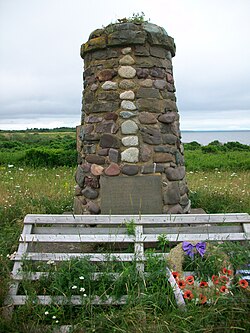
Interest in commemorating Culloden grew slowly, becoming more solemn by the mid-19th century. In 1881, Duncan Forbes erected a 20-foot memorial cairn and headstones to mark the mass graves of the fallen clans.
![Memorial cairn erected in 1881[46]](/images/ee/ea/eeeaf3d665229a3d0cdd100f251ed1e0bd79fb912abcc6141cb48cd051ee6f0b.jpg)
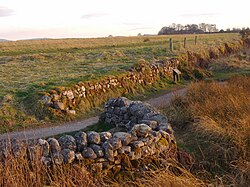
![In 1881, Duncan Forbes erected the headstones that mark the mass graves of fallen Jacobite soldiers. They lie on either side of an early 19th-century road which runs through the battlefield.[51]](/images/17/c4/17c499592b433bf750eb71fff449ea2af8f25d8f264fab96e5d27a5faa5ac497.jpg)
Today, the site is protected by Historic Scotland. Visitors can explore the battlefield via a visitor center opened in 2007. Key landmarks include the "English Stone," believed to mark the burial place of government dead, and the Leanach farmhouse, which stands on the site of a former field hospital.
| Feature | British Government | Jacobites |
|---|---|---|
| Commanders | Duke of Cumberland | Charles Edward Stuart |
| Army Strength | 6,900–7,200 | 5,000–6,000 |
| Casualties | c. 50 killed, 259 wounded | 1,500–2,000 killed/wounded |
| Prisoners | Negligible | 376 captured |
Frequently Asked Questions
Why is the Battle of Culloden significant?
It was the last pitched battle fought on British soil and marked the definitive end of the Jacobite rising of 1745 and the Stuart claim to the British throne.
What was the "Highland charge"?
The Highland charge was a tactical infantry assault characterized by a rapid, aggressive rush toward the enemy line, often utilizing broadswords and targes (shields).
How did the government forces defeat the Jacobites?
The government used superior artillery and a modified bayonet drill that allowed soldiers to bypass the Jacobites' shields, combined with a strategic counterattack that surrounded the Jacobite right wing.
What happened to Charles Edward Stuart after the battle?
Following the defeat, he ordered his remaining forces to disperse and eventually sought refuge, with some of his leaders attempting to maintain a presence in the Highlands until government punitive expeditions forced their surrender or flight.
Can you visit the battlefield today?
Yes, the site is managed by Historic Scotland and features a visitor center, footpaths, and various memorials, including the 1881 memorial cairn.