Barons of Britain and Ireland: History, Ranks, and Traditions
In the complex hierarchy of the British and Irish peerages, the baron represents the foundational rank of the nobility. Positioned immediately below viscounts, barons serve as a bridge between the landed gentry and the higher tiers of the peerage. While the role has evolved from medieval military obligations to modern legislative appointments, the title remains a symbol of prestige and historical continuity.
Across the Peerage of England, Great Britain, Ireland, and the United Kingdom, a woman holding this rank is titled a baroness. While the nature of the title varies significantly between the UK peerage and the distinct Scottish baronial system, both share a deep root in the feudal structures of the Middle Ages.
![A lord of Parliament, also called a baron, illustrated in the manuscript "Théâtre de tous les peuples et nations de la terre avec leurs habits et ornemens divers, tant anciens que modernes, diligemment depeints au naturel". Painted by Lucas d'Heere in the second half of the 16th century. Preserved in the Ghent University Library.[4]](/images/96/32/96329b87c15896fe23ba5ca32f86e7a1b51086de7d7753ca3eba7cc77467e6ce.jpg)
Key Facts
- Rank: The lowest rank in the Peerage of England, Great Britain, Ireland, and the United Kingdom.
- Creation: Modern baronies are created via letters patent, replacing the medieval writ of summons and feudal tenure.
- Life Peers: Most 20th-century non-hereditary appointments are granted at the rank of baron.
- Scottish Distinction: Scottish barons are considered minor nobility and are not members of the Peerage of Scotland.
- Heraldry: A UK baron's coronet features six silver pearls equally spaced around the rim.
The Evolution of the Baronage
From Feudal Tenure to Parliament
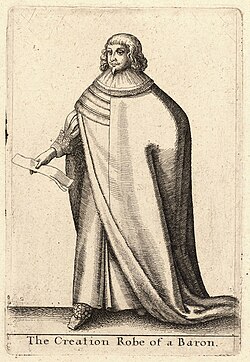
Following the Norman Conquest of 1066, the French feudal system was adapted for England. Originally, a "baron" was not a specific rank but a tenant-in-chief—someone who held land directly from the King (barones regis). These individuals were obligated to provide military service and attend the Great Council (Magnum Concilium), which eventually evolved into the Parliament of England.
By the 12th century, a distinction emerged between "greater barons," who held land by knight's service and received personal summons to the King's Council, and "lesser barons," who held manors. The former became the peers of the realm, while the latter were summoned as a group via the sheriff, eventually forming the precursor to the House of Commons.
Modern Methods of Creation
Over time, the link between land ownership and nobility severed. The crown shifted from granting baronies by tenure to using a writ of summons (a personal invitation to attend Parliament). Eventually, letters patent—legal documents issued by the monarch—became the sole method for creating modern baronies.
Legislation such as the Tenures Abolition Act 1660 and the Feudal Tenure Act 1662 rendered feudal baronies obsolete. Today, many historical feudal titles are held "in gross," meaning they are enveloped within a modern peerage title.
The Baronage in Ireland and Scotland
Irish Baronies
The title of baron (Irish: barún) was introduced to Ireland shortly after the Norman invasion in 1169. Some of the earliest examples include Baron Athenry (1172) and Baron Offaly (c. 1193), establishing a noble structure similar to that of England.
The Unique Status of Scottish Barons
Unlike their English counterparts, Scottish barons are not peers. They belong to the Baronage of Scotland, a rank of ancient nobility. These titles were originally attached to land erected into a "free barony" by Crown Charter.
The Court of the Lord Lyon officially recognizes these titles. Scottish barons rank below Lords of Parliament and are considered "minor barons." Because they are not peerage ranks, these titles can be transferred via inheritance or assignation.
Symbols, Styles, and Protocol
Heraldry and the Coronet
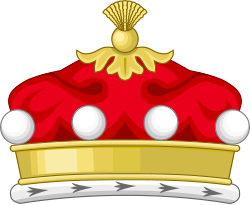
A UK baron is entitled to a specific coronet featuring six pearls of equal size and height around a plain rim. While the physical coronet is only worn during a monarch's coronation, it is used in heraldry above the shield, where only four pearls are typically visible.
Formal Address and Etiquette
The formal style for a baron is The Right Honourable The Lord [Barony], and for his wife, The Right Honourable The Lady [Barony]. Baronesses in their own right may choose between "The Right Honourable The Baroness [Barony]" or "The Right Honourable The Lady [Barony]."
It is a critical distinction in etiquette that the title follows the barony name, not the personal forename. For example, referring to a baron as "Lord [Forename] [Surname]" is incorrect and would instead imply the person is the younger son of a higher-ranking peer (like a duke).
Scottish Styles
Scottish barons use a different naming convention, often similar to Clan Chiefs. A formal written address is The Much Honoured Baron of [Place]. Their wives are styled as Lady [Place] or The Baroness of [Place].
Summary of Baronial Ranks
| Feature | UK/English/Irish Baron | Scottish Baron |
|---|---|---|
| Peerage Status | Member of the Peerage | Minor Nobility (Non-Peer) |
| Creation Method | Letters Patent (Modern) | Crown Charter / Feudal Superiority |
| Formal Style | The Right Honourable The Lord [X] | The Much Honoured Baron of [X] |
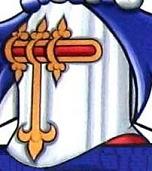
| Heraldic Symbol | Six-pearl coronet | Baron's helm (steel with gold grille) |
| Transferability | Hereditary or Life appointment | Inheritance or Assignation |
Frequently Asked Questions
What is the difference between a hereditary baron and a life peer?
A hereditary baron holds a title that can be passed down to their heirs. A life peer is appointed for their lifetime only; the title does not pass to their children. Most modern appointments to the House of Lords are life peerages at the rank of baron.
Can a woman be a baron in her own right?
Yes. A woman who holds the title independently is called a baroness. She may be styled as either "The Right Honourable The Baroness [Name]" or "The Right Honourable The Lady [Name]" based on her preference.
How is a Scottish baron different from a UK baron?
A UK baron is a peer of the realm with a rank in the peerage. A Scottish baron is a member of the ancient feudal nobility but is not a peer. Consequently, Scottish baronies can be transferred by assignation, whereas UK peerages cannot.
What is a "courtesy baron"?
A courtesy baron is typically the eldest son and heir of a higher-ranking peer (such as an Earl). They use the title "Lord [Barony]" as a courtesy, but they do not hold a peerage of their own and are not entitled to the style "The Right Honourable" unless they are a Privy Counsellor.
How are baronial titles recorded on passports?
In the UK, the title is entered into the surname field (e.g., Lord [Barony]). An official observation is then added to the passport stating the holder's full name and title, verified against records like Debrett's Peerage or The London Gazette.