B-52 Stratofortress: The Legacy of America's Strategic Heavy Bomber
B-52 Stratofortress: The Legacy of America's Strategic Heavy Bomber The Boeing B-52 Stratofortress stands as one of the most iconic and enduring aircraft in aviation history. A subsonic, ...
B-52 Stratofortress: The Legacy of America's Strategic Heavy Bomber
The Boeing B-52 Stratofortress stands as one of the most iconic and enduring aircraft in aviation history. A subsonic, jet-powered strategic heavy bomber, the B-52 was designed to deliver massive payloads across vast distances. Since its introduction to the United States Air Force (USAF) in 1955, this nuclear-capable powerhouse has evolved through numerous variants, remaining a cornerstone of global strategic deterrence for decades.
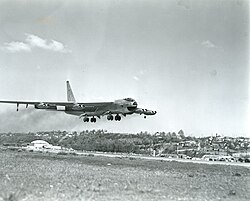
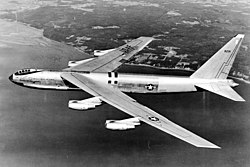
First flight of the B-52 Stratofortress on 15 April 1952: First flight of the B-52 Stratofortress on 15 April 1952
Originally developed during the early Cold War era, the B-52 was a massive undertaking. While the B-29 Superfortress required 153,000 engineering hours to design, the B-52 demanded a staggering 3,000,000 hours, reflecting the immense complexity of its subsonic jet design and long-range capabilities.
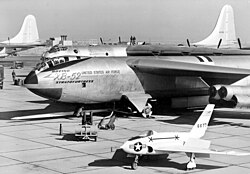
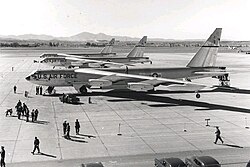
XB-52 prototype on flight line (X-4 in foreground; B-36 behind). Note original tandem-seat "bubble" style canopy, similar to Boeing's earlier B-47 Stratojet.: XB-52 prototype on flight line (X-4 in foreground; B-36 behind). Note original tandem-seat "bubble" style canopy, similar to Boeing's earlier B-47 Stratojet.
Key Facts
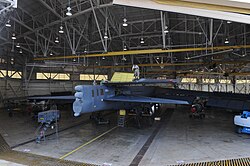
B-52H Stratofortress undergoing maintenance to its rudder with its fin folded
Manufacturer: Boeing
First Flight: 15 April 1952
Total Built: 744 aircraft
Primary User: United States Air Force
Payload Capacity: Up to 70,000 pounds (32,000 kg)
Combat Range: Approximately 8,800 miles (14,200 km) without aerial refueling
Development and Variants
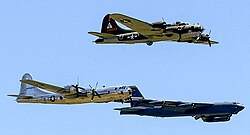
B-29 Superfortress Doc, B-17 Flying Fortress Thunderbird, and a B-52 Stratofortress flying in formation at the 2017 Barksdale Air Force Base Airshow
The B-52 has undergone extensive evolution since its inception. The production lineage spans from the early prototypes like the XB-52 and YB-52 to the highly capable B-52H, which has been the sole variant in military service since the mid-1990s. Over the years, various models such as the B-52C, D, E, F, and G were produced to meet changing strategic requirements.
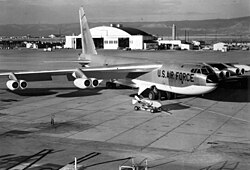
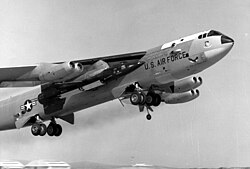
Side view of YB-52 bomber, still fitted with a tandem cockpit, in common with other jet bombers in US service, such as the B-45 Tornado, B-47 Stratojet and Martin B-57 Canberra: Side view of YB-52 bomber, still fitted with a tandem cockpit, in common with other jet bombers in US service, such as the B-45 Tornado, B-47 Stratojet and Martin B-57 Canberra
The Evolution of the Fleet
The production of the B-52 was a multi-year process, with the most significant production runs occurring between 1958 and 1962. The B-52D, for instance, saw a massive production of 170 units, while the B-52G reached 193 units. This continuous production allowed the USAF to maintain a robust fleet of strategic bombers during the height of the Cold War.
Three B-52Bs of the 93rd Bomb Wing prepare to depart March Air Force Base for Castle Air Force Base, California, after their record-setting round-the-world flight in 1957: Three B-52Bs of the 93rd Bomb Wing prepare to depart March Air Force Base for Castle Air Force Base, California, after their record-setting round-the-world flight in 1957
Technical Specifications of the B-52H
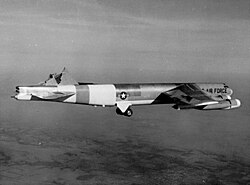
B-52H (AF Ser. No. 61-23), configured at the time as a testbed to investigate structural failures, still flying after its vertical stabilizer sheared off in severe turbulence on 10 January 1964. The aircraft landed safely.[102]
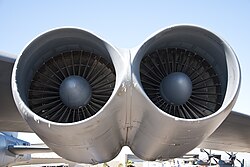
The B-52H represents the pinnacle of the Stratofortress's operational life. It is powered by eight Pratt & Whitney TF33 turbofan engines, each providing 17,000 lbf of thrust. This massive power allows the aircraft to reach a maximum speed of 650 mph and a service ceiling of 50,000 feet.
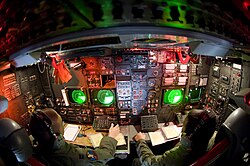
The aircraft's internal architecture is designed for maximum utility. The crew consists of five members: a pilot, copilot, weapon systems officer, navigator, and an electronic warfare officer. The lower deck, often referred to as the battle station, serves as a critical hub for mission operations.
A view of the lower deck of the B-52, dubbed the battle station: A view of the lower deck of the B-52, dubbed the battle station
Performance and Armament Summary
B-52H Technical Specifications
Feature
Specification
Crew
5 (Pilot, Copilot, WSO, Navigator, EWO)
Length
159 ft 4 in (48.5 m)
Wingspan
185 ft 0 in (56.4 m)
Max Takeoff Weight
488,000 lb (221,323 kg)
Cruise Speed
509 mph (819 km/h)
Service Ceiling
50,000 ft (15,000 m)
Operational History and Versatility
A B-52D with anti-flash white on the underside
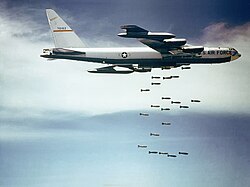
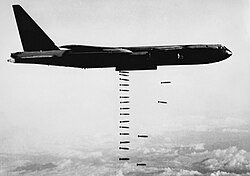
Beyond its primary role as a nuclear deterrent, the B-52 has proven its versatility in conventional warfare. It has been utilized in numerous conflicts, including the Vietnam War, where models like the B-52F were deployed for bombing missions.
B-52F dropping bombs on Vietnam: B-52F dropping bombs on Vietnam
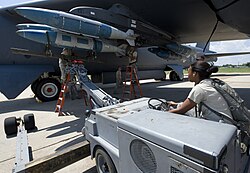
The aircraft's armament is incredibly diverse. It can carry a wide array of munitions, from conventional bombs to advanced cruise missiles like the AGM-158 JASSM. During specialized exercises, crews have been seen loading heavy munitions such as the GBU-31 Joint Direct Attack Munition.
Members of the Global Strike Challenge nuclear/conventional load crew team lift a GBU-31 Joint Direct Attack Munition into position during a dry run leading up to the 2012 Air Force Global Strike Command Challenge on Barksdale Air Force Base, Louisiana, 20 Aug 2012: Members of the Global Strike Challenge nuclear/conventional load crew team lift a GBU-31 Joint Direct Attack Munition into position during a dry run leading up to the 2012 Air Force Global Strike Command Challenge on Barksdale Air Force Base, Louisiana, 20 Aug 2012
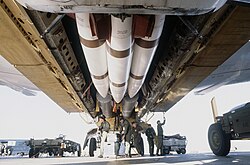
B-52H bomb bay: AGM-69 SRAM missiles (front, white) and B28 nuclear bombs (background, gray), as a downloading takes place during Exercise GLOBAL SHIELD '84: B-52H bomb bay: AGM-69 SRAM missiles (front, white) and B28 nuclear bombs (background, gray), as a downloading takes place during Exercise GLOBAL SHIELD '84
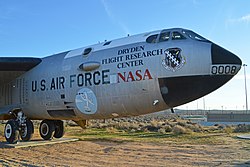
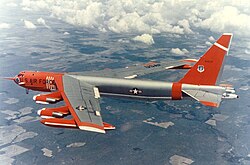
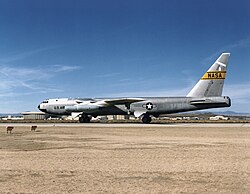
The B-52 has also served unique roles outside of combat. NASA utilized modified versions of the aircraft, such as the NB-52B "Mothership," as launch platforms for research aircraft, contributing significantly to aerospace science between 1959 and 2007.
Boeing NB-52B "Balls 8" at Dryden Flight Research Center: Boeing NB-52B "Balls 8" at Dryden Flight Research Center
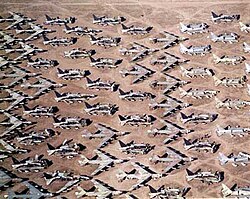
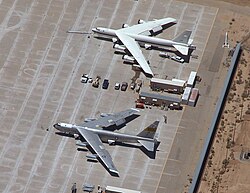
Even as older models are retired to storage facilities like the 309th AMARG (often called the "Boneyard") in Arizona, the B-52 remains relevant. Some aircraft, like the "Wise Guy," have even been resurrected from long-term storage to return to active service.
Retired B-52s are stored at the 309th AMARG (formerly AMARC), a desert storage facility often called the "Boneyard" at Davis–Monthan Air Force Base, near Tucson, Arizona.[199]: Retired B-52s are stored at the 309th AMARG (formerly AMARC), a desert storage facility often called the "Boneyard" at Davis–Monthan Air Force Base, near Tucson, Arizona.
B-52 "Wise Guy" leaving the "bone yard": B-52 "Wise Guy" leaving the "bone yard"
Frequently Asked Questions
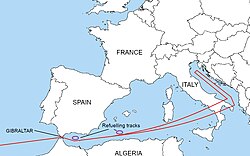
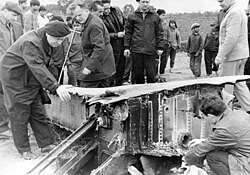
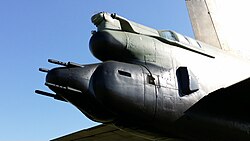
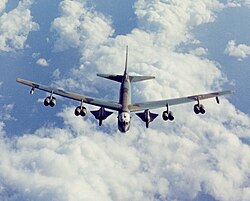
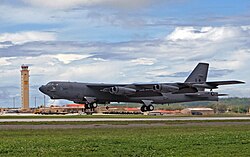
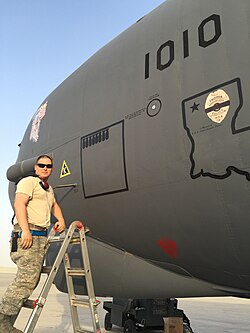
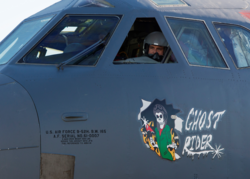
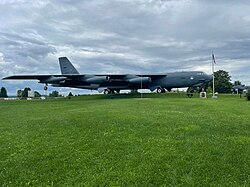
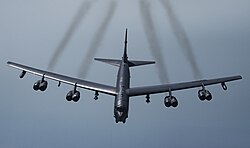
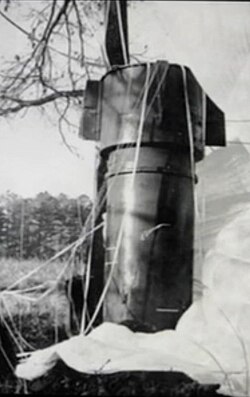
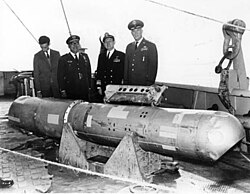
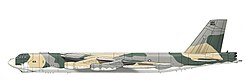
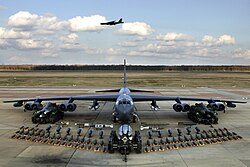
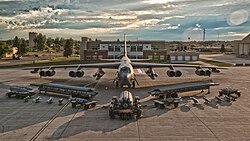
Southerly route of the Operation Chrome Dome airborne nuclear alertSoviet specialists inspect the wreckage of the B-52 Stratofortress shot down near Hanoi on 23 December 1972Tail armament of a B-52D, the model used on both occasions that a B-52 scored an aerial victory. In later models, the tail gunner was moved from the conventional position to the forward crew compartment before being removed altogether.B-52H modified to carry two Lockheed D-21B dronesA B-52H of the 2nd Bomb Wing takes off from Andersen Air Force Base, GuamB-52 Crew Chief SSgt Figueroa stenciling completed bombing sorties on B-52H (61–0010) during Operation Inherent Resolve, in part of the Military intervention against ISIL at Al Udeid Air Base, in QatarB-52H "Ghost Rider" leaving the "bone yard"B-52H Stratofortress with AGM-158 JASSM cruise missiles during the 2026 Iran war, 4 March 2026NB-52A carrying an X-15NASA's NB-52B Balls 8 (lower) and its replacement B-52H on the flight line at Edwards Air Force Base in 2004B-52D dropping 500-lb bombsBoeing NB-52E during the Air Force Flight Dynamics Laboratory-Boeing Control Configured Vehicles program 061128-F-1234S-001B-52G on static display at Langley Air Force Base in Hampton, VirginiaA static B-52G that resides at Griffiss International Airport (formerly Griffiss Air Force Base). Also pictured is an AGM-86 ALCM cruise missile.A Boeing B-52H Stratofortress in flight over the Persian GulfDryden NB-52B launch aircraftOne of the two MK 39 nuclear bombs involved in the 1961 Goldsboro crash after soft landing with parachute deployed. The weapon was recovered intact after three of the four stages of the arming sequence were completed.The thermonuclear bomb that fell into the sea recovered off Palomares, Almería, 1966B-52H profile, circa 1987Boeing B-52H static display with weapons, Barksdale Air Force Base 2006. A second B-52H can be seen in flight in the background.A B-52H Stratofortress and munitions are displayed in front of the Base Operations building at Minot Air Force Base
What is the primary role of the B-52 Stratofortress?
The B-52 is a strategic heavy bomber designed for long-range missions, capable of delivering both nuclear and conventional weapons payloads.
How many B-52 aircraft were built in total?
A total of 744 B-52 aircraft were produced between 1952 and 1962.
Which B-52 variant is currently in service?
The B-52H is the only variant currently remaining in active military service.
What is the "Boneyard"?
The "Boneyard" refers to the 309th AMARG at Davis–Monthan Air Force Base, a desert facility where retired aircraft are stored.
Can the B-52 fly without refueling?
Yes, the B-52 has a typical combat range of approximately 8,800 miles without the need for aerial refueling.