B-2 Spiritstealth bomberNorthrop GrummanUnited States Air Forcestrategic heavy bomber

B-2 Spirit: The Engineering and Legacy of America's Stealth Strategic Bomber

B-2 Spirit: The Engineering and Legacy of America's Stealth Strategic Bomber The B-2 Spirit stands as one of the most advanced pieces of aviation technology ever developed. As a stealth s...

B-2 Spirit: The Engineering and Legacy of America's Stealth Strategic Bomber

The B-2 Spirit stands as one of the most advanced pieces of aviation technology ever developed. As a stealth strategic heavy bomber, it was designed to penetrate sophisticated enemy air defenses, delivering both conventional and nuclear payloads with unprecedented precision and invisibility. Developed by the Northrop Corporation (now Northrop Grumman), this flying-wing aircraft has redefined the capabilities of long-range aerial warfare.
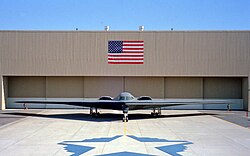
Front view of tailless aircraft parked in front of building. On the building face is a blue and red rectangular flag. A star-shaped artwork is on the taxiway in front of aircraft.
The B-2's first public display in 1988 at Palmdale, California: in front of the B-2 is a star formed with five B-2 silhouettes
: The B-2's first public display in 1988 at Palmdale, California: in front of the B-2 is a star formed with five B-2 silhouettes

Key Facts

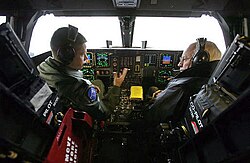
Vice President Dick Cheney inside a B-2 cockpit with pilot Captain Luke Jayne during a visit to Whiteman Air Force Base, 2006
  • Manufacturer: Northrop Grumman
  • Primary User: United States Air Force
  • Total Built: 21 aircraft
  • First Flight: July 17, 1989
  • Primary Mission: Stealth strategic heavy bombing
  • Successor: Northrop Grumman B-21 Raider

Development and History
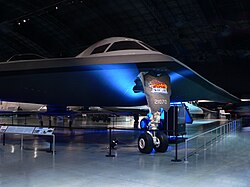
Restored B-2 Spirit full-scale test unit on display at the National Museum of the United States Air Force

The origins of the B-2 Spirit lie within the Advanced Technology Bomber program. Designed to operate in highly contested environments, the aircraft underwent rigorous development throughout the late 1980s. Following its first flight in July 1989, the program moved toward full-scale production between 1989 and 2000. The aircraft officially entered service on January 1, 1997.
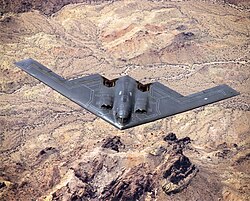
Top view of triangular aircraft, with sawtooth trailing edge, in flight over desert
The B-2's first publicized flight in 1989
: The B-2's first publicized flight in 1989

Throughout its operational history, the B-2 has been a cornerstone of the Air Force Global Strike Command. While the fleet has faced challenges, including accidents and maintenance complexities, the aircraft remains a vital component of the U.S. strategic deterrent. As the military looks toward the future, the B-21 Raider is slated to succeed the Spirit in the coming decades.
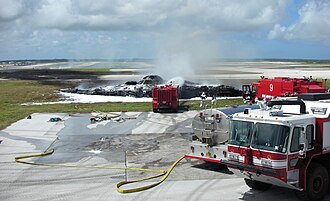
Wreckage of the 2008 B-2 crash
: Wreckage of the 2008 B-2 crash

Advanced Stealth Design and Engineering
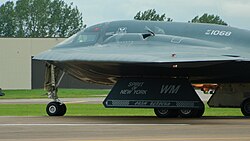
Spirit of New York
Spirit of New York

The most striking feature of the B-2 is its flying-wing design, which lacks a traditional fuselage and tail. This seamless, two-dimensional shape is critical for evading radar detection by minimizing the aircraft's radar cross-section.
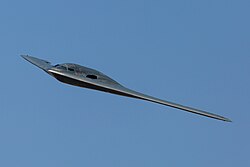
The Spirit of Missouri at the Dyess Air Force Base air show in 2018. This view depicts the body's two dimensional and seamless design, a distinct feature for evading radar detection.
: The Spirit of Missouri at the Dyess Air Force Base air show in 2018. This view depicts the body's two dimensional and seamless design, a distinct feature for evading radar detection.
Orthographically projected diagram of the B-2 Spirit
: Orthographically projected diagram of the B-2 Spirit

Radar and Infrared Signature Management

To maintain its stealth profile, the B-2 employs several sophisticated engineering techniques:

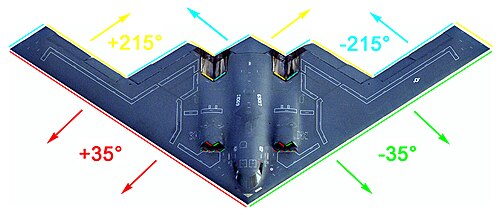
  • Radar Evasion: The aircraft's shape is designed to reflect radar waves away from the source rather than back to the receiver.
  • Engine Concealment: The engines are buried deep within the wing to hide the engine fans and minimize the infrared (heat) signature of the exhaust.
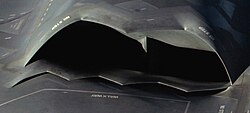
  • Boundary Layer Control: Specialized gaps below the air intakes prevent the boundary layer—the layer of air moving closely against the aircraft's surface—from entering the jet engines, which helps maintain aerodynamic efficiency and stealth.
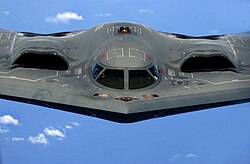
The B-2's engines are buried within its wing to conceal the engines' fans and minimize their exhaust signature.
: The B-2's engines are buried within its wing to conceal the engines' fans and minimize their exhaust signature.
Illustration of the B-2's basic radar reflection angles
: Illustration of the B-2's basic radar reflection angles
The gap below the air intake has the purpose of keeping the boundary layer out of the jet engine.
: The gap below the air intake has the purpose of keeping the boundary layer out of the jet engine.

Flight Controls and Performance

Operating a flying wing requires complex flight control systems to maintain stability. The B-2 is powered by four General Electric F118-GE-100 non-afterburning turbofans, providing a combined thrust that allows for a maximum speed of 630 mph at 40,000 feet. Its massive wingspan of 172 feet provides the lift necessary for its heavy payload and long-range capabilities.
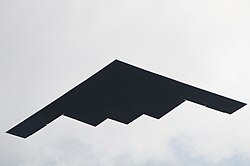
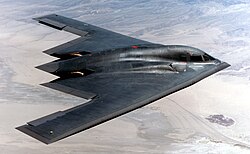
B-2 as viewed from below
: B-2 as viewed from below
Side view of a B-2 Spirit
: Side view of a B-2 Spirit

Armament and Operational Capabilities

The B-2 Spirit is a versatile platform capable of carrying a wide array of munitions. It utilizes both a Bomb Rack Assembly (BRA) for smaller munitions and a Rotary Launcher Assembly (RLA) for heavier ordnance.
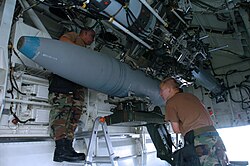
A 2,000 lb (910 kg) BDU-56 bomb being loaded onto a bomb bay's rotary launcher, 2004
: A 2,000 lb (910 kg) BDU-56 bomb being loaded onto a bomb bay's rotary launcher, 2004

Payload Specifications

The aircraft can be configured for various mission types, including conventional strikes and strategic nuclear missions:

  • Conventional: Up to 80 500 lb class bombs (such as the Mk-82 or GBU-38) or 36 750 lb class bombs.
  • Heavy Ordnance: 16 2,000 lb class bombs (such as the Mk-84 or GBU-31) via the RLA.
  • Penetration: 2 GBU-57 Massive Ordnance Penetrators (30,000 lb each).
  • Strategic: 16 B61 or B83 nuclear bombs.
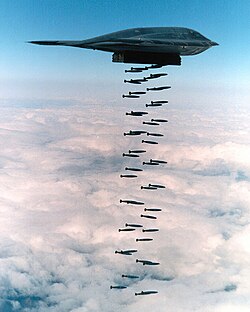
In a 1994 live fire exercise near Point Mugu, California, a B-2 drops 47 individual 500 lb (230 kg) Mark 82 bombs, which is more than half of a B-2's total ordnance payload.
: In a 1994 live fire exercise near Point Mugu, California, a B-2 drops 47 individual 500 lb (230 kg) Mark 82 bombs, which is more than half of a B-2's total ordnance payload.

Range and Endurance

For intercontinental sorties, the B-2 can undergo aerial refueling, which extends its operational range beyond 6,000 nautical miles (approximately 11,000 km).
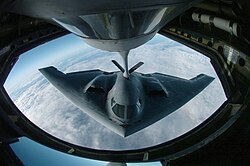
A B-2 during aerial refueling, which extends its range past 6,000 nautical miles (6,900 mi; 11,000 km) for intercontinental sorties
: A B-2 during aerial refueling, which extends its range past 6,000 nautical miles (6,900 mi; 11,000 km) for intercontinental sorties

Technical Specifications Summary

B-2 Block 30 Specifications
Feature Specification
Crew 2 (Pilot and Mission Commander)
Length 69 ft 0 in (21.0 m)
Wingspan 172 ft 0 in (52.4 m)
Empty Weight 158,000 lb (71,700 kg)
Max Takeoff Weight 376,000 lb (170,600 kg)
Cruise Speed 560 mph (900 km/h) at 40,000 ft
Service Ceiling 50,000 ft (15,200 m)

Maintenance and Deployment

Maintaining the stealth integrity of the B-2 is a labor-intensive process. Specialized crews must ensure the aircraft's surfaces remain smooth and the radar-absorbent materials are intact. The aircraft is deployed globally, with significant presence at bases such as Whiteman Air Force Base in Missouri and Andersen Air Force Base in Guam.
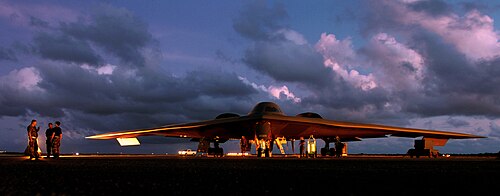

A maintenance crew servicing a B-2 at Andersen Air Force Base, Guam, 2004
: A maintenance crew servicing a B-2 at Andersen Air Force Base, Guam, 2004
Spirit of Indiana sits on the ramp at Andersen Air Force Base in Guam on 23 June 2006
: Spirit of Indiana sits on the ramp at Andersen Air Force Base in Guam on 23 June 2006

The B-2 has also participated in various formation flights and international exercises, demonstrating its ability to operate alongside other advanced military assets.
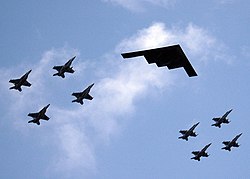
A B-2 in formation flight with eight U.S. Navy F/A-18 Hornets and Super Hornets
: A B-2 in formation flight with eight U.S. Navy F/A-18 Hornets and Super Hornets
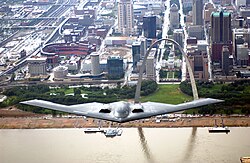
B-2 in flight over the Mississippi River (St. Louis, Missouri) with the Gateway Arch, St. Louis Basilica, and Busch Stadium and footprint of Busch Memorial Stadium in the background
: B-2 in flight over the Mississippi River (St. Louis, Missouri) with the Gateway Arch, St. Louis Basilica, and Busch Stadium and footprint of Busch Memorial Stadium in the background

Frequently Asked Questions

How does the B-2 Spirit achieve stealth?

The B-2 achieves stealth through its unique flying-wing shape, which minimizes radar reflections, and by burying its engines within the wings to reduce its infrared signature.

What is the maximum range of a B-2 bomber?

The B-2 has a standard range of 6,900 miles (11,000 km), which can be extended through aerial refueling for intercontinental missions.

What kind of weapons can the B-2 carry?

The B-2 can carry a variety of weapons, including 500 lb and 750 lb class conventional bombs, 2,000 lb class bombs, GBU-57 Massive Ordnance Penetrators, and B61 or B83 nuclear bombs.

Who manufactures the B-2 Spirit?

The B-2 Spirit was manufactured by the Northrop Corporation, which is now part of Northrop Grumman.

What is replacing the B-2 Spirit?

The Northrop Grumman B-21 Raider is the designated successor to the B-2 Spirit.

Where are B-2 bombers primarily based?

A large portion of the B-2 fleet is stationed at the 509th Bomb Wing at Whiteman Air Force Base in Missouri.

References

  1. The "stealth bomber" moniker has also been applied to the canceled McDonnell Douglas A-12 Avenger II and ongoing Northrop Grumman B-21 Raider.[3][4]
  2. Maximum takeoff weight is classified; listed figure is based on statement from manufacturer that aircraft's payload capacity is at least 40,000 lb.
  3. "Northrop B-2 Spirit fact sheet." Archived 28 February 2008 at the Wayback Machine National Museum of the United States Air Force. Retrieved 13 September 2009.
  4. "The Air Force in Facts and Figures" (PDF). Air & Space Forces Magazine. Vol. 92, no. 5. May 2009. Archived (PDF) from the original on 10 September 2025. Retrieved 14 August 2009.
  5. Sevenson, James Perry (2001). The $5 billion Misunderstanding: The Collapse of the Navy's A-12 Stealth Bomber Program. Annapolis, MD: Naval Institute Press. ISBN 978-1-55750-777-8.