Axis Mundi: The Universal Symbol of the World Center
Across nearly every major civilization and spiritual tradition, there exists a recurring concept known as the axis mundi—the "axis of the world." This symbol represents a central point or vertical pillar that connects different realms of existence, serving as a bridge between the earthly plane and the divine or subterranean worlds. Whether manifested as a towering mountain, a cosmic tree, or the human body itself, the axis mundi provides a sense of order and orientation in an otherwise chaotic universe.
Key Facts
- Definition: A symbolic center of the world that connects heaven, earth, and the underworld.
- Psychological Root: Originates from the perception that one's immediate, settled environment is a microcosm of order surrounded by external chaos.
- Metaphysical Role: Acts as a path for ascent or descent, allowing humans to gain insights into the macrocosm (the universe at a grand scale).
- Common Forms: Mountains, trees, temples, pillars, and the human anatomy.
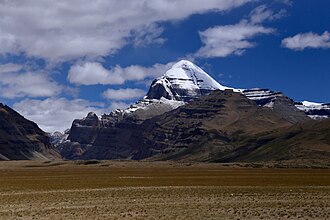
- Cultural Examples: Mount Kailash (Hinduism/Buddhism), Yggdrasil (Norse), and the Ka'aba (Islam).
Interpretations of the World Center
Psychological and Sociological Perspectives
One theory suggests the axis mundi stems from a universal human perception: the belief that the spot one occupies is the "center of the world." This known space creates a microcosm—a small-scale representation of order. Beyond these boundaries lie unfamiliar realms representing chaos, night, or death. From this secure center, humans venture in the four cardinal directions to discover and establish new centers of order. An example of this is the name of China (Zhōngguó), which translates to "Middle Nation," reflecting an ancient view of the polity as the world's center.
Metaphysical and Philosophical Perspectives
Another interpretation views the axis mundi as a reflection of the macrocosm (the grand scale of existence) within the microcosm (the individual or local environment). In this framework, humans act as a bridge between realms. Depending on the tradition, this bridge connects either two worlds (earthly and heavenly, as in Taoism and Hinduism) or three worlds (earthly, heavenly, and the "infra-earthly" or underworld, as seen in Ancient Egyptian, Mayan, Incan, and Greek systems). The vertical axis represents a path of spiritual ascent or descent, where human life is viewed as a quest for liberation and universal insight.
Physical Manifestations of the Axis Mundi
Sacred Mountains and Elevated Sites
High elevations are frequently regarded as natural connections to the divine. Many cultures have identified specific peaks as the world center. In China, Mount Kunlun serves this role, while in Tibet and Hinduism, Mount Kailash is revered as a holy site. The Pitjantjatjara people of Australia view Uluru as central to their culture, and the ancient Guanches of the Canary Islands saw the Teide volcano as an axis mundi.
In flat landscapes, humans have built artificial elevations to reach the heavens. The Sumerians and Babylonians constructed ziggurats (massive stepped platforms), and the residents of Teotihuacán in Mexico built huge pyramids. Interestingly, these pyramids were often placed over caves or springs, which were believed to be portals to the underworld.
Architectural and Ritual Symbols
Sacred architecture often mimics the "Sacred Mountain." Historian Mircea Eliade noted that temples, palaces, and royal residences function as centers of the world. Examples include:
- Asian Pagodas: Stairways linking earth and heaven.
- Church Steeples and Mosque Minarets: Vertical connections to the divine.
- Totem Poles and Maypoles: Representations of the world axis.
- Altars: Where incense and prayer create a column of smoke rising toward heaven.
- Mandalas: Two-dimensional representations of a world center.
The Axis Mundi in Nature and Humanity
The Cosmic Tree
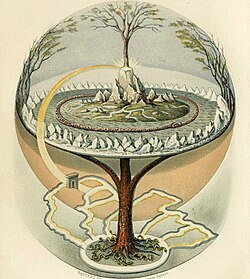
Plants frequently symbolize the axis mundi, most notably through the image of the Cosmic Tree. Its branches reach the sky, its trunk occupies the earth, and its roots penetrate the underworld. In Norse mythology, Yggdrasil (the World Ash) is the site where Odin sought enlightenment. Similarly, the Mesoamerican world tree and the Lithuanian Jievaras serve as cosmic connectors.
In Eastern traditions, the banyan tree is sacred in Hinduism (ashwath vriksha), representing eternal life. The Bodhi tree is specifically honored as the site where Gautama Siddhartha attained enlightenment. In Yoruba religion, the oil palm serves as the axis that Ọrunmila climbs to move between heaven and earth.
The Human Body as a Pillar
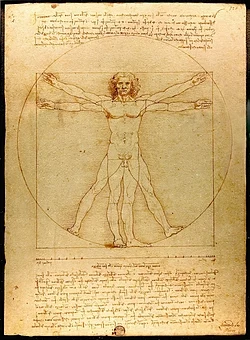
The human form is often viewed as a living axis mundi. Systems such as the chakras in Hinduism and Buddhism, or the sefirot in Kabbalism, treat the body as a pillar between heaven and earth. Practices like yoga and tai chi are based on this premise. This concept is further explored in the Renaissance through Leonardo da Vinci's Vitruvian Man, which mathematically explored the human form as a world axis.
Shamanism, Mythology, and Knowledge
A central theme in shamanic traditions is the healer's journey along the axis mundi to retrieve knowledge from other worlds. This motif appears in diverse stories, from the descent and ascent in Dante Alighieri's The Divine Comedy to folk tales like Jack and the Beanstalk and Rapunzel. Even the "heavenly horse" in Han Chinese and Indo-Iranian cultures is seen as a mediator linking royal authority to the cosmic order.
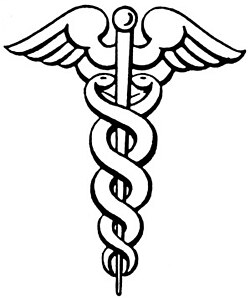
Objects suspended on this axis—such as serpents, rods, or fruit—are often seen as repositories of wisdom. This is reflected in the Rod of Asclepius and the caduceus, where the staff represents the axis mundi and the serpents act as guides to knowledge.
Summary of Axis Mundi Examples
| Category | Example | Cultural/Religious Tradition | Symbolic Function |
|---|---|---|---|
| Mountain | Mount Kailash | Hinduism / Vajrayana Buddhism | Home of Shiva / Sacred Center |
| Tree | Yggdrasil | Norse Mythology | Connection of three planes / Enlightenment |
| Structure | Ziggurat | Ancient Mesopotamia | Elevated temple for divine connection |
| Human | Chakra System | Hinduism / Buddhism | Body as a pillar between heaven and earth |
| Site | Ka'aba | Islam | First building on Earth / World Center |
Frequently Asked Questions
What is the difference between a microcosm and a macrocosm?
A microcosm is a small-scale representation of a larger system (such as an individual or a village), while the macrocosm is the entire universe or existence at a grand scale. The axis mundi suggests that the principles of the macrocosm are reflected within the microcosm.
How does the axis mundi relate to the concept of an omphalos?
An omphalos, meaning "navel," refers to a specific physical spot regarded as the center of the earth. While the axis mundi is the vertical connection (the pillar), the omphalos is the central point on the ground from which that axis rises.
Why are trees so common as symbols of the world axis?
Trees naturally span three distinct levels: the roots go deep into the earth (underworld), the trunk exists on the surface (earthly realm), and the branches reach upward (heavenly realm), making them perfect biological metaphors for a cosmic bridge.
Is the axis mundi only a religious concept?
No. While prevalent in religion, it also appears in psychological theories regarding how humans perceive space and order, as well as in secular architecture and traditional home layouts (such as feng shui or Navajo hogans).
What is the significance of the serpent in axis mundi imagery?
In symbols like the caduceus or the Rod of Asclepius, the serpent represents a guardian or a guide to the knowledge that is stored along the axis between the earthly and divine realms.