Authority Records and Files in Bibliographic Catalogs
In the world of library science, maintaining a consistent and organized catalog is essential for ensuring that users can find the materials they need. This is achieved through authority control, a process that standardizes the names, titles, and subjects used in a bibliographic catalog. To enforce this control, libraries utilize a specialized tool known as an authority file.
An authority file is a separate index of authority records that governs the headings used in the main catalog. Rather than acting as a general information source, its primary function is to organize data. It serves as a master record of decisions made by catalogers—whether within a single library or a larger cataloging consortium—to ensure that every author or title is unique and consistently represented.
Key Facts
- Primary Purpose: To organize bibliographic information and ensure unique access points rather than providing general biographical data.
- Authority File: A separate index used by catalogers to consult and revise decisions regarding official headings.
- Preferred Heading: The single, authorized version of a name or title chosen as the official entry.
- Cross References: Tools (See and See Also) that redirect users from variant names to the authorized heading.
- Justification: Documentation of the sources used to determine the authorized form of a heading.
The Anatomy of an Authority Record
While practices can vary globally, authority records in English-speaking libraries typically consist of three core components: headings, cross references, and statements of justification.
1. Preferred Headings
The heading is the official, authorized version of a name or title. Because headings function as access points, they must be distinct to avoid conflict. For example, the novelist William Collins (1824–89) is more widely known as Wilkie Collins. Catalogers must determine which name the public is most likely to use and establish that as the preferred heading to prevent confusion.
![Card catalog records such as this one used to be physical cards contained in long rectangular drawers in a library; today, generally, this information is stored in online databases.[17]](/images/7c/dd/7cdddee53575af6cc634a00c8ec35aa81882c7421debcaa66524a38f66f25c0c.png)
2. Cross References
Cross references guide users who search for a name or title using a form other than the preferred heading. There are two main types:
- See references: These point from a deprecated or passed-over form of a name to the authorized heading.
- See also references: These link one authorized heading to another authorized heading, often to connect earlier or later versions of a name. While common for corporate bodies, these are rare for personal names.
![Authority control with "Kesey, Ken" as the chosen heading.[17]](/images/54/40/54405434d4c7eae72331a2d29339d5ca10bfd6b6e146811cc97576f31fa83f81.png)
3. Statements of Justification
A statement of justification is a brief account explaining why a specific heading was chosen. This documentation often includes the title and publication date of the source used, the specific location of the name within that source, and the exact form in which it appeared.
Practical Application: The Case of Brian O'Nolan
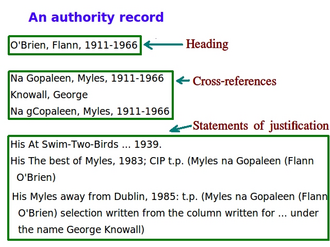
The complexity of authority records is best illustrated by the Irish writer Brian O'Nolan (1911–1966), who wrote under various pen names, including Flann O'Brien and Myles na Gopaleen. To organize his works, the United States Library of Congress established a specific authority record:
- Authorized Heading: "O'Brien, Flann, 1911–1966" was chosen as the official form. Every work by this author in the catalog should use this heading.
- See References: Variants such as "Na Gopaleen, Myles, 1911–1966" and the non-anglicized Irish spelling "Na gCopaleen, Myles, 1911–1966" are listed as see references. If a user searches for these, they are redirected to the authorized "O'Brien, Flann" heading.
- Justification: The record cites the 1939 edition of the novel At Swim-Two-Birds as the source for the authorized name, noting that other pen names appeared in later publications.
| Component | Function | Example |
|---|---|---|
| Preferred Heading | The official, unique access point. | O'Brien, Flann, 1911–1966 |
| See Reference | Redirects deprecated forms to the official heading. | See O'Brien, Flann (from "Myles na Gopaleen") |
| See Also Reference | Links two different authorized headings. | Links to a corporate body's previous name |
| Justification | Provides evidence for the chosen heading. | Citation of a 1939 novel edition |
Frequently Asked Questions
What is the main difference between a catalog and an authority file?
A bibliographic catalog lists the actual items available in a library, while an authority file is a separate index that manages the standardized headings used within that catalog to ensure consistency.
Why are "See" references necessary?
They ensure that users can find a resource regardless of which version of a name they use. If a user searches for a pen name or a common misspelling, the "See" reference directs them to the single authorized heading.
What is a cataloging consortium?
A cataloging consortium is a group of libraries that collaborate to share the work of creating and maintaining authority records and bibliographic data.
How does a cataloger decide on a preferred heading?
Catalogers consider which name the public is most likely to use and research authoritative sources. They then document this decision in a statement of justification to provide a transparent trail of evidence.
Are "See Also" references common for individual authors?
No, "See Also" references are exceedingly rare for personal name authority records, though they are frequently used for corporate bodies to link different authorized versions of an organization's name.