Australian Trade and Consular History in Shanghai
The history of Australia's diplomatic and commercial presence in Shanghai is a narrative of fluctuating geopolitical tides, spanning over a century of evolving trade relations and political shifts. From the early ambitions of the 1920s to the formal establishment of a modern Consulate-General, Australia's engagement with this global hub has mirrored its broader strategic interests in the Far East.
The Little Trade Commission (1921–1923)
Australia's formal trade representation in China began on February 26, 1921, with the appointment of Edward S. Little. As the first Trade Commissioner ever appointed by the Australian Government, Little was tasked by the Department of Trade and Customs to establish a foothold in Shanghai. Prime Minister Billy Hughes envisioned this as the start of a broader service of trade commissioners linked to the Bureau of Commerce and Industry.
Before departing, Little toured Australia to assess business interest in China. He emphasized that his posting represented the first direct Australian representation within China itself, noting that previous representation in Hong Kong did not constitute a presence in mainland China.
However, this initial venture was short-lived. On July 26, 1923, Minister for Trade and Customs Austin Chapman announced the closure of the office due to concerns over maintenance expenses. The decision sparked controversy; while The Age criticized the office as useless and alleged expense abuse by Little, the Shanghai press—including the North China Daily News and Finance and Commerce—condemned the move as a blow to Australian prestige. Little later defended himself in The Bulletin, claiming his dismissal was wrongful and the allegations unfounded.
The Bowden Trade Commission (1935–1941)
A decade later, the Australian government revisited its strategy. On August 30, 1933, Minister for Commerce Frederick Stewart sought approval for several Eastern Trade Commissions. This move was bolstered by a fact-finding mission led by Attorney General and Minister for External Affairs John Latham, who identified a critical need for representatives to improve mercantile connections in the region.
Following Latham's meetings with the British Chamber of Commerce and the China Association in the Shanghai International Settlement, acting Prime Minister Earl Page announced the appointment of Vivian Gordon Bowden to Shanghai on June 7, 1935.
When the Second Sino-Japanese War broke out in July 1937, followed by the Battle of Shanghai in August, the government decided Bowden should remain in the city. Operating from the HSBC Building within the relatively safe International Settlement, Bowden provided vital intelligence on the conflict and worked to protect Australian lives and property.
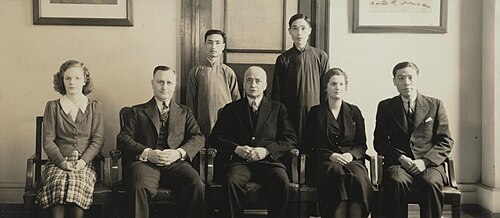
Bowden's tenure ended in September 1941 when he was appointed Official Representative of the Commonwealth Government in Singapore. He was not replaced in Shanghai; instead, trade and commerce responsibilities shifted to the Australian Legation in Chungking, led by Minister Sir Frederic Eggleston.
The Wootten Trade Commission and Post-War Transition (1946–1951)
Following the war, the Department of Commerce and Agriculture sought to revive the service. In June 1946, Prime Minister Ben Chifley appointed Alfred Wootton—who had previously served under Bowden—as the new Trade Commissioner in Shanghai.
Wootton encountered a city in turmoil, facing a collapsing economy and a power struggle between the Nationalist Government and the Chinese Communist Party. Due to the decline in trade prospects, the Trade Commission closed in December 1948.
Despite the closure of the trade office, consular functions continued. Osmond Charles Fuhrman served as Consul-General starting July 5, 1947. After the departure of Wootton and Fuhrman in January 1949, the post was managed by Acting Consul-Generals F. R. Penhalluriack, Harold Loveday, and finally Colonel Alistair Clark. The post was officially evacuated on September 8, 1951.
Establishment of the Modern Consulate-General
After decades of absence, Australia returned to Shanghai in the 1980s. In February 1984, Foreign Minister Bill Hayden announced the creation of an Australian Consulate-General. Roger Brown was appointed as the first Consul-General on June 25, 1984.
The consulate was officially opened on July 2, 1984, by Attorney General Gareth Evans, who described the office as a reflection of the remarkable growth in bilateral relations between Australia and China.
Key Facts
- First Commissioner: Edward S. Little (appointed 1921).
- Strategic Location: The Bowden Commission was based in the HSBC Building within the International Settlement.
- War-time Role: Vivian Gordon Bowden remained in Shanghai during the 1937 conflict to protect Australian interests.
- Final Post-War Exit: The last representative left Shanghai on September 8, 1951.
- Modern Era: The current Consulate-General was officially opened on July 2, 1984.
| Period | Representative/Office | Key Event/Status |
|---|---|---|
| 1921–1923 | Edward S. Little | First Trade Commissioner; office closed due to expense concerns. |
| 1935–1941 | Vivian Gordon Bowden | Managed trade and safety during the Second Sino-Japanese War. |
| 1946–1948 | Alfred Wootton | Post-war attempt to revive trade amidst economic collapse. |
| 1947–1951 | Consular Staff | Consular functions maintained until final evacuation in 1951. |
| 1984–Present | Consulate-General | Modern diplomatic mission established under Bill Hayden. |
Frequently Asked Questions
Who was the first Australian Trade Commissioner in Shanghai?
Edward S. Little was the first Trade Commissioner, appointed on February 26, 1921, marking the start of the Australian Trade Commissioner Service.
Why was the first Trade Commission closed in 1923?
The office was closed by the Minister for Trade and Customs, Austin Chapman, primarily due to concerns regarding the expenses of maintaining the representation in Shanghai.
What role did Vivian Gordon Bowden play during the Second Sino-Japanese War?
Bowden remained in Shanghai during the 1937 conflict to keep the Australian government informed and to implement measures for the protection of Australian lives and property.
When did Australia officially evacuate its post in Shanghai after World War II?
The final evacuation of the post in Shanghai took place on September 8, 1951, following the tenure of Acting Consul-General Colonel Alistair Clark.
When was the modern Australian Consulate-General in Shanghai opened?
The Consulate-General was officially opened on July 2, 1984, by Attorney General Gareth Evans.