Australian Rock Music: The Evolution of Oz Rock
From the early days of rock and roll to the global dominance of hard rock, Australian rock (often affectionately called Oz rock or Aussie rock) has developed a unique identity. The journey of the genre is marked by distinct "waves" of popularity, shifting from conservative pop to the raw energy of pub rock and the experimental sounds of electronica.
Key Facts
- First Wave: Characterized by early rock 'n' roll and conservative acts featured on the TV show Bandstand.
- Second Wave (1964–1969): Known as the "beat boom," heavily influenced by the British Invasion and The Beatles.
- Third Wave (1970–1975): A period of stylistic diversification, the rise of major festivals, and the birth of influential media outlets.
- Global Icons: AC/DC stands as one of the most successful exports, selling over 71 million records in the US alone by 2014.
- Media Influence: The TV show Countdown and the radio station Double Jay were pivotal in promoting local talent.
The First Wave: 1950s to Early 1960s
The initial surge of rock 'n' roll in Australia was brief. By the early 1960s, the scene had become more conservative. The music industry was dominated by a few major players; for instance, in 1960, media magnate Rupert Murdoch purchased Festival, and the US-owned CBS took over the Australian Record Company (ARC).
During this era, the charts were filled with clean-cut acts. Many were part of the "Bandstand family," appearing on the popular TV show Bandstand (1958–1972), which aimed for a broad appeal across all ages. This period saw a decline in edgy rock, with the scene remaining relatively bland between the last major hit of Johnny O'Keefe in 1961 and the emergence of Billy Thorpe in 1964.
The Second Wave: The Beat Boom (1964–1969)
The "beat boom" revitalized the local scene, sparked largely by the British Invasion. The impact of The Beatles was seismic; when they toured in June 1964, an estimated 300,000 people—roughly one-third of Adelaide's population—gathered to see their motorcade.
This influence inspired hundreds of local bands to develop a distinctive Australian inflection. One notable success was "Spicks and Specks," released in September 1966, which reached No. 4 on the Go-Set Australian National Top 40. Other acts, such as the Bee Gees, also found success during this era before expanding their careers into the UK and US markets.
The Third Wave: 1970–1975
The third wave saw the coalescence of surviving 1960s veterans and new performers into more distinctively Australian styles. However, local acts often struggled to find international success due to poor management or a lack of radio exposure.
The 1970 Radio Ban and Cover Versions
A significant conflict between record labels and radio broadcasters led to a radio ban from May to October 1970. While commercial radio refused to play major UK and Australian releases, the Australian Broadcasting Commission (ABC) continued to do so. This gap allowed local artists on labels like Fable Records to find success with cover versions of UK hits, such as Liv Maessen's version of "Knock, Knock Who's There?"
The Rise of Rock Festivals
Inspired by Woodstock, Australia saw its first major rock festivals. The most prominent was the annual Sunbury music festival, held near Melbourne from 1972 to 1975. While Sunbury was a landmark event, a disastrous final festival in 1975 left promoters bankrupt and made large-scale festivals seem too risky for years to come.
Media Catalysts: Countdown and Double Jay
By 1973, the proportion of Australian acts in the charts had hit an all-time low. This changed with the 1974 debut of Countdown, a weekly TV pop show broadcast by the ABC. Its massive national audience gave local artists unprecedented visibility and influenced radio programming across the country.
In January 1975, the ABC launched Double Jay (2JJ) in Sydney. This was a landmark in Australian media: it was the first non-commercial 24-hour rock station in a capital city and the first to employ female disc jockeys.
The Era of Pub Rock and Global Success
The late 1970s saw the rise of pub rock, a raw, high-energy style suited for the local tavern circuit. Cold Chisel, formed in Adelaide in 1973, became icons of this movement, achieving massive domestic success despite limited international reach.
In contrast, AC/DC—which also began as a pub rock group in 1973—became a global phenomenon. They influenced hard rock worldwide and achieved staggering sales, including over 71 million records in the US by 2014.
Evolution into Electronica and Alternative Rock
As the music evolved, Australian artists began experimenting with electronic sounds. Russell Morris's "The Real Thing" (1969) was an early precursor to dance music. By the early 1980s, the group Severed Heads introduced high-BPM electronic music with "Lamborghini." Severed Heads later became the first electronic group to perform at the Big Day Out.
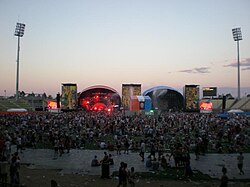
The landscape continued to shift through the 1990s and 2000s, incorporating alternative rock, hardcore punk, and neo-psychedelic styles, further diversifying the "Oz rock" sound.
![Pendulum bassist Gareth McGrillen. The band mixes numerous genres, including electronic.[66]](/images/a2/94/a294f66ca5e8ea9e8c8627419a0f39db8fed437eedce21f5a6df69003107ac78.jpg)
Summary of Australian Rock Eras
| Era/Wave | Timeframe | Key Characteristics | Notable Influence/Act |
|---|---|---|---|
| First Wave | 1950s – Early 1960s | Conservative pop, clean-cut acts | Bandstand TV show |
| Second Wave | 1964 – 1969 | Beat boom, British Invasion influence | The Beatles |
| Third Wave | 1970 – 1975 | Stylistic diversification, festivals | Sunbury Festival |
| Pub Rock Era | Late 1970s – 1980s | High-energy, live tavern performances | AC/DC, Cold Chisel |
| Electronic/Alt | 1980s – Present | Dance beats, alternative and indie | Severed Heads |
Frequently Asked Questions
What was the "beat boom" in Australian rock?
The beat boom occurred between 1964 and 1969. It was a period of intense activity where hundreds of local bands were inspired by the British Invasion, particularly The Beatles, leading to a vibrant and distinctive local rock scene.
How did the 1970 radio ban affect local music?
The ban prevented commercial radio from playing major UK and Australian releases. This led to a surge in the popularity of local cover versions of international hits, as artists on new labels like Fable Records filled the void.
What role did Countdown play in the music industry?
Launched in late 1974, Countdown was a nationwide TV show that significantly increased the visibility of Australian artists. Its popularity forced radio programmers to include more local content to satisfy its loyal audience.
Why was Double Jay (2JJ) significant?
Double Jay was the first non-commercial 24-hour rock station in an Australian capital city. It broke media conservatism by being the first such station to employ women disc jockeys.
Which Australian rock band achieved the most international success?
AC/DC is among the most globally recognized, having sold millions of albums and over 71 million records in the US alone by 2014, profoundly influencing the hard rock genre.