Australian Jazz History: From Minstrelsy to Modern Improvisation
Jazz has long held a prestigious place in the Australian cultural landscape. From the high-energy atmosphere of local clubs and festivals to a vast catalog of recordings, the genre has flourished across the continent. While jazz originated as an American musical genre created by African Americans, its syncopated rhythms and improvisational spirit were rapidly embraced by Australian musicians, who helped shape a distinct local scene that eventually gained international recognition.
Key Facts
- Rapid Adoption: Jazz-influenced dance music appeared in Australia within a year of the genre's emergence in the United States.
- The Father of Australian Jazz: Trombonist Frank Coughlan is widely regarded as the foundational figure of the local scene.
- Academic Integration: The Sydney Conservatorium of Music launched the first tertiary jazz studies course in Australia in 1973.
- Global Reach: Groups like the Australian Jazz Quartet and musicians such as Bruce Cale achieved significant success in the US and UK.
- Modern Recognition: The Necks won the 2004 ARIA Award for Jazz Album of the Year for their work Drive-By.
The Precursors and Early Influence
Before jazz became a defined genre, its precursors arrived in Australia via white American and British "black face" bards in the 1840s. These performers brought imitations of slave plantation music, introducing polyrhythmic breaks—complex rhythmic patterns that would later become a hallmark of jazz. By the 1850s, full minstrel shows with orchestras toured major cities and boom towns like Ballarat and Bendigo.
The 1870s saw an increase in American vaudeville troupes due to regular steamship services, alongside genuine African-American minstrel troupes and Jubilee Singers (black chamber choirs), further diversifying the musical influences available to local audiences.
The Rise of the Jazz Age (1920s–1940s)
By the mid-1920s, "jazz" or "jass" (hot dance music) was firmly established. This growth was fueled by Tin Pan Alley marketing, phonograph records, piano rolls, and visiting acts. Early recordings include "Red Hot Mamma" and "Sweet Georgia Brown" by Ray Tellier's San Francisco Orchestra in 1925.
Between 1923 and 1928, white American orchestras from the West Coast, such as Frank Ellis and his Californians, were the primary influence. Thousands of fans gathered at Sydney's Palais Royale to witness these performances. However, after 1928, restrictions on touring American bands—following the forced departure of Sonny Clay's Plantation Orchestra—forced Australian musicians to rely on recorded sources, "how to jazz" courses, and literature like Australian Dance Band News.
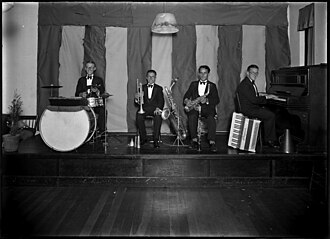
During this era, Frank Coughlan emerged as a pivotal figure. Known as "The Father of Australian Jazz," Coughlan led the orchestra for the 1936 opening of the Sydney Trocadero, which remained the city's premier dance venue until 1971.
Post-War Evolution and International Success
Following World War II, Australian jazz moved toward more sophisticated arrangements. The Australian Jazz Quartet (AJQ) became a highly successful unit, recording ten albums and performing at major US venues. The group's international ties were strengthened when American bassist Ed Gaston joined the AJQ in 1958 and eventually settled in Australia.
Other musicians also found success abroad. Bassist Bruce Cale collaborated with Bryce Rohde in Sydney before moving to London to work with the Tubby Hayes Quartet and later to the US, where he played with legends like Zoot Sims and Phil Woods. Upon returning to Australia in the late 1970s, Cale became a cornerstone of the local scene and a composer for ABC Radio.
In Melbourne, the 1957 opening of "Jazz Centre 44" by producer Horst Liepolt provided a vital hub for musicians like Brian Brown and the Melbourne New Orleans Jazz Band for nearly a decade.
The Impact of Media and Education
Television began showcasing jazz in the late 1950s through ABC series such as Look Who's Dropped In (1957–1958), Sweet and Low (1959), and the Australian All Star Jazz Band (1959).
The 1970s marked a shift toward formal education. In 1973, the Sydney Conservatorium of Music introduced the first tertiary jazz studies course, a result of collaboration between Director Rex Hobcroft and musician Don Burrows. In 1980, Brian Brown founded the jazz course at the Victorian College of the Arts, where he influenced generations of musicians through his focus on interactive improvisation.
Contemporary Jazz and the Modern Era
The late 20th century saw the rise of versatile musicians like guitarist Tony Barnard, who performed at the Sydney Opera House and later joined the Ronnie Scott's Jazz Orchestra in the UK. Simultaneously, The Necks (formed in 1987) gained international acclaim for their hypnotic, spontaneous compositions, blending jazz and ambient music.
While the first decade of the 21st century saw a slight dip in momentum, jazz remains active through venues like Melbourne's Bennett's Lane Jazz Club and organizations such as the Melbourne Jazz Co-operative, which has run three concerts a week since 2007.
Summary of Australian Jazz Milestones
| Period | Key Development / Figure | Significance |
|---|---|---|
| 1840s–1870s | Minstrelsy & Jubilee Singers | Introduced polyrhythmic breaks and early American styles. |
| 1920s | Palais Royale / Ray Tellier | Establishment of "hot dance music" and early disc recordings. |
| 1936 | Frank Coughlan / The Trocadero | Creation of Sydney's leading dance venue for 35 years. |
| 1957 | Jazz Centre 44 | Major hub for the Melbourne jazz scene. |
| 1973 | Sydney Conservatorium | First tertiary jazz studies course in Australia. |
| 2004 | The Necks | ARIA Award for Jazz Album of the Year (Drive-By). |
The Australian Jazz Convention
The Australian Jazz Convention (AJC) continues to be a vital gathering for the community. Recent highlights include the 68th Convention in Goulburn (2013) and the 69th in Swan Hill (2014), which featured 30 young musicians from the VJC Jazz Youth Workshop. In 2019, the 74th AJC reintroduced guest artists for the first time in 30 years, featuring New Orleans band leaders Marla Dixon and Shaye Cohn.
Frequently Asked Questions
Who is considered the Father of Australian Jazz?
Trombonist and bandleader Frank Coughlan is regarded as the Father of Australian Jazz due to his influential career from the 1920s to the 1970s and his leadership of the Sydney Trocadero orchestra.
When did jazz education become formalized in Australia?
Formal tertiary education began in 1973 with the inception of the jazz studies course at the Sydney Conservatorium of Music, followed by Brian Brown's course at the Victorian College of the Arts in 1980.
What was the significance of Jazz Centre 44?
Established in 1957 in Melbourne, Jazz Centre 44 was a premier venue for nearly a decade, hosting local musicians like Brian Brown and the Melbourne New Orleans Jazz Band.
Which Australian jazz group has gained significant international acclaim for ambient compositions?
The Necks, formed in 1987, are well-known internationally for their spontaneous, hour-long compositions and won a 2004 ARIA Award for their album Drive-By.
How did American jazz first reach Australia?
It arrived initially through minstrel shows in the 1840s, followed by visiting vaudeville troupes, phonograph records, and touring orchestras from the US West Coast in the 1920s.