Asteriornis: The 'Wonderchicken' That Rewrites Early Bird Evolution
Deep within the sediment of Belgium lies a fossil that challenges our understanding of how modern birds survived the apocalypse. Asteriornis, affectionately nicknamed the "Wonderchicken," is an extinct genus of bird from the Late Cretaceous period. As one of the oldest known members of the Neornithes—the group encompassing all living birds—this small, long-legged creature provides a critical link between the dinosaurs of the past and the poultry of the present.
Living approximately 66.8 to 66.7 million years ago, Asteriornis co-existed with more primitive avian species like Ichthyornis. Its discovery suggests that the ancestors of modern birds were already widespread across the northern continents long before the catastrophic event that wiped out the non-avian dinosaurs.
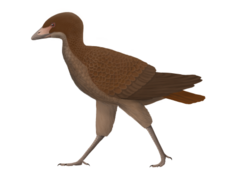
Key Facts
- Scientific Name: Asteriornis maastrichtensis
- Nickname: Wonderchicken
- Temporal Range: Late Maastrichtian (66.8–66.7 Ma)
- Location: Maastricht Formation, Belgium
- Classification: A basal member of the Galloanserae (ancestors of chickens and ducks)
- Estimated Mass: Approximately 394 grams
Discovery and Naming
The specimen (NHMM 2013 008) was first unearthed in 2000 by amateur paleontologist Maarten van Dinther at the CBR-Romontbos quarry near Eben-Emael. The fossil consists of an almost complete skull along with fragments of a radius and leg bones. It was found in the Maastricht Formation, the geological namesake of the Maastrichtian stage—the final chapter of the Mesozoic era.
The name Asteriornis is a blend of the Greek word ornis (bird) and Asteria, the Greek goddess of falling stars who famously transformed into a quail. This naming is a poetic double entendre: it refers both to the Chicxulub asteroid (the "falling star") and the bird's relation to quails and other galloanserans.
Physical Description
Asteriornis was a small bird with a lightweight, slightly downcurved beak. While it lacked the specialized hooked tip seen in some modern waterfowl, its skull architecture reveals a fascinating evolutionary mosaic. It possesses a mix of traits from two different superorders:
- Galliform-like traits: Similar to chickens and pheasants, it had unfused snout bones and nasal bones that forked in front of the eyes.
- Anseriform-like traits: Similar to ducks and geese, the postorbital process (the bone at the rear of the eye socket) curved forward at its lower end.
Beyond the skull, the fossil reveals elongated, slender leg bones and a radius that widens toward the wrist. These features indicate a terrestrial, ground-living lifestyle, which likely played a role in its survival.
The Secret to Survival
The existence of Asteriornis helps scientists understand why Neornithes were the only dinosaurs to survive the Cretaceous–Paleogene (K-Pg) extinction event. Because Asteriornis lived alongside non-neornithean birds like Ichthyornis, researchers believe that direct competition was not the primary cause of the latter's extinction.
Instead, the "Wonderchicken" exemplifies the ecological advantages that allowed modern birds to endure: a small body size, a generalist diet, and a terrestrial lifestyle. These traits made them more resilient to the global environmental collapse following the asteroid impact.
Classification and Evolutionary Debate
Determining exactly where Asteriornis fits on the family tree has been a subject of intense study. Most phylogenetic analyses place it near the base of Galloanserae, the group containing landfowl and waterfowl. While some early studies suggested it might be a paleognath (related to ostriches and tinamous), more recent research from 2025 supports its position as a stem-galliform—a close relative to the ancestors of chickens.
| Feature | Description | Evolutionary Significance |
|---|---|---|
| Beak | Lightweight, slightly downcurved | Generalist feeding strategy |
| Legs | Elongated and slender | Terrestrial/ground-dwelling habit |
| Skull | Mixed Galliform/Anseriform traits | Close to the common ancestor of ducks and chickens |
| Weight | ~394 grams | Small size aided survival during K-Pg event |
Frequently Asked Questions
What does the name Asteriornis mean?
The name combines ornis (Greek for bird) and Asteria (the Greek goddess of falling stars). This refers to both the asteroid that caused the mass extinction and the myth of Asteria turning into a quail.
Why is it called the "Wonderchicken"?
It earned this nickname because it is one of the oldest undisputed fossils of a modern-style bird (Neornithes) and shares characteristics with both chickens and ducks.
How did Asteriornis survive while other birds died out?
Researchers believe its small size, generalist diet, and terrestrial lifestyle provided an ecological advantage that allowed it and other neornithes to survive the K-Pg extinction event.
Where was the Asteriornis fossil found?
The fossil was discovered in the Maastricht Formation of Belgium, specifically at the CBR-Romontbos quarry near Eben-Emael.
Is Asteriornis a direct ancestor of the modern chicken?
Not necessarily. While it is closely related to the group containing chickens (Galliformes), phylogenetic analyses suggest it is a sister taxon or a stem-relative rather than a direct linear ancestor.