Army Combat Badges: From Unofficial Insignia to Official Recognition
For decades, the U.S. Army has utilized specialized badges to recognize the bravery and service of soldiers who engage in active ground combat. While the Combat Infantryman Badge (CIB) has long been the gold standard for infantry, the journey toward recognizing combat service across other branches was a complex process involving unofficial traditions, legislative attempts, and evolving military regulations.
The CIB was introduced in 1943 specifically for soldiers in the Infantry Branch who personally fought in active ground combat. This created a perceived gap in recognition for other branches, leading to a long history of soldiers seeking their own symbols of combat valor.
The Era of Unofficial Combat Badges
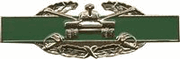
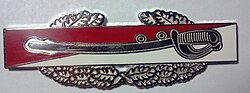
Following the introduction of the CIB, members of other branches argued that they deserved similar recognition. Although a War Department review board ruled against creating branch-specific combat badges shortly after World War II, unofficial versions began to emerge. These unsanctioned awards included the Combat Artilleryman's Badge, the Combat Tanker's Badge, and the Combat Cavalryman's Badge.
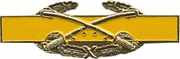
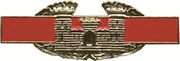
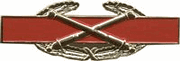
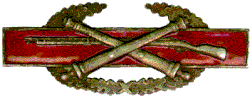
These unofficial badges were often created through improvised means. Some soldiers simply pinned their branch insignia over a CIB and repainted the blue field to match their branch color. Others manufactured custom badges, replacing the CIB's rifle with symbols such as:
- Crossed cannons on a red background for artillery.
- A tank on a green background for armor (notably using green, which was the armor color during World War II, rather than the later yellow).
- Crossed sabers on a yellow background for cavalry.
Usage and Social Reception
Because these badges were not officially sanctioned, they were rarely worn on standard utility uniforms. Instead, they were typically displayed in personal shadow boxes or worn on dress uniforms for special events, such as inspections or dinners, provided a unit commander allowed it. The most common use of these badges was on personal items, including car decals and ballcaps.
The use of these badges sometimes led to friction among soldiers. Memoirs from Korean War veterans describe tense encounters in mess halls where soldiers wearing unofficial artillery badges were confronted by peers who insisted such medals did not officially exist.
The Path to Official Recognition
The transition from unofficial traditions to official policy began in 2004 when Congressman Mark Green introduced H.R. 3950. This bill specifically sought to establish an official combat artillery badge. However, the bill did not pass through the committee.
The landscape changed significantly with the National Defense Authorization Act (NDAA) of 2005. This act initially required the Secretary of the Army to create a Combat Recognition Ribbon (CRR) to honor combat service across all branches. However, the CRR was never developed; it was instead replaced by the Close Combat Badge (CCB).
The Close Combat Badge and the Combat Action Badge
The Close Combat Badge (CCB) had very restrictive criteria. It was designed for armor, cavalry, field artillery, and combat engineer soldiers who served in units specifically reorganized to conduct infantry-unique close combat missions. To earn the CCB, a soldier had to be personally present and under fire while performing these specific missions.
Eventually, the Army moved toward a more inclusive standard by creating the Combat Action Badge (CAB). Unlike previous iterations, the CAB is available to soldiers of any branch and any unit who enter into combat with the enemy. The establishment of the CAB effectively made the old unofficial branch-specific combat badges obsolete.

Key Facts
- The Combat Infantryman Badge (CIB) was established in 1943.
- Unofficial badges for artillery, armor, and cavalry were often improvised by modifying CIBs.
- The Close Combat Badge (CCB) was limited to soldiers in units performing infantry-specific roles.
- The Combat Action Badge (CAB) is the current official award for any soldier, regardless of branch, who engages in combat.
- The Combat Recognition Ribbon (CRR) was mandated by the 2005 NDAA but never implemented.
Summary of Combat Recognition Evolution
| Award/Badge | Status | Eligibility | Primary Purpose |
|---|---|---|---|
| Combat Infantryman Badge | Official | Infantry Branch | Active ground combat |
| Unofficial Branch Badges | Unsanctioned | Artillery, Armor, Cavalry | Personal recognition of combat |
| Close Combat Badge | Official | Specific non-infantry units | Infantry-unique close combat missions |
| Combat Action Badge | Official | All branches/units | Engagement with the enemy |
Frequently Asked Questions
Why were unofficial combat badges created?
They were created because soldiers in branches other than the infantry desired a visible symbol of their active combat service, similar to the Combat Infantryman Badge.
How were unofficial badges typically made?
Some were made by pinning branch insignia over a CIB and repainting the background, while others were custom-made with symbols like crossed cannons, tanks, or crossed sabers.
What is the difference between the CCB and the CAB?
The Close Combat Badge (CCB) required soldiers to be in units specifically reorganized for infantry-style missions. The Combat Action Badge (CAB) is broader, awarded to any soldier of any branch who enters combat with the enemy.
Did the Army ever issue a Combat Recognition Ribbon?
No. Although the National Defense Authorization Act of 2005 required its creation, the Army scrapped the ribbon in favor of the Close Combat Badge.
Were unofficial badges worn on utility uniforms?
It is unlikely. Most were worn on dress uniforms for special events or displayed in personal shadow boxes, as subdued versions for utility uniforms were not officially produced.