Argentine Federal Police (PFA)
The Argentine Federal Police (Spanish: Policía Federal Argentina or PFA) serves as the national civil police force of the Argentine federal government. With a presence spanning the entire country, the PFA is tasked with federal law enforcement and security. While it maintains a national mandate, it historically provided direct policing for the capital city of Buenos Aires until a transition in 2017.
Operating under the motto "Al Servicio de la Seguridad de Estado" (To serve the community), the PFA is a civilian agency subordinate to the Ministry of National Security. It currently employs approximately 25,000 sworn members.
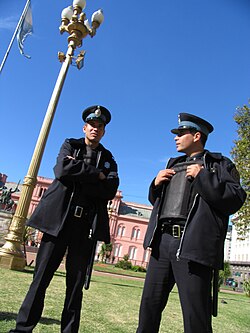
Key Facts
- Founded: December 24, 1943.
- Headquarters: Departamento Central de Policía, Buenos Aires.
- Leadership: Led by Chief Comisario General Juan Carlos Hernández.
- Jurisdiction: Federal operations across Argentina.
- Specializations: Includes federal firefighting, scientific police, and counter-terrorism.
Historical Evolution
The roots of the PFA extend back to 1580, when Captain Juan de Garay established a local militia to defend Buenos Aires against Native American raids. This evolved into the Policía de Buenos Aires, which operated until 1880. Following the federalization of the city, the force became the Policía de la Capital.
The modern PFA was established via Decree 17.750 on December 24, 1943, under President Pedro Pablo Ramírez. The transition from the Capital Police was incremental, beginning with the PFA's assignment as the Presidential Guard of the Casa Rosada in February 1944 and concluding with a full unification on January 1, 1945.
Throughout the 20th century, the PFA's role often mirrored Argentina's political climate. During various authoritarian regimes, the force was utilized as a political instrument. This included repressive campaigns against modern culture in the 1960s and participation in the abduction and torture of dissidents following the 1976 coup. The agency began restoring its public prestige and democratic relations following the 1983 elections.
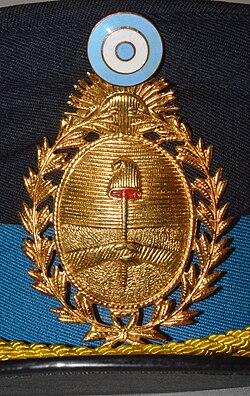
Jurisdictional Shifts in Buenos Aires
The control of the PFA in the capital was a point of contention for decades. The 1994 constitutional reform granted Buenos Aires greater self-governance, but National Law 24.588 (the "Cafiero Law") reserved control of the force for the national government. This tension persisted until January 1, 2017, when most PFA agents in the city were transferred to the newly created Buenos Aires City Police, which now handles local policing in the capital.
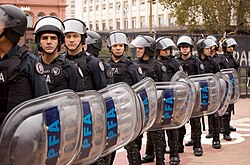
General Organization and Infrastructure
The PFA is headquartered at the Departamento Central de Policía in Montserrat, Buenos Aires. This eclectic Baroque-influenced structure, designed by Juan Antonio Buschiazzo and engineered by Francesco Tamburini, covers over 12,000 square meters and is famous for its Palm Tree Patio.
The agency is organized into several Superintendencias (Superintendencies), which manage specialized functions:
- Scientific Police: Forensic and technical investigations.
- Federal Firefighting: Serving as the state fire service.
- Dangerous Drugs: Narcotics enforcement.
- Federal Investigation: Complex federal crimes.
- Information Technologies: Communications and digital security.
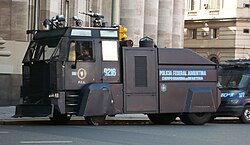
Training and Education
The PFA maintains a university specializing in criminology (the scientific study of crime and criminals) and collaborates with Interpol and the Los Angeles Police Department. Training is conducted through three primary institutions: the "Commissioner General Alberto Villar" School for Agents and NCOs, the "Colonel (AA) Ramon Falcon" Academy, and the "Commissioner General Enrique Fentanes" Staff College.
Specialized Tactical Units
The PFA maintains elite units for high-risk operations and counter-terrorism:
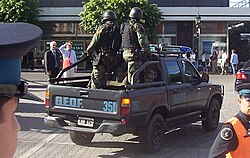
- Federal Operations Special Group (GEOF): Created after the 1994 AMIA bombing, this unit specializes in international terrorism and complex crimes, with divisions in Tucumán, Rosario, and Buenos Aires.
- Special Group One: Originally established in 1978 as Special Combat Teams for the Football World Cup, it became the premier counter-terrorism team in 1988.
Equipment and Assets
The PFA utilizes a diverse array of assets to maintain national security, managed through the Dirección General de Aviación Federal and various motorized units.
| Category | Examples / Models |
|---|---|
| Aircraft | Eurocopter EC135/EC145, MBB Bo 105, Cessna Citation I |
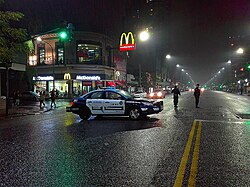
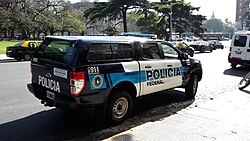
| Vehicles | Ford Ranger, Ford Focus, Iveco Daily, Mercedes-Benz Sprinter |
| Handguns | Bersa Thunder 9, Glock 17, Beretta 92 |
| Long Guns | FN FAL, HK MP5, SIG SG 552, IWI ACE, M24 SWS |
Frequently Asked Questions
What is the primary role of the Argentine Federal Police?
The PFA is the national civil police force responsible for federal law enforcement across Argentina, including specialized tasks like firefighting and counter-terrorism.
Does the PFA still police the city of Buenos Aires?
No. As of January 1, 2017, local policing responsibilities in the capital were transferred to the Buenos Aires City Police.
What is the GEOF?
The Grupo Especial de Operaciones Federales (GEOF) is a specialized unit focused on combating international terrorism and managing complex crimes, established in the wake of the 1994 AMIA bombing.
Who leads the PFA?
The agency is currently headed by Chief Comisario General Juan Carlos Hernández, supported by Deputy Chief Comisario General Osvaldo Mato.
What is the difference between a Comisario and a Superintendente?
While both are often translated as "superintendent" or "commissioner" in English, superintendente is a specific term used for those commanding the various Superintendencies within the PFA's organizational structure.