Argentina Time Zone: History and Current Standards
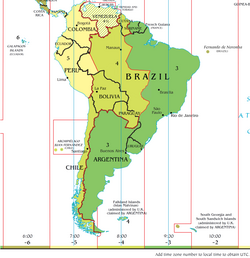
Argentina operates on a time standard that differs from its geographical longitude. While the country's position would naturally place it within the UTC−04:00 or UTC−05:00 time zones (Coordinated Universal Time), it currently utilizes UTC−03:00.
The official national time is maintained by the Argentine Hydrographic Service. While the federal government determines whether to observe daylight saving time (DST)—the practice of advancing clocks during warmer months to extend evening daylight—on a year-by-year basis, individual provinces maintain the right to opt out of these federal decisions. Currently, Argentina does not observe clock changes.
Key Facts
- Current Time Zone: UTC−03:00, known as Argentina Time (ART) or hora oficial argentina (HOA).
- Official Authority: The Argentine Hydrographic Service.
- DST Status: Not currently observed.
- Geographic Offset: The country uses a time zone further east than its natural longitude suggests.
The Evolution of Argentine Standard Time
The journey toward a standardized time in Argentina began in the late 19th century, followed by decades of fluctuations between standard and daylight saving offsets.
Early Standardization and Initial Shifts
The first official standardization occurred on October 31, 1894, establishing UTC−04:00 as the national standard. For nearly five decades, from 1920 to 1969, the country employed a biannual switch: UTC−04:00 during the winter and UTC−03:00 as daylight saving time during the summer.
The Era of Double DST
Between 1974 and 1993, the time offsets shifted further forward. During this period, the official time alternated between UTC−03:00 (winter DST) and UTC−02:00 (summer double DST).
Modern Stabilization
In 1993, the government fixed the national time at UTC−03:00. Although there was a brief return to biannual switching between UTC−03:00 and UTC−02:00 in 2007 and 2008, this was replaced in 2009 by a permanent adoption of UTC−03:00.
Time Zone Summary Table
| Period | Standard/Winter Time | Summer/DST Time | Notes |
|---|---|---|---|
| 1894 – 1920 | UTC−04:00 | N/A | First official standardization |
| 1920 – 1969 | UTC−04:00 | UTC−03:00 | Biannual switching |
| 1974 – 1993 | UTC−03:00 | UTC−02:00 | Winter DST and Summer Double DST |
| 1993 – Present | UTC−03:00 | Varies | Fixed at UTC−03:00 since 2009 |
Frequently Asked Questions
What is the current time zone in Argentina?
Argentina currently uses UTC−03:00, which is officially referred to as Argentina Time (ART) or hora oficial argentina (HOA).
Does Argentina currently use daylight saving time?
No, Argentina does not currently change its clocks for daylight saving time.
Who is responsible for maintaining the official time in Argentina?
The Argentine Hydrographic Service is the entity responsible for maintaining the official national time.
Can Argentine provinces choose their own time settings?
Yes, individual provinces may opt out of federal decisions regarding the observation of daylight saving time.
Why is Argentina's time zone different from its longitude?
While its longitude naturally aligns with UTC−04:00 or UTC−05:00, the country has officially adopted UTC−03:00 for national standardization.