Argentina 2011 Presidential Election: Cristina Fernández de Kirchner's Landslide Victory
On October 23, 2011, Argentina held general elections that resulted in a historic victory for the incumbent president, Cristina Fernández de Kirchner. Representing the Front for Victory (FPV-PJ), Fernández de Kirchner secured a second four-year term in a landslide win, capturing 54.11% of the popular vote. This victory marked a significant milestone, as she became the first woman to be re-elected as a head of state in Latin American history.
The election was characterized by a high voter turnout and a dominant performance by the ruling coalition, which not only secured the presidency but also gained substantial control over the National Congress.

Key Facts
- Winner: Cristina Fernández de Kirchner (Front for Victory) with 54.11% of the vote.
- Voter Turnout: 79.39% of the 28,916,183 registered voters.
- Historic Margin: The 37.1% margin of victory exceeded the previous record set by Juan Perón in 1973.
- Congressional Impact: The Front for Victory won 130 of the 257 seats in the Chamber of Deputies.
- Geographic Reach: The winning ticket carried 22 provinces and the City of Buenos Aires (CABA).
The Presidential Campaign
The road to the 2011 election was shaped by fluctuating approval ratings and a fragmented opposition. Following a period of decline during the 2008 conflict with the agricultural sector and a subsequent recession, President Fernández de Kirchner saw her approval ratings recover throughout 2010. By the start of the 2011 season, her job approval stood at approximately 58%.
The Front for Victory (FPV) Strategy
After initially remaining non-committal, Fernández de Kirchner announced her candidacy on June 21, 2011, naming Economy Minister Amado Boudou as her running mate. The ticket dominated the August 14 primary elections (PASO), obtaining over 50% of the vote and establishing a lead of nearly 38% over the nearest rival.
Demographic data indicated that her strongest support came from the poor (65.2%) and voters aged 30 to 44 (54.6%), while her weakest support was among the upper middle class (43.5%).
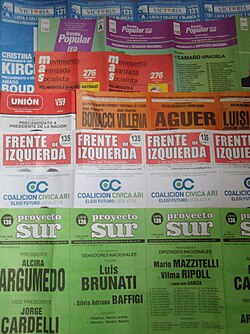
The Opposition Coalitions
The opposition was split among several coalitions and individual candidates:
- Broad Progressive Front: Led by Hermes Binner, who became the runner-up in the general election. His support was strongest among the middle and upper middle classes.
- Union for Social Development: Led by Ricardo Alfonsín, who performed strongly among voters aged 45 to 59.
- Federal Peronists: This center-right group was divided. Alberto Rodríguez Saá (Federal Commitment) and Eduardo Duhalde (Popular Front) ran on separate tickets. Rodríguez Saá was the only candidate to carry a province (San Luis).
- Civic Coalition: Led by Elisa Carrió, who withdrew from the race after receiving only 3% in the primaries.
Election Results Summary
The general election confirmed the trends seen in the primaries, with the Front for Victory securing an absolute majority in the first round, avoiding the need for a runoff.
| Candidate | Alliance/Party | Popular Vote | Percentage | States Carried |
|---|---|---|---|---|
| Cristina Fernández de Kirchner | FPV-PJ | 11,865,055 | 54.11% | 22 + CABA |
| Hermes Binner | FAP | 3,684,970 | 16.81% | 0 |
| Ricardo Alfonsín | UDESO | 2,443,016 | 11.14% | 0 |
| Alberto Rodríguez Saá | CF | 1,745,354 | 7.96% | 1 |
| Eduardo Duhalde | Federal Peronism | 1,285,830 | 5.86% | 0 |
Legislative Outcomes
Chamber of Deputies
The Front for Victory achieved a significant victory in the lower house, securing 85 seats (out of 257), representing 52.22% of the vote. This was a substantial increase of 41 seats compared to previous standings.
The Senate
The Senate results were more balanced. The Front for Victory won 15 of the 24 seats contested, maintaining a majority of 40 out of 72 total seats. A key political shift occurred with the departure of Vice President Julio Cobos (UCR), which removed a critical tie-breaking vote for the opposition.
Frequently Asked Questions
Who won the 2011 Argentine presidential election?
Incumbent President Cristina Fernández de Kirchner of the Front for Victory won the election with 54.11% of the popular vote.
What was the significance of the 2011 election results?
It was a landslide victory that made Cristina Fernández de Kirchner the first woman to be re-elected as head of state in Latin American history, with a margin of victory that broke previous historical records.
Which candidate won the most provinces besides the president?
Alberto Rodríguez Saá of the Federal Commitment alliance was the only other candidate to carry a province, winning in San Luis.
How did the Front for Victory perform in the National Congress?
The coalition won a majority in the Chamber of Deputies with 85 seats and maintained a majority in the Senate with 40 total seats.
What was the voter turnout for the presidential election?
The turnout was 79.39%, with over 22.9 million total votes cast from a registered pool of 28,916,183 voters.