Argentina 1931 Presidential Election: The Rise of the Concordancia
The general elections held in Argentina on November 8, 1931, marked a pivotal and contentious moment in the nation's political history. Occurring in the wake of the Great Depression and a military coup, these elections transitioned the country from a provisional military government to a conservative civilian administration under the Concordancia alliance.
Political Background: From Coup to Contest
The road to the 1931 election began in September 1930, when a coup d'état deposed President Hipólito Yrigoyen. Yrigoyen, the first leader elected via secret male universal suffrage, had faced mounting tension with business interests—specifically regarding the state oil company YPF—and internal fractures within his own Radical Civic Union (UCR) party.
Following the coup, General José Félix Uriburu assumed the role of Provisional President. Uriburu sought to dismantle the 1912 Sáenz Peña Law, which guaranteed the secret ballot and universal male suffrage, in favor of a single-party system reminiscent of the landowner-dominated National Autonomist Party (PAN) that had ruled from 1874 to 1916.
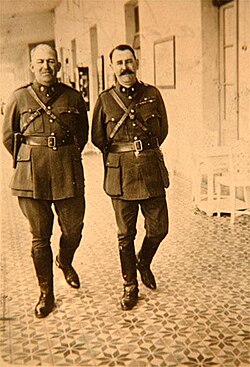
However, Uriburu's attempts at electoral reform faltered when conservatives lost gubernatorial polls in the critical Province of Buenos Aires in April 1931. This failure, combined with the rise of Marcelo Torcuato de Alvear as the leader of the UCR, prompted Uriburu to abandon his pledge to restore constitutional order. He annulled the Buenos Aires elections and utilized the Argentine Civic Legion, a fascist organization, to intimidate political opponents.
The Candidates and Alliances
The political landscape for the November polls was divided into three primary camps:
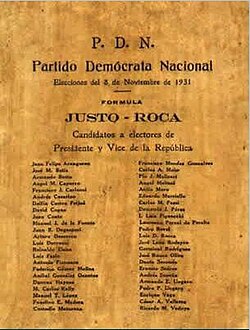
- The Concordancia: A conservative alliance supporting retired General Agustín Justo and his running mate, Julio Roca. This coalition was formed with the support of Uriburu and UCR Senator Leopoldo Melo.
- The Civil Alliance: A reformist coalition comprising the Democratic Progressive Party (PDP) and the Socialist Party of Argentina, led by Senator Lisandro de la Torre and Nicolás Repetto.
- The Independent UCR: While the main UCR boycotted the election following the deportation of Alvear, some splinter groups participated, most notably under Francisco A. Barroetaveña in Entre Ríos Province.
Election Results and the Electoral College
The election was characterized by widespread irregularities and voter intimidation, which heavily favored the Concordancia. While the popular vote showed a significant lead for Justo, the process was finalized through the Electoral College, where 189 votes were needed to win.
The Electoral College was closely divided initially, with Justo receiving 135 votes and de la Torre 124. However, various splinter UCR tickets, who held 117 electors, largely pledged their support to Justo to block the reformist de la Torre, ultimately securing Justo's presidency.
| Candidate | Alliance/Party | Popular Vote % | Electoral Votes | Outcome |
|---|---|---|---|---|
| Agustín P. Justo | Concordancia | 61.44% | 237 | Elected President |
| Lisandro de la Torre | Civil Alliance | 34.66% | 124 | Defeated |
Legislative Outcomes: Chamber of Deputies
Parallel to the presidential race, elections were held for the 158 seats of the Chamber of Deputies. The Concordancia secured a dominant majority, winning 95 seats (60.05% of the vote), while the Civil Alliance took 57 seats (34.25%). A small contingent of 6 seats was won by the Entre Ríos UCRA.
Key Facts
- Election Date: November 8, 1931.
- Voter Turnout: Approximately 73.80%.
- Winning Candidate: Agustín P. Justo (Concordancia).
- Total Registered Voters: 2,116,552.
- Legislative Control: The Concordancia won 95 of the 158 seats in the Chamber of Deputies.
- Political Context: The election followed the 1930 coup that deposed Hipólito Yrigoyen.
Frequently Asked Questions
Why did the UCR boycott the 1931 election?
The Radical Civic Union (UCR) boycotted the election after President Uriburu annulled the Buenos Aires Province elections and ordered the deportation of their leader, Marcelo Torcuato de Alvear.
What was the Concordancia?
The Concordancia was a conservative political alliance that supported General Agustín Justo, combining interests from the National Democratic Party and anti-Yrigoyen factions of the UCR.
How did Agustín Justo win the presidency?
Justo won through a combination of a strong popular vote (aided by irregularities) and the support of splinter UCR electors in the Electoral College who opposed Lisandro de la Torre.
What role did the Argentine Civic Legion play?
The Argentine Civic Legion was an armed fascist organization promoted by President Uriburu to intimidate political opposition during the lead-up to the elections.
Who was the main opponent of Agustín Justo?
The main opponent was Senator Lisandro de la Torre, representing the Civil Alliance, which consisted of the Democratic Progressive Party and the Socialist Party.