Aquilegia skinneri: The Vibrant Mexican Columbine
The Aquilegia skinneri, widely known as the Mexican columbine or Skinner's columbine, is a striking perennial flowering plant. A member of the Ranunculaceae family, this species is celebrated for its unique floral structure and vivid colors, making it a prized addition to botanical collections and gardens alike.
Key Facts
- Common Names: Mexican columbine, Skinner's columbine.
- Native Range: Mexico and Guatemala.
- Flower Characteristics: Nodding blooms with straight red nectar spurs.
- Growth Habit: Perennial herb reaching 60 to 100 cm in height.
- Primary Use: Cultivated as a garden ornamental.
Botanical Description
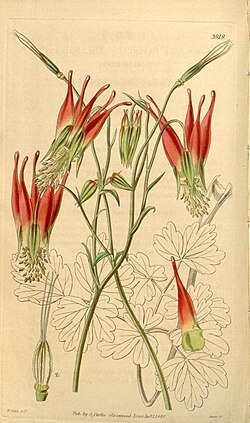
Aquilegia skinneri typically grows to a height of 60 to 100 cm (24 to 39 in). Its foliage consists of basal leaves that are long-stalked and feature hairy undersides. These leaves are triternate, meaning they are divided into three main branches, which further divide into three parts, each ending in three leaflets.
The flowers are the most distinctive feature of the plant. They are nodding in posture and measure between 5.5 to 7.5 cm (2.2 to 3.0 in) in length and 3.5 to 4 cm (1.4 to 1.6 in) in width. The sepals are spreading and greenish-yellow, measuring 18 to 24 mm (0.71 to 0.94 in) long. Most notably, the petals feature straight red nectar spurs that extend 3.5 to 5 cm (1.4 to 2.0 in).
Taxonomy and History
The species was first described in 1842 by William Jackson Hooker in Curtis's Botanical Magazine. The description was based on seeds collected by George Ure Skinner (1804–1867), who was reported to have gathered them in Guatemala.
The taxonomic history of the plant has seen several revisions. In the same year as the original description, Hooker described Aquilegia mexicana, which is now recognized as a synonym for A. skinneri. Later, in 1909, Joseph Nelson Rose described Aquilegia madrensis based on samples from Mexico's Sierra Madre. Because these samples shared a similar morphology, A. madrensis is also now considered part of the same species.
Interestingly, the initial belief that the plant was native to Guatemala may have been a result of mislabeled samples in England. Evidence suggests that Skinner's original samples were actually collected in Chihuahua, located in northern Mexico.
Distribution and Ecology
Aquilegia skinneri is native to Guatemala and Mexico. Within Mexico, its distribution is widespread, appearing in the following states:
- Chiapas, Chihuahua, and Colima
- Durango, Guerrero, and Hidalgo
- Jalisco, Mexico, and Oaxaca
- Sinaloa, Sonora, Veracruz, and Zacatecas
In terms of its ecological cycle, the plant typically flowers during the summer months.
Summary Table
| Feature | Details |
|---|---|
| Scientific Name | Aquilegia skinneri Hook. |
| Family | Ranunculaceae |
| Plant Height | 60–100 cm |
| Flower Color | Greenish-yellow sepals with red nectar spurs |
| Native Regions | Mexico and Guatemala |
| Conservation Status | Not yet assessed (IUCN Red List) |
Frequently Asked Questions
What is the origin of the name "Skinner's columbine"?
Both the specific epithet "skinneri" and the common name are derived from George Ure Skinner, the collector who provided the seeds used for the plant's first scientific description.
What are the physical characteristics of the leaves?
The leaves are basal, long-stalked, and hairy on the underside. They are triternate, meaning they follow a triple-division pattern of branching and leaflets.
Is Aquilegia skinneri an endangered species?
As of November 2024, the species has not yet been assessed for the IUCN Red List, so there is no official conservation status.
Where is this plant commonly used today?
Due to its striking appearance, Aquilegia skinneri is frequently cultivated as an ornamental plant in gardens.
Which other species names are now considered synonyms for A. skinneri?
Aquilegia mexicana and Aquilegia madrensis are both now considered to be the same species as Aquilegia skinneri.