Aquilegia paui: The Rare Spanish Columbine Facing Extinction
Hidden within the rugged mountains of northeastern Spain lies a botanical rarity: Aquilegia paui. This perennial flowering plant, a member of the columbine genus, is a striking example of extreme endemism, meaning it is found in one specific location and nowhere else on Earth. For decades, this delicate species remained a mystery to the scientific community, nearly lost to history due to taxonomic confusion and a lack of field observations.
Today, A. paui serves as a critical case study in plant conservation, illustrating how easily a species can slip into anonymity when its identity is misunderstood or its habitat is encroached upon by human activity.
Key Facts
- Scientific Name: Aquilegia paui
- Family: Ranunculaceae (Buttercup family)
- Native Range: Ports de Tortosa-Beseit massif, Tarragona, Spain
- Status: Threatened; highly vulnerable due to limited range
- Primary Threats: Overgrazing, human construction, and low genetic diversity
- Reproduction: Primarily through rhizome spreading and self-fertilization (autogamy)
Botanical Description and Characteristics
Aquilegia paui is a herbaceous perennial that typically grows between 6 cm and 20 cm tall. The plant features a rootstock that can be simple or branching, from which one or two glandular and pubescent (covered in small hairs) stems emerge each year. The density of these hairs generally increases toward the top of the stem.
The plant's foliage consists of basal leaves arranged in rosettes. These leaves are 10 mm to 4 cm long, featuring long petioles (leaf stalks). While the topsides of the leaves are glabrous (hairless), the undersides are often glaucous (a blue-grey color). The flowers, which bloom primarily between mid-May and early July, are a beautiful bluish-purple to whitish color, measuring 20 mm to 30 mm in diameter.
Flower Structure and Pollination
Like other columbines, the flowers of A. paui possess a unique structure consisting of five sepals and five petals. Each petal features a broad limb and an elongated nectar spur that extends backward to hold nectar. Interestingly, A. paui often has fewer petals (between one and four) and produces less nectar than its relatives.
While many flowering plants rely on insects, studies have shown that A. paui receives very few insect visits. Instead, the species relies heavily on autogamy, or self-fertilization. This ability to self-pollinate helps the plant survive in isolated environments where pollinators may be scarce.
Taxonomic History: A Century of Confusion
The history of A. paui is a cautionary tale for botanists. Named by the Spanish botanist Pius Font i Quer in 1917 and first described in 1920, the species was later misidentified. Due to a mistake in herbarium specimens where A. paui was mixed with the more common Aquilegia vulgaris, scientists spent much of the 20th century believing A. paui was merely a subspecies of the common columbine.
It was not until a rediscovery in 1999 in the Parc Natural dels Ports that the species was recognized as distinct. Subsequent studies in 2001, 2003, and 2007 confirmed its status as a unique species, noting significant morphological differences such as smaller leaves and fewer flowers compared to A. vulgaris.
Ecology and Habitat
The species is extremely restricted to the Ports de Tortosa-Beseit massif in the Province of Tarragona, Catalonia. It thrives in specific microclimates, preferring rocky outcrops, calcareous cliffs, and screes (slopes covered in loose rock). It is typically found at elevations between 990 m and 1,390 m above sea level, often in shady, north-facing locations.
| Feature | Aquilegia paui | Aquilegia vulgaris |
|---|---|---|
| Habitat Preference | Rocky cliffs and screes | Moist, shady areas |
| Flower Size | Smaller (20–30 mm) | Larger |
| Pollination Method | Primarily self-fertilizing | Open-pollination (insects) |
| Leaf Size | Smaller | Larger |
Conservation Challenges
As of 2011, the population was estimated at approximately 2,000 individuals spread across four small subpopulations. Despite this, the species is considered highly vulnerable. Several factors threaten its continued existence:
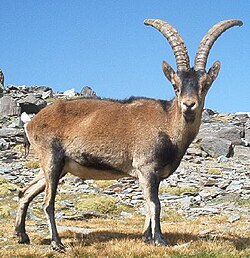
- Predation: The native Southeastern Spanish ibex frequently consumes the plant's leaves, stems, and fruit. It is estimated that up to 30% of the fruit may be lost to predation before maturity.
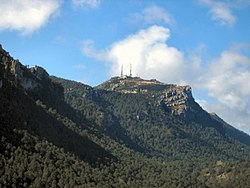
- Human Activity: Construction, such as telecommunication facilities on Mont Caro, has been linked to population declines in certain areas.
- Genetic Risks: Low genetic diversity and a limited geographic range make the species susceptible to environmental changes and disease.
- Reproductive Difficulty: While the plant spreads well via rhizomes (underground stems), it does not reproduce effectively through seeds, making ex situ conservation (preservation outside the natural habitat) difficult.
Frequently Asked Questions
Why is Aquilegia paui so rare?
The species is an extreme endemic, meaning its entire natural range is limited to a very small area within the Ports de Tortosa-Beseit massif in Spain. This narrow geographic distribution makes it highly susceptible to localized threats.
How does the plant reproduce?
While A. paui produces seeds, it appears to be more proficient at reproducing through the spreading of its rhizomes. It also utilizes autogamy, which is the ability to self-fertilize.
What is the difference between Aquilegia paui and Aquilegia vulgaris?
Unlike the widespread A. vulgaris, A. paui has smaller leaves, fewer flowers, and fewer fruit follicles. It also prefers rocky, cliffside habitats rather than the moist, shady areas favored by A. vulgaris.
Does the Spanish ibex affect the plant?
Yes. The Southeastern Spanish ibex preys on the plant, consuming its basal leaves, flowering stems, and fruit. This grazing can pose a risk to the survival of the plant populations.
Can Aquilegia paui be grown in gardens?
While other columbine species are common in gardens, studies suggest that cultivating A. paui would be difficult due to its poor ability to reproduce via seed.