Aquilegia glandulosa: The Altai and Siberian Columbine
The Aquilegia glandulosa, commonly known as the Altai columbine or Siberian columbine, is a striking perennial flowering plant. A member of the Ranunculaceae family, this species is native to the rugged landscapes of northern and central Asia, where it has adapted to high-altitude environments.
Key Facts
- Common Names: Altai columbine, Siberian columbine.
- Native Range: North-central Asia, including Russia, China, Kazakhstan, Mongolia, and India.
- Habitat: Alpine meadows, stream-banks, and rocky areas at 1,900–2,700 meters.
- Bloom Period: June through August.
- Distinctive Feature: Strongly hooked incurved nectar spurs and pubescent (fuzzy) pistils.
Botanical Description
Aquilegia glandulosa is a compact plant, typically reaching heights of only 20–40 cm (7.9–15.7 in). Its foliage consists of narrow, blue-green basal leaves that are biternate, meaning the leaflets are divided twice into smaller segments.
The flowers are the most prominent feature of the species, measuring between 6 and 9 cm (2.4–3.5 in) in diameter. They feature blue sepals and petals that can be either white or blue. A defining characteristic of these flowers is the presence of nectar spurs—tubular extensions of the petals—which measure 6–12 mm (0.24–0.47 in) in length.
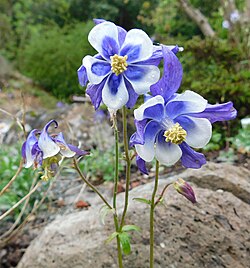
Distinguishing from Similar Species
To the untrained eye, Aquilegia glandulosa looks very similar to Aquilegia flabellata (the fan columbine). However, botanists distinguish the two by observing the pistils, which are pubescent in A. glandulosa, and the nectar spurs, which are strongly hooked and incurved.
Taxonomy and Etymology
The scientific name Aquilegia glandulosa is derived from Latin, with the specific epithet glandulosa meaning "glandular" or "having glands."
Taxonomically, this species is believed to be most closely related to Aquilegia sibirica. Research suggests that the two diverged during the mid-Pleistocene epoch, a period of significant climatic fluctuation.
Distribution and Habitat
This species is widely distributed across north-central Asia. Its native range encompasses several regions, including:
- Russia: Altai, Buryatia, Irkutsk Oblast, Khanty-Mansi Autonomous Okrug, Krasnoyarsk Krai, Sakha Republic, Tuva, Yamalo-Nenets Autonomous Okrug, and Zabaykalsky Krai.
- Other Nations: Kazakhstan, Mongolia, China (Xinjiang), and India (Jammu and Kashmir).
The plant primarily thrives in alpine meadows at altitudes ranging from 1,900 to 2,700 m (6,200–8,900 ft). While meadows are its primary home, it is also occasionally found in forest zones, clinging to rocks or growing along the banks of streams.
| Feature | Details |
|---|---|
| Height | 20–40 cm |
| Flower Diameter | 6–9 cm |
| Nectar Spur Length | 6–12 mm |
| Altitude Range | 1,900–2,700 m |
| Flowering Season | June to August |
Frequently Asked Questions
What is the difference between Aquilegia glandulosa and Aquilegia flabellata?
While they appear similar, Aquilegia glandulosa is distinguished by its pubescent pistils and nectar spurs that are strongly hooked and incurved.
Where is the Altai columbine naturally found?
It is native to north-central Asia, specifically in Russia, Kazakhstan, Mongolia, China, and India, typically in high-altitude alpine meadows.
What does the name "glandulosa" mean?
The term comes from Latin and means "glandular" or "having glands."
When does Aquilegia glandulosa bloom?
The plant typically flowers between the months of June and August.
What is the conservation status of this species?
Aquilegia glandulosa has not yet been assessed for the IUCN Red List.