Angle of Incidence: Principles of Geometric Optics and Illumination
In the study of physics and geometry, the angle of incidence is a fundamental concept used to describe how waves interact with a surface. Whether dealing with light, sound, or electromagnetic radiation, understanding this angle is essential for predicting how a ray will reflect or refract when it hits a boundary.
The Fundamentals of Geometric Optics
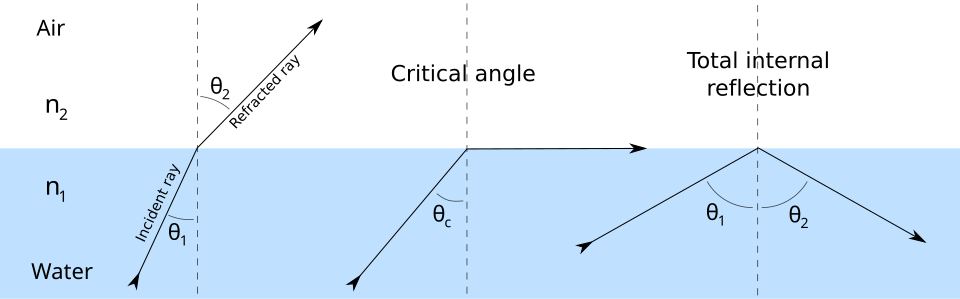
In geometric optics, the angle of incidence is defined as the angle formed between an incident ray—a ray striking a surface—and the normal. The normal is an imaginary line drawn perpendicular (at a 90-degree angle) to the surface at the exact point where the ray makes contact.
While often associated with visible light, these principles apply to any wave-based ray, including acoustic (sound), microwave, and X-ray waves.
Related Optical Angles
The angle of incidence is closely linked to other critical measurements in optics:
- Angle of Reflection: The angle at which a ray bounces off a surface.
- Angle of Refraction: The angle at which a ray bends as it passes from one medium into another.
- Critical Angle: The specific angle of incidence at which light is first totally internally reflected, rather than passing through the boundary.
Applications in Geography and Computer Graphics
Beyond pure physics, the angle of incidence is utilized in geography and computer graphics, where it is frequently referred to as the illumination angle. This describes the relationship between a light source, such as the Sun, and a surface, such as the Earth.
In this context, the angle can be described as the difference between the tangent plane of the surface and a plane positioned at right angles to the light rays. For example, if the Sun is positioned precisely overhead, the illumination angle is 0°. Conversely, during sunrise or sunset, the illumination angle reaches 90°.
Calculating Reflection on Different Surfaces
The complexity of calculating the angle of reflection depends entirely on the geometry of the surface. For a planar surface (a flat plane), determining the angle of reflection is trivial. However, for almost any other surface shape, the computation becomes significantly more difficult, a concept often explored in the study of specular reflection.
Key Facts
- The angle of incidence is measured between the incident ray and the normal (a perpendicular line).
- It applies to optical, acoustic, microwave, and X-ray waves.
- The critical angle is the point where total internal reflection begins.
- In geography, an illumination angle of 0° means the light source is directly overhead.
- Reflection calculations are simple for flat surfaces but complex for non-planar surfaces.
| Term | Definition/Value | Context |
|---|---|---|
| Normal | Line perpendicular (90°) to the surface | Geometric Optics |
| Critical Angle | Angle causing total internal reflection | Refraction/Optics |
| 0° Illumination | Light source is precisely overhead | Geography/Graphics |
| 90° Illumination | Light source is at the horizon (sunrise/sunset) | Geography/Graphics |
Frequently Asked Questions
What is the "normal" in the context of the angle of incidence?
The normal is a reference line that is drawn perpendicular to the surface at the point where the incident ray strikes, forming a 90-degree angle with the surface.
Does the angle of incidence only apply to light?
No. While common in optics, the angle of incidence applies to any wave, including X-rays, microwaves, and acoustic waves.
What happens at the critical angle?
The critical angle is the specific angle of incidence at which light is first totally internally reflected instead of being refracted into the second medium.
How is the illumination angle measured on Earth?
It is measured as the angle between the surface's tangent plane and a plane at right angles to the light rays; it is 0° when the Sun is overhead and 90° at sunrise or sunset.
Why is calculating reflection difficult for some surfaces?
While reflection from a flat, planar surface is straightforward, surfaces with curves or irregularities make the computation of the reflection angle significantly more complex.