Ancient Murrelet: The Remarkable Long-Distance Voyager of the North Pacific
The ancient murrelet (Synthliboramphus antiquus) is a small, captivating member of the auk family. Known for its distinctive appearance and extraordinary migratory patterns, this seabird is a true marvel of the North Pacific. The term "murrelet" is a diminutive of "murre," while the "ancient" descriptor stems from the grey plumage on its back, which resembles a shawl worn by the elderly.
Key Facts
- Scientific Name: Synthliboramphus antiquus
- Conservation Status: Least Concern (IUCN 3.1), though listed as Special Concern in Canada.
- Migration: The only bird known to cross the entire North Pacific Ocean.
- Diet: Primarily crustaceans and small mesopelagic fish.
- Unique Trait: Spends less time on land than any other bird species.
Taxonomy and Origins
Formally described in 1789 by German naturalist Johann Friedrich Gmelin, the ancient murrelet was originally placed in the genus Alca. It is now classified under the genus Synthliboramphus, a name introduced in 1837 by Johann Friedrich von Brandt. The genus name is derived from the Ancient Greek sunthlibō ("to compress") and rhamphos ("bill"), while the specific epithet antiquus is Latin for "ancient."
There are two recognized subspecies: S. a. antiquus, found from northeast Asia and the Aleutian Islands to western Canada, and S. a. microrhynchos, which is native to the Commander Islands of eastern Russia.
Physical Description and Flight
This small auk is characterized by a black head, throat, and rear neck, contrasted by a grey back and white underparts. Its bill is short, stubby, and yellow, and it possesses a small, rounded black tail. During the summer, adults develop white head streaks that contribute to their "aged" appearance.
In the air, ancient murrelets exhibit a distinct flight style, banking from side to side more significantly than other small auks. Because they have short wings, they maintain flight with rapid, fast wing beats.
Physical Specifications
| Measurement | Range |
|---|---|
| Length | 7.9–9.4 in (20–24 cm) |
| Weight | 5.4–8.8 oz (150–250 g) |
| Wingspan | 17.7–18.1 in (45–46 cm) |
Distribution and Extraordinary Migration
The ancient murrelet breeds across the North Pacific, from the islands off China in the Yellow Sea, through the Russian Pacific coast and Aleutian Islands, to the Haida Gwaii archipelago in British Columbia. Approximately half of the global population breeds in Haida Gwaii.
This species is renowned for its incredible migration. Some individuals travel 8,000 kilometers (5,000 miles) from Canada to winter near China and Japan. Genetic evidence suggests the species originated in Asia, meaning this migration is a return to their ancestral homeland. While most stay in the Pacific, rare sightings have occurred far afield, including a bird that visited Lundy Island in England for three consecutive springs starting in 1990, and sightings in Finland in 2021.
Behavior, Diet, and Breeding
Like other auks, ancient murrelets use their wings for propulsion to swim underwater while foraging. Their diet varies by season: crustaceans dominate in winter, while small fish and crustaceans are consumed in summer. In Haida Gwaii, stable isotope analysis indicates a preference for small mesopelagic fish (fish that live in the mid-water zone of the ocean).
Nesting and Rearing
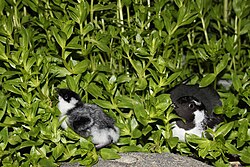
Ancient murrelets nest in colonies, often in burrows excavated in forest soil, under logs, among tree roots, or in rock crevices. To avoid predation, they arrive at and depart from nesting grounds under the cover of night.
Their rearing process is unique: chicks are never fed at the nest. Instead, they are taken to sea just 1–3 days after hatching. Parents and chicks recognize each other by call; once the chicks reach the water, the family swims up to 30 miles (48 km) away from land, often traveling for at least twelve hours. The young are then fed exclusively at sea for over a month.
Conservation Status
While listed as Least Concern globally, the ancient murrelet is of Special Concern in Canada. The primary threat has been the introduction of invasive mammalian predators, specifically rats, which were brought to breeding islands by ships in the 1800s. On one island, the population plummeted from 200,000 breeding pairs to roughly 14,000.
To combat this, the "Night Birds Returning" project was launched in 2009. This $2.5 million initiative, involving Parks Canada and the Haida Nation, focused on eradicating rats in the Gwaii Haanas National Park Reserve and Haida Heritage Site. Eradication efforts included ground-based removal and aerial drops of poisoned pellets, as even a single pregnant rat can repopulate an island within two years.
Frequently Asked Questions
Why is it called the "ancient" murrelet?
It is called "ancient" because the grey feathers on its back resemble a shawl, which was traditionally associated with the clothing of elderly people.
What makes its migration unique?
It is the only bird species known to cross the entire North Pacific Ocean, traveling up to 8,000 kilometers between its breeding grounds in Canada and wintering grounds near Asia.
How do the chicks survive without being fed in the nest?
The chicks leave the burrow 1–3 days after hatching and are led to the ocean by their parents' calls. Once at sea, they are fed exclusively by their parents for more than a month.
What is the biggest threat to their population?
Invasive rats introduced to breeding islands have been the most significant threat, as they prey on the birds and their eggs, drastically reducing colony sizes in some areas.
Where is the largest breeding population located?
About half of the world's ancient murrelet population breeds in the Haida Gwaii archipelago of British Columbia, with one of the largest colonies found on Frederick Island.