Anchors: Types, Mechanics, and Maritime Applications
An anchor is a specialized metal device designed to secure a vessel to the bed of a body of water. By gripping the seafloor, it prevents a craft from drifting due to the influence of wind or currents. The term originates from the Latin ancora, which is derived from the Greek ankȳra.
Anchors are categorized into two primary types: temporary and permanent. Permanent anchors are used to establish a mooring—a fixed point that is rarely moved and typically requires professional services for maintenance. In contrast, vessels carry one or more temporary anchors of varying designs and weights to suit different environments.
Key Facts
- Purpose: Prevents vessel drift by securing the craft to the seabed.
- Scope: The ratio of the anchor rode (cable) to the water depth; higher ratios generally increase holding power.
- Materials: Traditionally made of metal, with modern variants using aluminum alloys or galvanized steel.
- Evolution: Design has progressed from ancient fluked anchors to specialized high-holding scoop and plough types.
- Permanent vs. Temporary: Permanent anchors create moorings, while temporary anchors are carried aboard the ship.
Types of Anchors
Fluked and Classical Anchors
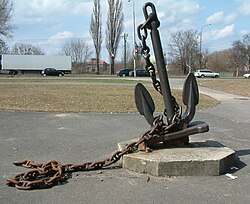
Fluked anchors have been used since antiquity, appearing in Roman Nemi ships from the 1st century AD and Viking Ladby ships from the 10th century. These designs typically feature a shank and flukes that penetrate the bottom at an angle to hook into the seabed.
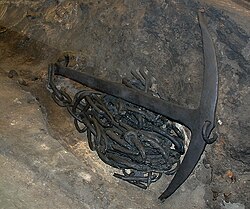
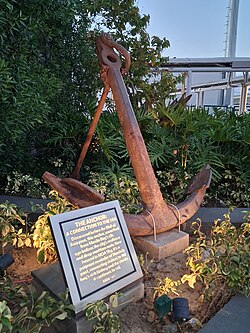
The Admiralty Anchor is a reinvention of this classical design. It remained largely unchanged for centuries, though stocks transitioned from wood to iron in the late 1830s and early 1840s. The stock forces one of the flukes into the bottom upon deployment.
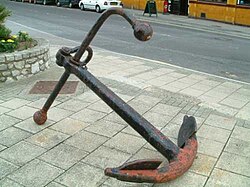
Stockless Anchors
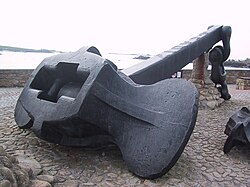
Patented in England in 1821, the stockless anchor marked a major shift in maritime engineering. While they offer a lower holding-power-to-weight ratio than Admiralty patterns, they are far easier to handle and store on large ships. They are hauled up so the shank rests inside the hawsepipes (the holes in the hull through which the cable passes), with the flukes resting against the hull or in an anchor box.
Small Boat and Specialized Anchors
For smaller vessels, a variety of specialized designs exist to balance weight and holding power:
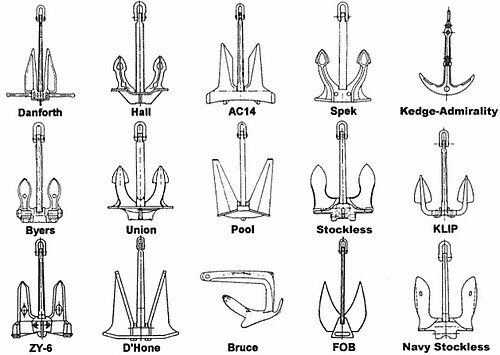
- Plough Anchors: Based on the 1933 CQR (Coastal Quick Release) design by Geoffrey Ingram Taylor, these resemble agricultural ploughs.
- Danforth Anchors: Invented in the 1940s for landing craft, these use hinged, flat triangular flukes that bury deep into the seabed.
- Bruce (Claw) Anchors: Designed by Peter Bruce in the 1970s, these are highly effective in larger sizes and are popular on charter fleets for their ability to set quickly.
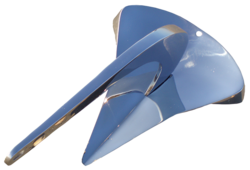
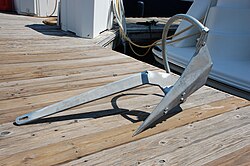
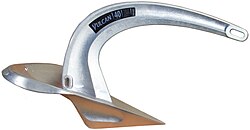
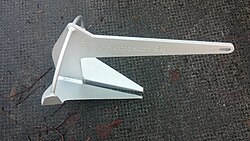
- Scoop Anchors: Including the Bügel, Spade, and Rocna designs, these use a concave, shovel-like fluke to dig deeper as more pressure is applied.
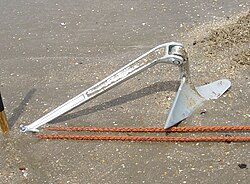
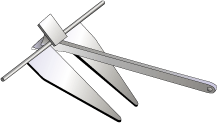
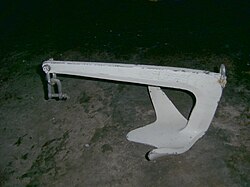
![A galvanised Rocna Anchor [38]](/images/e6/1d/e61d25e73a2325a176e4ee61e785d2a0794ce9cdee0d898170fd5ce2ca50c9e0.jpg)
Permanent Anchors
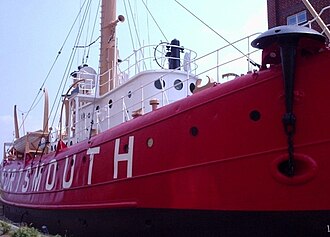
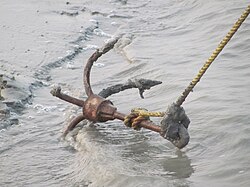
Permanent anchors, such as the mushroom anchor, are ideal for silt or fine sand. Invented by Robert Stevenson around 1807 for lightvessels, the mushroom shape allows the device to embed itself firmly into the soft bottom over time.
Anchoring Mechanics and Gear
The Anchor Rode and Scope
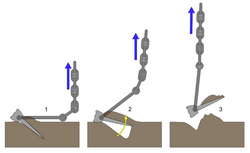
The rode is the cable or chain connecting the anchor to the vessel. The scope is the ratio of the length of this rode to the vertical distance from the bow roller to the seabed.
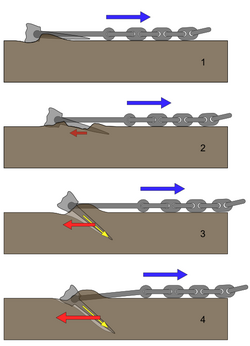
In moderate conditions, a scope of 4:1 is common. In rougher weather, this may increase to 8:1 or more to reduce the angle of the cable, which prevents the anchor from breaking out of the seabed. A 10:1 scope provides maximum holding power but increases the vessel's drifting radius.
![Massive anchor chain for large ships. The weight of the chain is vital for proper holding of the anchor.[1]](/images/90/db/90db046f7cef26481ad7c0d557ae0dbfd5a91d1fca80c79cdfbf826b000c6964.jpg)
Deployment Hardware
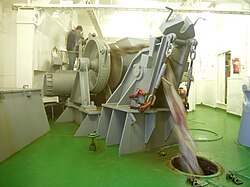
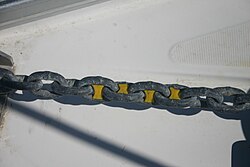
Modern ships use a windlass (anchor winch) to manage the heavy chain. To assist the operator, some modern chains feature colored plastic inserts that indicate exactly how much chain has been paid out.
Advanced Mooring Techniques
- Forked Moor: Using two anchors set approximately 45° to 90° apart from the bow to face strong winds and limit the vessel's swing.
- Bow and Stern: Setting an anchor at both ends of the vessel to align it with specific wind or current conditions and severely limit swing range.
Summary of Anchor Types
| Anchor Type | Primary Use | Key Characteristic | Bottom Type |
|---|---|---|---|
| Stockless | Large Ships | Easy stowage in hawsepipes | General |
| Danforth | Small Boats | Hinged flukes for deep burial | Sand/Mud |
| Bruce/Claw | Small/Medium Boats | High first-try set rate | Various |
| Plough (CQR) | General Purpose | Agricultural plough shape | General |
| Mushroom | Permanent Mooring | Self-embedding shape | Silt/Fine Sand |
| Scoop (Rocna/Spade) | High Holding | Concave blade design | Weed/Grass/Sand |
Symbolism and History
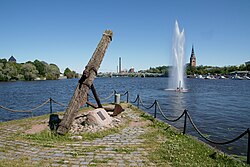
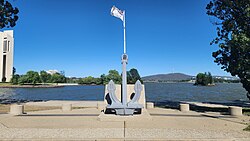
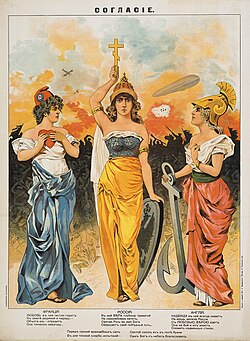
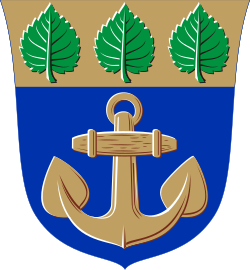
Beyond utility, the anchor is a powerful symbol. In heraldry, it appears in the coat of arms of Mariehamn and is associated with the Mariner's Cross (St. Clement's Cross). It has historically symbolized naval power and stability, as seen in statues of Peter the Great and early 20th-century political posters.

Frequently Asked Questions
What is anchor scope and why does it matter?
Scope is the ratio of the length of the anchor rode to the depth of the water. A proper scope ensures the pull on the anchor is nearly parallel to the seabed, which maximizes holding power and prevents the anchor from being pulled vertically out of the bottom.
What is the difference between a stock and a stockless anchor?
A stock anchor has a crossbar (the stock) that forces the flukes to dig into the seabed. A stockless anchor lacks this bar, allowing it to be pulled directly into a hull recess (hawsepipe), making it much easier to store on large commercial vessels.
Which anchor is best for sandy or muddy bottoms?
The Danforth anchor is highly effective for sand and mud due to its large, flat flukes that bury deeply. Mushroom anchors are also specifically suited for permanent moorings in silt or fine sand.
How does a scoop anchor work?
Scoop anchors, such as the Rocna or Spade, use a concave, shovel-like fluke. They are designed to dig into the seabed like a shovel, increasing their grip as more tension is applied to the line.
What is a forked moor?
A forked moor involves setting two anchors at an angle (usually 45° to 90°) from the bow. This creates a stronger hold against strong winds and narrows the area in which the vessel can swing.