Analytical Chemistry: Methods, Evolution, and Modern Applications
Analytical chemistry is the specialized branch of chemistry dedicated to developing and applying methods to identify the chemical composition of materials and quantify the amounts of components within mixtures. Whether identifying an unknown compound in a solution or determining the exact concentration of a substance in a gas, this field provides the essential tools for scientific discovery and quality control.
The discipline focuses on two primary goals: identifying what is present (qualitative analysis) and determining how much of it exists (quantitative analysis). This can be measured in terms of amount of substance, concentration, percentage by mass, or number of moles.
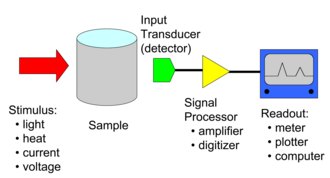
Key Facts
- Scope: Covers both classical techniques (titration, gravimetry) and modern instrumental methods (spectroscopy, mass spectrometry).
- Core Goals: Qualitative analysis (identification) and Quantitative analysis (measurement).
- Modern Trends: Shift toward automation, miniaturization, real-time sensing, and "big data" integration.
- Sustainability: The rise of Green Analytical Chemistry aims to reduce the environmental footprint of chemical testing.
- Interdisciplinary Reach: Essential for forensics, medicine, archaeology, and environmental monitoring.
The Evolution of Chemical Analysis
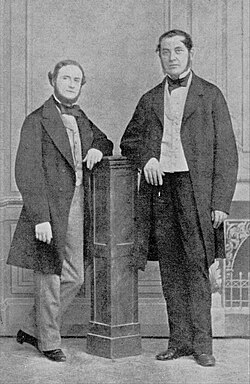
The journey of analytical chemistry began with foundational instrumental analysis. In 1860, Robert Bunsen and Gustav Kirchhoff developed flame emissive spectrometry, a breakthrough that led to the discovery of the elements rubidium (Rb) and caesium (Cs).
Most significant advancements occurred after 1900, as instrumental analysis began to dominate the field. The early 20th century saw the birth of basic spectroscopic and spectrometric techniques, which were further refined toward the end of the century. By the 1970s, the field expanded into bioanalytical chemistry, moving beyond inorganic and small organic molecules to address complex biological questions.
In the 21st century, the field has been transformed by digitalization. The use of high-resolution instruments, such as Orbitrap mass spectrometers, generates massive datasets, making machine learning and chemometrics (the application of mathematical and statistical methods to chemical data) indispensable for interpreting results.
Classical vs. Instrumental Methods
Analytical chemistry is broadly divided into classical methods and instrumental approaches.
Classical Methods
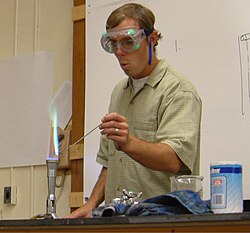
Classical methods rely on basic chemical reactions and physical properties. Qualitative analysis uses chemical tests, such as the flame test, to identify elements based on characteristic colors.
Quantitative analysis measures the exact amount of a constituent. This is achieved through:
- Gravimetric analysis: Measuring the mass of a substance.
- Volumetric analysis: Measuring the volume of a solution (e.g., titration).
Instrumental Methods
Modern analysis utilizes sophisticated hardware to achieve higher precision and speed. Key categories include:
- Spectroscopy: Studying the interaction between matter and electromagnetic radiation.
- Mass Spectrometry: Measuring the mass-to-charge ratio of ions to identify molecules.
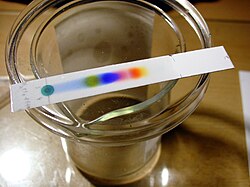
- Chromatography: Separating components of a mixture for individual analysis.
- Electrochemical Analysis: Using electrical properties to study chemical species.
- Thermal Analysis: Studying material properties as a function of temperature.
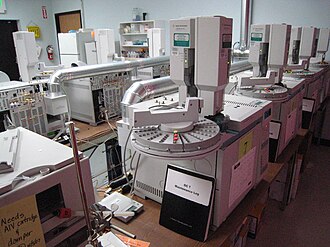
To increase accuracy, scientists often use hybrid techniques (hyphenated techniques), where two instruments are linked—such as gas chromatography-mass spectrometry (GCMS)—to provide a complete characterization of a sample.
Precision, Errors, and Signal Quality
A critical aspect of analytical chemistry is managing the relationship between the true value and the observed value. Errors are often expressed as relative or percent errors to determine the accuracy of a measurement.
To ensure reliability, chemists use standard curves and internal standards. One specialized approach is standard addition, where known concentrations of an analyte are added to an unknown sample to overcome the "matrix effect," where other components in the sample interfere with the measurement.
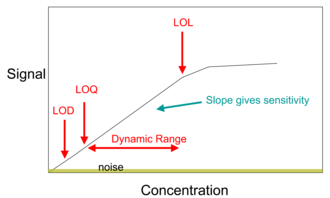
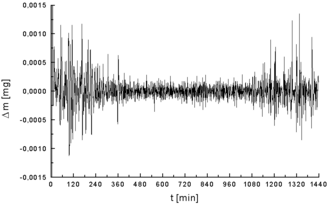
Another primary challenge is maximizing the signal-to-noise ratio (S/N). Noise can stem from various sources:
- Thermal noise: Random fluctuations caused by the movement of electrons.
- Flicker noise: Low-frequency noise (1/f spectrum) often caused by impurities in conductive channels.
- Environmental noise: External interference from human activity or the surroundings.
Broad Applications in Science and Industry
Analytical chemistry is the backbone of numerous professional fields. In forensic science, it enables DNA fingerprinting and toxicology. In clinical analysis, it powers blood glucose monitoring and PCR testing for viruses like COVID-19.
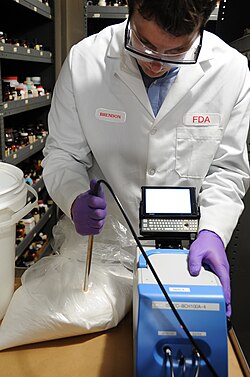
Other applications include environmental monitoring for pollutants, materials science for semiconductor quality control, and archaeology through radiocarbon dating.
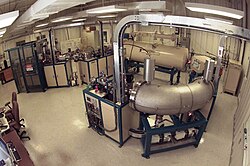
Recent innovations have led to Lab-on-a-chip technology, which integrates multiple laboratory functions onto a single miniature chip for rapid, point-of-care diagnostics.
![Fluorescence microscope image of two mouse cell nuclei in prophase (scale bar is 5 μm)[31]](/images/b5/04/b5043eea3ad839d135c0df75524cd55949af4c53882d288db71c0fafd0adc22a.jpg)
| Approach | Primary Goal | Common Examples | Key Characteristic |
|---|---|---|---|
| Qualitative | Identification | Flame tests, Chemical tests | Determines "What" is present |
| Quantitative | Measurement | Titration, Gravimetry | Determines "How much" is present |
| Instrumental | High-precision analysis | GCMS, Spectroscopy, NMR | Uses electronic sensors/detectors |
| Hybrid | Complete characterization | LC-MS, GC-MS | Combines separation and identification |
Frequently Asked Questions
What is the difference between qualitative and quantitative analysis?
Qualitative analysis is used to identify the chemical species present in a sample (the "what"), while quantitative analysis determines the exact amount or concentration of those species (the "how much").
What is the "matrix effect" in chemical analysis?
The matrix effect occurs when components of a sample other than the analyte interfere with the measurement. This is often solved using the method of standard addition.
What is Green Analytical Chemistry?
Green Analytical Chemistry is a subfield focused on sustainability, aiming to minimize the environmental impact of chemical analyses by reducing toxic waste and energy consumption.
How does signal-to-noise ratio affect results?
The signal-to-noise ratio (S/N) determines the clarity of the data. A higher ratio means the desired signal is stronger than the background noise, leading to more accurate and reliable measurements.
What are hyphenated techniques?
Hyphenated techniques are hybrid methods that combine a separation technique (like chromatography) with an identification technique (like mass spectrometry) to provide a comprehensive analysis of complex mixtures.