Amethyst: The Science, History, and Value of the Purple Quartz
Amethyst is a striking violet variety of natural quartz, prized for millennia for its vivid color and crystalline beauty. From the royal regalia of medieval Europe to the intricate jewelry of ancient Egypt, this semiprecious stone has transitioned from a rare "cardinal gem" to one of the most popular gemstones in the world. Whether found as a towering geode or a faceted jewel, amethyst combines a rich cultural legacy with fascinating geological properties.
Key Facts
- Chemical Composition: Silicon dioxide (SiO2).
- Color Origin: Caused by irradiation and iron (Fe) impurities.
- Hardness: 7 on the Mohs scale.
- Crystal System: Trigonal.
- Primary Sources: Brazil, Uruguay, Zambia, and Russia.
- Birthstone: February.
The Science of Amethyst
Amethyst belongs to the tectosilicate mineral category and is a variety of quartz. Its chemical formula is silica (silicon dioxide, SiO2). Structurally, it consists of a rigid three-dimensional network of tetrahedra, where silicon atoms are centered and surrounded by four oxygen atoms. This rigid structure provides the mineral with its characteristic hardness and resistance to weathering.
The signature purple hue is not inherent to pure quartz but is the result of complex crystal lattice substitutions. When trivalent iron (Fe3+) replaces silicon in the lattice and is exposed to irradiation, it forms a [FeO4] color center. This process, combined with trace elements of large ionic radius, produces the violet tones.
Physical and Optical Properties
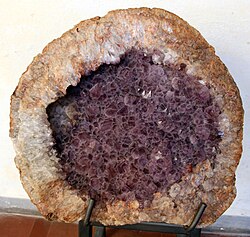
Amethyst typically forms as six-sided prisms ending in six-sided pyramids. It possesses a vitreous (glassy) luster and exhibits a conchoidal fracture, meaning it breaks along smooth, curved surfaces. Optically, it is uniaxial and dichroic, showing different shades of reddish-violet and bluish-violet depending on the angle of observation.
| Property | Value/Description |
|---|---|
| Crystal Class | Trapezohedral (32) |
| Mohs Hardness | 7 |
| Refractive Index | nω = 1.543–1.553; nε = 1.552–1.554 |
| Melting Point | 1,650 ±75 °C |
| Specific Gravity | 2.65 (constant) |
| Streak | White |
Hue, Tone, and Varieties
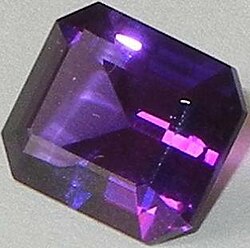
Amethyst colors range from pale lavender to deep purple. The most coveted grade is "Deep Siberian," characterized by a primary purple hue of 75–80%, with secondary blue (15–20%) and occasional red flashes. A lighter, lilac shade is known as "Rose de France."
Color zoning is common, with the most intense saturation often appearing at the crystal terminations. It is also important to distinguish amethyst from its relatives: prasiolite is the scientific name for green quartz (sometimes called green amethyst), while ametrine is a naturally occurring hybrid of amethyst and citrine.
The Effect of Heat and Light
Amethyst is sensitive to environmental changes. Prolonged exposure to light can cause the color to fade. When subjected to heat, amethyst loses its dichroism and turns yellow-orange or brownish, often resembling citrine. In the jewelry trade, much of the "citrine" sold is actually heat-treated amethyst.
Geographic Distribution and Mining
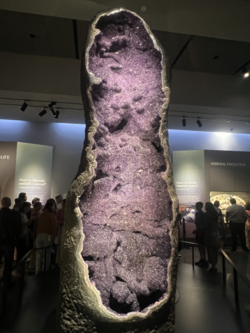
Amethyst is found globally, though production is concentrated in a few key regions. Brazil and Uruguay are world leaders, where amethyst frequently occurs in large geodes—hollow, rounded rocks lined with crystals—within volcanic rocks.
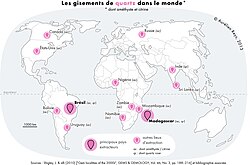
Other significant producers include Zambia, which produces approximately 1,000 tons annually, and Russia, where high-quality crystals are found in granitic rocks near Mursinka. In North America, the largest mine is located in Thunder Bay, Ontario, while the United States sees production in Arizona and Georgia. Amethyst is also the official state gemstone of South Carolina.
History and Cultural Significance
The word "amethyst" derives from the Koine Greek amethystos, meaning "not intoxicated." The ancient Greeks believed the stone could prevent drunkenness, a belief that led them to carve drinking vessels from the mineral.
Throughout history, the stone has held various meanings:
- Ancient Egypt: Used extensively for intaglio engraved gems.
- Medieval Europe: Soldiers wore amethyst amulets for protection in battle to remain cool-headed.
- Religious Symbolism: Anglican bishops often wear amethyst rings, referencing the Apostles' sobriety at Pentecost.
- Eastern Traditions: Tibetans consider the stone sacred to the Buddha and use it for prayer beads.
Value and Market
Until the 18th century, amethyst was considered one of the five "cardinal gems," ranking alongside diamonds, rubies, sapphires, and emeralds. However, the discovery of massive deposits in Brazil shifted its status to a semiprecious stone.
Unlike many gemstones, the value of amethyst is driven primarily by color depth rather than carat weight. While "Deep Russian" amethyst remains rare and valuable to collectors, the general availability of the stone keeps it accessible for mainstream jewelry.
Synthetic Amethyst and Treatment
Laboratory-grown amethyst is created via hydrothermal growth, using a high-pressure autoclave to simulate natural conditions. Additionally, clear quartz can be artificially turned into amethyst through irradiation (gamma rays, X-rays, or electron beams) after being doped with ferric impurities.
Frequently Asked Questions
How can I tell the difference between natural and heat-treated amethyst?
Natural amethyst is dichroic (showing reddish-violet and bluish-violet hues). When amethyst is heated to look like citrine, it loses this dichroism, which distinguishes it from genuine natural citrine.
Why does amethyst change color in the sun?
Amethyst is sensitive to light and heat. Overexposure to strong light sources can cause the iron-based color centers to destabilize, leading to a fading of the purple tone.
What is the best way to clean and care for amethyst jewelry?
Because it is sensitive to heat, you should avoid using steamers or ultrasonic cleaners. Use gentle cleaning methods and avoid prolonged exposure to direct sunlight to preserve the color.
Is amethyst a precious or semiprecious stone?
Historically, it was a precious cardinal gem. However, due to the abundance of large deposits found in the 18th century, particularly in Brazil, it is now classified as a semiprecious stone.