Altitudinal Migration: Seasonal Movement Across Elevation Gradients
While many people envision migration as a journey across continents, some of the most critical animal movements happen vertically. Altitudinal migration is a short-distance migration where animals move from lower altitudes to higher altitudes and back again. Unlike long-distance latitudinal migration, these shifts occur along an elevation gradient, typically in response to seasonal changes in climate and food availability.
This behavior is most prevalent in temperate and tropical ecosystems, particularly among species inhabiting montane (mountainous) areas. While most commonly observed in birds, altitudinal migration is also found in other vertebrates and a small number of invertebrates. These movements can occur during both reproductive and non-reproductive seasons, ensuring that animals remain in the most resource-rich environment possible throughout the year.
Key Facts
- Definition: Seasonal movement between different elevations to optimize survival and reproduction.
- Distribution: Occurs on every continent except Antarctica.
- Primary Drivers: Food abundance, reproductive needs, and avoidance of nest predation.
- Common Taxa: Highly prevalent in birds (especially frugivores and nectarivores) and mountain ungulates.
- Environmental Risks: Highly susceptible to climate change and deforestation of migration corridors.
Regional Patterns and Characteristics
Altitudinal migration is documented globally, though our understanding of it varies by region. In temperate zones, these patterns are well-studied, whereas tropical ecosystems remain less understood despite documented cases. Generally, as elevation increases, species richness—the number of different species in a given area—decreases.
Tropical altitudinal migrants often share specific traits. Many are frugivores (fruit-eaters) or nectarivores (nectar-eaters). They typically move to higher elevations during breeding seasons and return to lower areas during non-breeding periods. Interestingly, some populations exhibit partial migration, where only a portion of the group migrates while others remain year-round. This can be sex-biased; for example, in juncos, males are less likely to migrate than females.
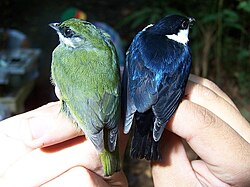
The white-ruffed manakin (Corapipo altera) serves as a primary example of these traits, combining a fruit-based diet with a predictable breeding-season migration cycle.
Species That Migrate Altitudinally
Birds
Avian species are the most prominent altitudinal migrants. In the tropics, hummingbirds shift elevation based on the abundance of nectar. Other neotropical examples include the resplendent quetzal and at least 16 species of raptors, including the Andean condor (Vultur gryphus), which typically breed in the high Andes and move to lowlands during non-breeding seasons.
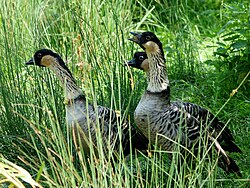
The Hawaiian goose, or Nene, exhibits a unique pattern: it occupies lower elevations during breeding and molting seasons, moving to higher elevations during non-breeding periods.
In temperate regions, species such as the American robin, mountain chickadee, and American dipper are known to migrate altitudinally.
Mammals
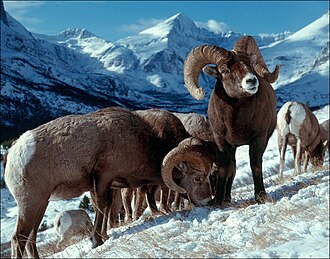
Among mammals, altitudinal migration is common in ungulates (hoofed mammals) of the Rocky Mountains, including bighorn sheep, mountain goats, and roe deer.
Tropical mammals are less documented, though some tropical bat species exhibit this behavior. In temperate bat species, migration is often sex-biased, with females moving to lower elevations during reproductive periods.
Invertebrates
While vertebrates are the primary focus of study, as of 2021, there are a few documented examples of invertebrates that also engage in altitudinal migration.
The Drivers of Vertical Movement
Determining the ultimate causes of altitudinal migration is challenging due to the difficulty of tracking small animals via mark-and-recapture techniques. However, several leading hypotheses exist:
Food Abundance and Nutrition
The most accepted theory is that species follow peaks in food abundance along the mountain slope. Frugivorous birds, for instance, move upward to exploit seasonal fruit peaks. This provides a competitive advantage over sedentary species by allowing migrants to forage over a larger area and increase nutrient uptake.
Reproduction and Nest Predation
Reproductive needs often dictate movement. Many hummingbirds in Monteverde increase their altitude during the wet season to breed. Additionally, some passerine birds migrate to higher altitudes to reduce the risk of nest predation. Research in Costa Rica indicates that predation is often highest at intermediate altitudes and lower at higher elevations.
Anthropogenic Influence
Human activity is increasingly driving species to higher altitudes, adding a man-made layer to natural migratory patterns.
Conservation and Environmental Impact
Altitudinal migrants are highly vulnerable to environmental shifts. Because over 30% of birds and other species in montane forests migrate altitudinally, any disruption can trigger a trophic cascade—a series of indirect effects that ripple through the entire food web.
| Threat | Effect on Migration | Ecological Consequence |
|---|---|---|
| Climate Change | Shifted timing of migration | Mismatch between arrival and resource availability |
| Deforestation | Disruption of migration corridors | Narrower, limited migration paths |
| Global Warming | Upward range shifts | Mountaintop extinction and lowland biotic attrition |
| Pattern Shifts | Altered movement of frugivores | Decreased efficiency of seed dispersal |
Deforestation is particularly damaging because many species require closed forest corridors to move safely between lowland and montane habitats. Furthermore, because tropical frugivorous birds are key agents of seed dispersal across different life zones, a change in their migration patterns can hinder the spread of plant species and weaken ecological linkages.
Frequently Asked Questions
What is the difference between altitudinal and latitudinal migration?
Latitudinal migration involves moving north or south across latitudes (often across continents), while altitudinal migration involves moving up and down in elevation within a smaller geographic area.
Why do some animals move to higher altitudes to breed?
Animals may move higher to exploit seasonal peaks in food abundance or to find safer nesting sites with a lower risk of predation.
How does climate change affect these species?
Climate change can cause animals to migrate too early, arriving at breeding sites before food resources have developed, or force them higher up the mountain until there is no habitat left, leading to mountaintop extinction.
Which animals are the most common altitudinal migrants?
Birds are the most common, particularly those that eat fruit or nectar, followed by mountain ungulates like bighorn sheep and mountain goats.
Can humans influence altitudinal migration?
Yes, through anthropogenic influences such as deforestation, which destroys the forest corridors animals use to move between elevations, and through climate change.