AlphaStation Workstations: A Comprehensive History of Digital and Compaq Models
The AlphaStation series represented a pinnacle of high-performance computing during the 1990s, leveraging the powerful Alpha RISC (Reduced Instruction Set Computer) architecture. These machines were designed for demanding professional workloads, evolving from standalone workstation designs to configurations based on the robust AlphaServer line, starting with the XP900 model.
Key Facts
- Architecture Evolution: Progressed through several CPU generations, including the EV4, EV45, EV5, EV56, EV6, and EV7.
- Memory Scalability: Memory capacities grew from early 8 MB minimums to as much as 32 GB in later models like the ES40.
- Form Factors: Available in various enclosures including Desktop, Tower, and Pedestal designs.
- Integration: Later AlphaStation models were essentially workstation configurations of corresponding AlphaServer models.
The Avanti Family
The Avanti family served as the early foundation for AlphaStation, utilizing the 21064 (EV4) and 21064A (EV45) processors. These systems were primarily available in desktop and tower enclosures, offering a balance of performance and expandability through PCI and ISA slots.
Models like the 200 4/100 (code-named Mustang) launched in early 1995, while the 400 series provided tower-based options for users requiring more expansion capabilities.
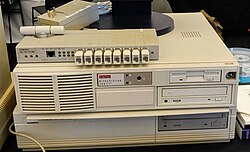
The Alcor, Noritake, and Rawhide Families
As the architecture matured, the Alcor family introduced the 21164 (EV5) and 21164A (EV56) CPUs. This era saw a significant jump in clock speeds, reaching up to 500 MHz in the 500/500 model, and the introduction of larger B-caches (Back-side cache) to improve data throughput.
The Noritake and Rawhide families further pushed these boundaries. The Rawhide family, specifically the 1200 (code-named DaVinci), introduced multi-processor support with up to two CPUs and expanded memory capacity up to 4 GB. Notably, a variant of the AlphaStation 1200 was marketed as the Digital Ultimate Workstation 533.
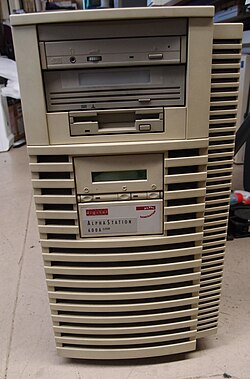
The Tsunami Family
The Tsunami family marked a transition toward the 21264 (EV6) series. This generation introduced 100 MHz SDRAM (Synchronous Dynamic Random Access Memory) and PCI-X slots for faster peripheral communication. The XP1000, introduced in February 1999, exemplified this era with its tower design and 21264 processor.
High-end models like the ES40 (Clipper) offered massive scalability, supporting up to four CPUs and a staggering 32 GB of memory, bridging the gap between a workstation and a full-scale server.
Titan and Marvel Families
The final evolution of the AlphaStation line included the Titan and Marvel families. The Titan series utilized the 21264C (EV68CB) processor, hitting the 1 GHz milestone. The Marvel family, specifically the ES47, moved to the 21364 (EV7) processor, incorporating on-die cache and high-speed RDRAM (Rambus Dynamic RAM) to maximize bandwidth.
| Family | Key CPU | Max CPUs | Max Memory | Enclosure Types |
|---|---|---|---|---|
| Avanti | 21064 / 21064A | 1 | 512 MB | Desktop, Tower |
| Alcor | 21164 / 21164A | 1 | 1 GB | Desktop, Pedestal |
| Rawhide | 21164A | 2 | 4 GB | Pedestal |
| Tsunami | 21264 / 21264A/B | 4 | 32 GB | Desktop, Tower, Pedestal |
| Titan/Marvel | 21264C / 21364 | 2 | 16 GB | Desktop, Tower |
Frequently Asked Questions
What was the relationship between AlphaStations and AlphaServers?
Starting with the XP900 model, AlphaStations were no longer distinct designs but were instead workstation configurations of the existing AlphaServer models.
Which AlphaStation was the first to reach 1 GHz?
The Titan family, including the DS15A and DS25 models using the 21264C (EV68CB) processor, reached the 1000 MHz (1 GHz) mark.
What was the maximum memory supported by the Tsunami family?
The ES40 (Clipper) model within the Tsunami family supported up to 32 GB of 100 MHz SDRAM.
Did any AlphaStations support multiple processors?
Yes, several models supported multiple CPUs, including the Rawhide 1200 (up to 2), the DS20E (1 or 2), and the ES40 (1 to 4).
What memory technology did the Marvel family use?
The Marvel family, specifically the ES47, utilized RDRAM (Rambus Dynamic RAM) for its memory subsystem.