Allies of World War IIBig FourUnited Nations DeclarationGrand AllianceWorld War II military coalition

Allies of World War II: The Grand Alliance That Defeated the Axis

Allies of World War II: The Grand Alliance That Defeated the Axis The Allies, formally known as the United Nations from 1942 onward, were a massive international military coalition that f...

Allies of World War II: The Grand Alliance That Defeated the Axis

The Allies, formally known as the United Nations from 1942 onward, were a massive international military coalition that formed during World War II (1939–1945). This alliance was established with the singular goal of opposing the Axis powers. While dozens of nations eventually joined the cause, the coalition was anchored by the "Big Four": the United Kingdom, the Soviet Union, the United States, and China.

The formation of this alliance was not instantaneous but evolved through a series of diplomatic shifts, invasions, and shared existential threats. From the early days of the Franco-Polish alliance to the eventual creation of the modern United Nations, the Allied effort represented one of the most complex diplomatic and military undertakings in human history.

Wartime poster for the United Nations, created in 1941 by the U.S. Office of War Information

Key Facts

"Long live the victory of the Anglo-Soviet-American military alliance!" – USSR stamp of 1943, quoting Stalin
  • The Big Four: The primary leadership consisted of the United Kingdom, Soviet Union, United States, and China.
  • Formal Name: The coalition was formally referred to as the United Nations starting in 1942.
  • Foundational Document: The Declaration by United Nations, signed on January 1, 1942, unified the original 26 signatories.
  • Key Conferences: Strategic coordination occurred at the Tehran, Yalta, and Potsdam conferences.
  • Global Reach: The alliance included governments-in-exile, resistance factions, and associated powers across every inhabited continent.

Origins of the Grand Alliance

Three men, Chiang Kai-shek, Roosevelt and Churchill, sitting together elbow to elbow
The Allied leaders of the Pacific War: Chiang Kai-shek, Franklin D. Roosevelt, and Winston Churchill meeting at the Cairo Conference in 1943

The Early Conflict (1939–1941)

The war began on September 1, 1939, when Germany invaded Poland. In response, Britain and France declared war on Germany on September 3. While the Soviet Union invaded Poland from the east on September 17, it initially remained officially neutral in the conflict between Germany and the Western Allies.

For the first two years, the United Kingdom and France led the effort, though France fell in June 1940. During this period, the UK became the central hub for coordinating the war effort, hosting various governments-in-exile.

Expansion of the Coalition

The alliance shifted dramatically in 1941. In June, the Axis invaded the Soviet Union, pushing Stalin toward the Allies. By September 1941, the Soviet Union adopted the Atlantic Charter—a joint declaration of goals for the post-war world. The coalition expanded further on December 7–8, 1941, when Japan attacked American and British territories in Asia and the Pacific, prompting the United States to enter the war. China, which had been resisting Japanese invasion since 1937, formally declared war on the Axis on December 9.
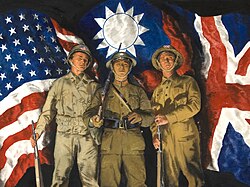
An Allied propaganda poster of a US, Chinese and British Soldier lining up with their National Flags
An Allied propaganda poster of a US, a Chinese, and a British soldier lining up in front of their national flags.

The Big Four and the Declaration by United Nations

Free French forces at the Battle of Bir Hakeim, 1942

In December 1941, during the First Washington Conference, President Franklin D. Roosevelt proposed the name "United Nations" for the coalition, a suggestion Winston Churchill accepted. On January 1, 1942, the leaders of the Big Four signed the Declaration by United Nations. The following day, 22 other allied nations signed. Notably, the Free French were excluded at this time because the U.S. still recognized the Vichy government in France.

Three men, Stalin, Roosevelt and Churchill, sitting together elbow to elbow
The Allied leaders of the European theatre (left to right): Joseph Stalin, Franklin D. Roosevelt and Winston Churchill meeting at the Tehran Conference in 1943

Major Allied Powers and Their Contributions

FAFL Free French GC II/5 "LaFayette" receiving ex-USAAF Curtiss P-40 fighters at Casablanca, French Morocco

United Kingdom and the British Empire

Following the fall of France, the UK served as the primary coordinator for the Allied effort. The British Empire, including India, provided vast manpower and resources. The UK acted as the de facto representative for many governments-in-exile throughout the war.

The Soviet Union

The Soviet Union bore a massive burden on the Eastern Front. Its forces were diverse, including millions of troops from the Central Asian Republics: approximately 1.4 million from Uzbekistan, over 1 million from Kazakhstan, and over 700,000 from Azerbaijan.

Soviet soldiers fighting in the ruins of Stalingrad during the Battle of Stalingrad

The United States

The U.S. played a dual leadership role. In the Pacific theatre, it led the fight against Japanese forces from 1941 to 1945. In Europe, from 1943 to 1945, the U.S. coordinated the Western Allies' efforts under the command of General Dwight D. Eisenhower.

U.S. soldiers departing landing craft during the Normandy landings on 6 June 1944 known as D-Day

China

China's war effort involved two primary factions: the Nationalists and the Communists. While often at odds, both resisted Japanese occupation. In August 1945, the Soviet invasion of Manchuria further impacted the region, with Mao Zedong planning the mobilization of up to 250,000 soldiers to assist Soviet forces.

Soldiers of the National Revolutionary Army associated with Nationalist China, during the Second Sino-Japanese War

Other Allied States and Resistance Movements

The French fleet scuttled itself rather than fall into the hands of the Axis after their invasion of Vichy France on 11 November 1942.

Beyond the Big Four, numerous nations contributed to the victory. This included the Free French, who fought in Africa and Europe after the fall of France, and the Polish forces, who fought both in the West (such as the No. 303 "Kościuszko" Fighter Squadron) and in the East alongside the Soviets.

Resistance movements also played a critical role. In Yugoslavia, the Partisans led by Josip Broz Tito and the Chetniks led by General Mihailovic fought Axis occupiers, though they often represented different political visions for the future.
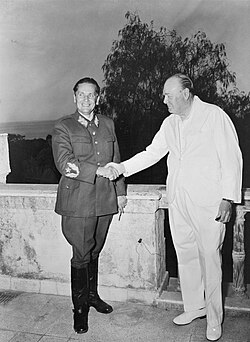
Partisan leader Marshal Josip Broz Tito with Winston Churchill in 1944

Summary of Allied Participation

The following table outlines the entry and status of key Allied nations.

Key Allied Nations and Their Entry into the War
Country Declaration by UN Declared War on Axis Role/Status
United Kingdom 1942 1939 Big Four / Lead Coordinator
Soviet Union 1942 1941 Big Four / Eastern Front
United States 1942 1941/42 Big Four / Pacific & Western Lead
China 1942 1941 Big Four / Asian Theatre
France 1944 1939/40/41/44 Allied / Free French Forces
Poland 1942 1941 Allied / Government-in-Exile
Canada 1942 1939/40/41 Allied / British Empire
Australia 1942 1939/40/42 Allied / British Empire

Frequently Asked Questions

The fall of Damascus to the Allies, late June 1941. A car carrying Free French commanders General Georges Catroux and General Paul Louis Le Gentilhomme enters the city, escorted by French Circassian cavalry (Gardes tcherkesses).
Soviet soldiers and T-34 tanks advancing near Bryansk in 1942
Soviet Il-2 ground attack aircraft attacking German ground forces during the Battle of Kursk, 1943
American Douglas SBD Dauntless dive-bombers onboard the USS Enterprise during the Battle of Midway, 4 June 1942
Philippine Scouts at Fort William McKinley firing a 37 mm anti-tank gun in training, circa 1941
Soldiers of the First Workers' and Peasants' Army associated with Communist China, during the Sino-Japanese War
Victorious Chinese Communist soldiers holding the flag of the Republic of China during the Hundred Regiments Offensive
Members of the Belgian Resistance with a Canadian soldier in Bruges, September 1944 during the Battle of the Scheldt
Norwegian soldiers on the Narvik front, May 1940
Pilots of the No. 303 "Kościuszko" Polish Fighter Squadron during the Battle of Britain
Polish partisan of the Home Army (AK), "Jędrusie" unit, holding a Browning wz.1928 light machine gun
Partisans and Chetniks escorting captured Germans through Užice, autumn 1941
Chetniks leader General Mihailovic with members of the U.S. military mission, Operation Halyard, 1944
The dead bodies of Benito Mussolini, his mistress Clara Petacci, and several Fascist leaders, hanging for public display after they were executed by Italian partisans in 1945
Poster with V for Victory
U.S. government poster showing a friendly Soviet soldier, 1942
Flags of the Allies as of 1943, after the entry of Iraq and Bolivia

Who were the "Big Four" of the Allies?

The Big Four were the United Kingdom, the Soviet Union, the United States, and China. These nations provided the primary military and political leadership for the coalition.

When did the Allies become known as the "United Nations"?

The term "United Nations" was proposed by Franklin D. Roosevelt in December 1941 and formally adopted in the Declaration by United Nations on January 1, 1942.

Why were the Free French not original signatories of the 1942 Declaration?

The Free French were not invited to sign the original declaration because the United States still recognized the Vichy government, which had been established in France after its defeat by Germany.

What was the role of the Soviet Union in the alliance?

The Soviet Union joined the Allies in 1941 after the Axis invasion. It fought the primary land war against Germany on the Eastern Front and later intervened against Japan in Manchuria in 1945.

How did the alliance transition into the post-war era?

The wartime coalition laid the groundwork for the formal United Nations organization, established between April and June 1945, which aimed to maintain international peace and security after the war.

References

  1. "On the political front, the Soviet Union and Great Britain had signed an agreement in Moscow on July 12, 1941. Requested by Stalin as a sign of cooperation, it provided for mutual assistance and an understanding not to negotiate or conclude an armistice or peace except by mutual consent. Soviet insistence on such an agreement presumably reflected their suspicion of Great Britain, though there is no evidence that either party to it ever ceased to have its doubt about the loyalty of the other if attractive alternatives were thought to be available." See Weinberg (2005) pp. 284-285.
  2. "The Anglo-American alliance was the most formidable, intricate and, in many ways, harmonious military alliance in history." See Bouverie (2025) p. xii.
  3. China had been in an undeclared war with Japan since 18 September 1931. It declared war on Japan, Germany and Italy on 9 December 1941 and joined the Allies in December 1941 after the attacks on Pearl Harbor.
  4. France declared war on Germany on 3 September 1939, two days after the German invasion of Poland. It was a member of the Allies until its defeat in the German invasion of France in June 1940. Unlike the other governments-in-exile in London, which were legitimate governments that had escaped their respective countries and continued the fight, France had surrendered to the Axis. The "Free French Forces" were a section of the French army which refused to recognize the armistice and continued to fight with the Allies. They worked towards France being seen and treated as a major allied power, as opposed to a defeated and then liberated nation. They struggled with legitimacy vis-a-vis the German client state "Vichy France", which was the internationally recognized government of France even among the Allies. A National Liberation Committee was formed by the Free French after the gradual liberation of Vichy colonial territory, which led to the full German occupation of Vichy France in 1942. This started a shift in Allied policy from trying to improve relations with the Vichy regime into full support to what was now the Provisional Government of the French Republic.
  5. Poland was allied with the United Kingdom and France, and was attacked by Germany and the Soviet Union in 1939. The government-in-exile continued to fight alongside the Western Allies. It also signed the alliance with the Soviet Union on 30 July 1941, which was broken by the Soviets on 25 April 1943. Subsequently, the puppet, created in Moscow, Union of Polish Patriots fought against Germany and Polish Underground State alongside the Soviets.