All the King's Men (2006): A Political Drama of Power and Corruption
Released in 2006, All the King's Men is an American political drama that delves into the seductive and destructive nature of power. Written, directed, and produced by Steven Zaillian, the film is an adaptation of the 1946 Pulitzer Prize-winning novel by Robert Penn Warren. While the story had previously been adapted into a Best Picture Oscar-winning film in 1949, Zaillian's version sought to bring a fresh perspective to this classic tale of ambition and betrayal.
The narrative centers on the rise and fall of Willie Stark, a charismatic and idealistic small-town lawyer who ascends to the governorship of a state in the American South. The character of Stark is loosely based on the real-life Louisiana governor Huey Long, who served from 1928 to 1932 and was later assassinated in 1935 after being elected as a U.S. senator.
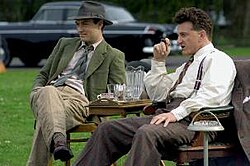
Key Facts
- Director/Writer: Steven Zaillian
- Based On: The 1946 novel by Robert Penn Warren
- Lead Cast: Sean Penn, Jude Law, and Kate Winslet
- Budget: $55 million
- Box Office: $9.5 million worldwide
- Release Date: September 22, 2006
- Running Time: 128 minutes
Plot Summary: The Ascent and Fall of Willie Stark
The story is told through the eyes of Jack Burden, a Louisianan news reporter. Burden becomes fascinated by Willie Stark, a parish treasurer and lawyer. Encouraged by local political leader Tiny Duffy, Stark enters the race for governor. Burden, who has deep ties to the political elite through his godfather Judge Irwin and his friend Dr. Adam Stanton, joins Stark's campaign as a reporter.
Burden soon discovers that Duffy is using Stark as a pawn to split the opposing party's vote. Upon learning this, Stark defies Duffy's strategy, adopting a straightforward, populist approach. By attacking political corruption and promising infrastructure like schools and roads for the common people—whom he refers to as "ignorant hicks"—Stark wins the election and appoints Duffy as his lieutenant governor.
As governor, Stark delivers on his promises but becomes increasingly consumed by power. He employs patronage (the appointment of people to government positions as a reward for political support) and intimidation to maintain control. His relationship with the elite sours, particularly with Judge Irwin, who leads investigations into Stark's spending. In a ruthless move to silence his critics, Stark forces Burden to uncover a decades-old bribe involving Judge Irwin, a revelation that eventually leads to the judge's suicide.
The tragedy culminates when Stark's corruption extends to the public hospital project headed by Adam Stanton. Combined with the discovery of Stark's affair with Adam's sister, Anne, Adam is driven to assassination. Adam kills Stark at the state capitol, only to be killed instantly by the governor's bodyguard. It is later revealed that Adam was manipulated into the murder by Duffy and Sadie Burke, allowing Duffy to seize the governorship.
Production and Cast
The film featured a high-profile ensemble cast, including Sean Penn as Willie Stark, Jude Law as Jack Burden, and Kate Winslet as Anne Stanton. Other notable performances came from Anthony Hopkins, James Gandolfini, and Mark Ruffalo. The production was filmed on location in Louisiana, including New Orleans, Morgan City, Donaldsonville, and the Louisiana State Capitol in Baton Rouge.

The film's atmosphere was supported by a score composed and conducted by James Horner, performed by the Hollywood Studio Symphony. The soundtrack, released in 2007, includes thematic pieces such as "The Rise to Power" and "Verdict and Punishment."
Critical Reception and Box Office Performance
Despite the pedigree of its cast and crew, All the King's Men was a significant critical and commercial failure. It grossed only $9.5 million worldwide against a $55 million budget, earning it a place among notable box-office bombs.
Critics were largely unimpressed, with the film receiving a 12% approval rating on Rotten Tomatoes. Reviewers criticized the narrative cohesiveness and Sean Penn's performance. A.O. Scott of The New York Times described the film as "overwrought and tedious." However, some critics, such as Richard Schickel of Time and Kenneth Turan of the Los Angeles Times, praised the film's moral seriousness and its faithfulness to the tone of the original novel.
| Metric | Detail |
|---|---|
| Production Budget | $55 Million |
| Worldwide Gross | $9.5 Million |
| Rotten Tomatoes Score | 12% |
| Metacritic Score | 37/100 |
| CinemaScore | B− |
Frequently Asked Questions
Who was the character Willie Stark based on?
Willie Stark is a fictional character loosely based on Huey Long, the governor of Louisiana from 1928 to 1932 and a U.S. senator who was assassinated in 1935.
How did the film perform at the box office?
The film was a commercial failure, grossing approximately $9.5 million worldwide against a production budget of $55 million.
What was the critical consensus of the movie?
The majority of critics gave the film negative reviews, citing a lack of narrative cohesiveness and poor political insight, though a few praised its ensemble acting and moral depth.
Who composed the music for All the King's Men?
The film's score was composed and conducted by James Horner and performed by the Hollywood Studio Symphony.
Was the 2006 film the first adaptation of the novel?
No, the novel was previously adapted into a film in 1949, which won the Academy Award for Best Picture.