Alice Eastwood: The Heroic Botanist Who Saved California's Natural History
In the annals of scientific history, few figures stand as tall as Alice Eastwood. A self-taught botanist whose passion for plant life spanned nearly a century, Eastwood was not only a prolific researcher but a guardian of precious biological heritage. Her legacy is defined by her immense contributions to the study of Western United States flora and her legendary bravery during one of San Francisco's darkest hours.
Key Facts
- Scientific Impact: Authored 395 land plant species names, the fourth-highest number for any female scientist.
- Major Achievement: Saved 1,497 vital type specimens from the 1906 San Francisco earthquake and subsequent fires.
- Career Longevity: Served as Curator of the Botany Department at the California Academy of Sciences until age 90.
- Scientific Recognition: Seventeen recognized species and three genera are named in her honor.
- Publications: Published over 310 scientific articles throughout her career.
Early Life and Self-Taught Beginnings
Born on January 19, 1859, in Toronto, Canada West, Alice Eastwood's journey to scientific prominence began far from the laboratories of San Francisco. After moving to Denver, Colorado, as a teenager, she worked as a school teacher to support herself. It was during these years that her botanical passion took root; she used her modest salary to fund summer expeditions into the Colorado mountains, collecting specimens that would eventually form the basis of the University of Colorado's herbarium.
Eastwood was largely self-taught, mastering the discipline through botanical manuals such as Gray's Manual and the Flora of Colorado. Her expertise was so notable that she was once requested to guide the famous naturalist Alfred Russel Wallace up the summit of Grays Peak.
A Career of Discovery and Dedication
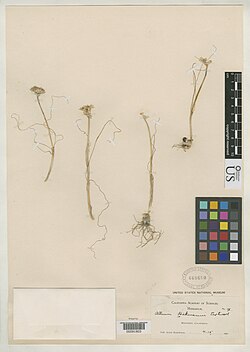
Eastwood's career was marked by relentless exploration. From the desert regions of the Four Corners to the rugged frontiers of the Big Sur coast, she sought out the unknown. In 1892, during an expedition in Colorado, she discovered the type specimen of Oreocarya aperta, a rare desert flowering plant in the forget-me-not family. This species remains so elusive that it is known today primarily from her original collection.
Her work in San Diego and later San Francisco further expanded her reach. She maintained a lifelong friendship and scientific correspondence with horticulturalist Kate Sessions, who provided specimens for Eastwood to describe and name. One such collaboration resulted in the naming of Ceanothus cyaneus.
The 1906 Earthquake and the Preservation of Science
In 1891, Eastwood joined the California Academy of Sciences, eventually rising to become the Head of the Department of Botany. Her most defining moment occurred during the 1906 San Francisco earthquake. Recognizing the imminent danger to the academy's most precious assets, Eastwood had previously implemented a system of segregating type specimens—the original specimens used to formally describe a species.
As fires swept through the city, Eastwood acted with incredible presence of mind. She retrieved 1,497 specimens from the damaged building, lowering them from a window using her apron to a friend below before commandeering a wagon to transport them to safety. These specimens and records constituted almost the entirety of the academy's surviving collection.
Following the disaster, Eastwood dedicated herself to reconstructing the lost collection. Through extensive expeditions to Alaska, Arizona, Utah, and Idaho, and by exchanging duplicates with other global institutions, she grew the academy's herbarium to approximately 300,000 specimens by 1942—nearly triple the number lost in the fire.
Scientific Legacy and Honors
Eastwood's influence on botany is immortalized in the very names of the plants she studied. Beyond her 310 articles and the founding of the journal Leaflets of Western Botany, her name is attached to numerous taxa.
| Category | Examples |
|---|---|
| Genera Named for Her | Aliciella, Eastwoodia, Eastwoodiella |
| Species Named for Her | Amsinckia eastwoodiae, Salix eastwoodiae, Fritillaria eastwoodiae |
| Major Honors | Honorary President of the VII International Botanical Congress (1950) |
| Institutional Impact | Built California Academy of Sciences collection to ~300,000 specimens |
Frequently Asked Questions
What is a type specimen in botany?
A type specimen is the original physical specimen used by a scientist to formally describe and name a new species. These are critical for scientific accuracy, as they serve as the definitive reference point for that species.
How many species did Alice Eastwood name?
Alice Eastwood authored the names of 395 land plant species, making her one of the most prolific female scientists in the field of botany.
What was her role in the development of Golden Gate Park?
Eastwood worked alongside John McLaren to help plan Golden Gate Park, ensuring a diverse range of horticultural plantings. She also assisted in the creation of the park's Shakespeare Garden.
How is Alice Eastwood remembered in San Francisco today?
Her legacy is honored through the Alice Eastwood Garden, named by the San Francisco Garden Club, and the Eastwood Hall of Botany at the California Academy of Sciences.
What were her primary botanical interests?
Her research focused heavily on the flora of the Western United States, with specific interests in the Liliaceae family and the genera Lupinus, Arctostaphylos, and Castilleja.