Alibaba Group: A Comprehensive Overview of its Ecosystem and Entities
Alibaba Group has evolved from a simple trading platform into a global conglomerate spanning e-commerce, cloud computing, artificial intelligence, and digital finance. By building a vast network of affiliated entities, the company has redefined how businesses and consumers interact in the digital age, particularly within the Chinese market and increasingly on a global scale.
Key Facts
- Global Reach: Alibaba.com serves over 10 million buyers and 150,000 verified sellers across 200+ countries.
- Market Dominance: Taobao and Tmall are among China's most visited websites, with combined monthly active users exceeding 1 billion as of 2018.
- AI Innovation: The company develops advanced LLMs like Tongyi Qianwen and reasoning models like QwQ-32B-Preview.
- Logistics Power: Cainiao manages a massive delivery network, supported by a 100 billion yuan investment plan for global expansion.
- Financial Infrastructure: Alipay pioneered third-party escrow payments in China, later gaining official regulatory recognition.
E-commerce and Retail Service Platforms
Alibaba's core strength lies in its diverse retail ecosystem, which caters to different segments of the market through specialized platforms.
B2B and Global Trade
Alibaba.com is the world's largest online business-to-business (B2B) trading platform for small businesses. It operates alongside 1688.com, which focuses on domestic Chinese B2B trade (and began global marketing in 2025), and AliExpress, a global business-to-consumer (B2C) marketplace.

In 2019, Alibaba.com expanded its reach by allowing small and medium-sized U.S. businesses to sell on the platform, aiming to capture the American B2B market. At that time, while one-third of the site's buyers were U.S.-based, over 95% of sellers remained in China.
![Alibaba Binjiang Campus in Hangzhou, headquarters for Alibaba's B2B service[88]](/images/a6/49/a64910e0f5612e5954aa550f0d3e564493680091930551908424f9d2035ff62b.jpg)
Consumer Retail: Taobao and Tmall
Launched in 2003, Taobao Marketplace became China's largest consumer-to-consumer (C2C) platform by offering free registration and commission-free transactions. To complement this, Alibaba launched Tmall (originally Taobao Mall) in 2008, focusing on global brands for affluent consumers.
Other retail innovations include Juhuasuan, a flash-sale site launched in 2010, and eTao, a comparison shopping engine. The group has also expanded through acquisitions, such as the $2 billion purchase of Kaola from NetEase in 2019 and a $3.6 billion deal to control Sun Art, China's largest hypermarket operator, in 2020.
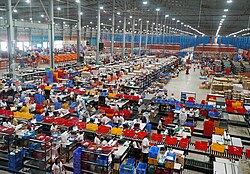
Cloud Computing and Artificial Intelligence
Alibaba Cloud, launched in 2009, is China's largest high-end cloud computing company. It provides critical infrastructure for data mining, processing, and customization, with R&D centers spanning from Silicon Valley to Dubai.
Hardware and AI Development
The company's subsidiary, T-Head, has developed specialized hardware, including the XuanTie-910 (a 64-bit RISC-V processor) and the Hanguang 800 AI accelerator, designed for high-speed image inference.
Generative AI and LLMs
Alibaba has aggressively entered the generative AI space with Tongyi Qianwen (Qwen), a chatbot integrated into services like DingTalk. In November 2024, the company released QwQ-32B-Preview, a reasoning-focused model under the Apache 2.0 License capable of solving complex logic and math problems. Most recently, in April 2025, Alibaba Cloud released the Wan 2.1-FLF2V-14B AI video generation model.
Smart Logistics and FinTech
To support its massive retail volume, Alibaba co-founded Cainiao in 2013. This logistics network aims to optimize delivery across China and globally, with Alibaba increasing its stake to 51% to drive efficiency.
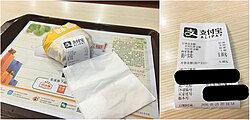
On the financial side, Alipay revolutionized online shopping by introducing an escrow service, ensuring buyers receive goods before funds are released to sellers. This system moved third-party payments from a legal grey area to a regulated industry recognized by the People's Bank of China in 2010.
Diversified Services and Entertainment
Alibaba has expanded into several niche sectors to create a comprehensive digital lifestyle:
- Entertainment: Operates Alibaba Pictures Group and AliMusic (including Xiami and Tiantian Music). It also holds a significant stake in Youku Tudou.
- Travel: Fliggy (formerly Alitrip) serves as a one-stop travel mall, featuring a strategic partnership with Marriott International.
- Health and Maps: Alibaba Health provides pharmaceutical e-commerce, while the group acquired AutoNavi for mapping services.
- Internet Services: Includes Aliwangwang (instant messaging), Shenma (mobile search), and the acquisition of UCWeb.
| Entity | Primary Function | Market Focus |
|---|---|---|
| Alibaba.com | B2B Trading | Global Wholesale |
| Taobao | C2C Marketplace | Chinese Consumers |
| Tmall | B2C Retail | Global Brands in China |
| Alibaba Cloud | Cloud & AI | Enterprise Infrastructure |
| Alipay | Digital Payments | FinTech/Escrow |
| Cainiao | Logistics | Supply Chain/Delivery |
Frequently Asked Questions
What is the difference between Taobao and Tmall?
Taobao is primarily a C2C (consumer-to-consumer) platform where individuals and small sellers list products. Tmall is a B2C (business-to-consumer) platform designed for established global brands to sell directly to Chinese consumers.
How does the Gold Supplier membership work on Alibaba.com?
The Gold Supplier membership is a paid status intended to verify that a seller is genuine. While it involves verification checks, Alibaba has previously admitted that some fraudulent dealers managed to obtain this status.
What is the purpose of the Cainiao network?
Cainiao is a smart logistics network established to handle the massive volume of packages generated by Taobao and Tmall, aiming to create the most efficient delivery system in China and worldwide.
What is Tongyi Qianwen?
Tongyi Qianwen (or Qwen) is Alibaba's large language model (LLM) and chatbot, similar to ChatGPT, which is integrated into the company's business operations and digital assistants.
What happened to Yahoo! China?
Alibaba formed a strategic partnership with Yahoo! in 2005, acquiring Yahoo! China. Over time, Yahoo gradually exited the Chinese market, leading to the closure of its mail services in 2013 and the migration of users to Alibaba's Alimail.