Alfred University: A Legacy of Innovation and Inclusive Education
Founded on the principles of accessibility and academic rigor, Alfred University stands as a testament to the evolution of higher education in the United States. From its humble beginnings as a non-sectarian select school to its current status as a hub for ceramic innovation, the university has consistently pushed the boundaries of who can access education and how that education is delivered.
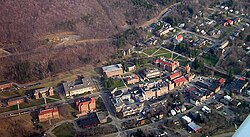
The institution's journey began in 1836, organized by Bethuel C. Church, a Seventh Day Baptist. With financial backing from the Seventh Day Baptist Educational Society and local "Female Educational Societies," the school was established in Alfred village. Remarkably for the mid-19th century, the school was co-educational from the start and welcomed African-American and Native American students within its first two decades.
From Academy to University
The institution first received a charter as Alfred Academy from the New York State Board of Regents in 1842, focusing primarily on teacher training. By 1855, the curriculum expanded into Academic and Collegiate departments, offering classic and scientific tracks, as well as a comprehensive program for women.
The transition to a full university occurred in March 1857, when the New York State Legislature granted a charter to Alfred University. This move was driven by Jonathan Allen, the university's second president, who sought to establish a government-accredited institution to support a theological seminary. Today, Alfred University is recognized as the oldest surviving co-educational college in New England and New York, and the first in the U.S. to admit women to the majority of its programs rather than limiting them to female-specific curricula.
Specialized Education and the Ceramic Legacy
At the turn of the 20th century, Alfred University became a pioneer in industrial education. In 1900, the New York State Legislature approved the creation of a State School of Clay-Working and Ceramics to support the state's raw materials and ceramic industry. This evolved into the New York State College of Ceramics, which remains part of the State University of New York (SUNY) system.
The College of Ceramics uniquely bridges two worlds: the School of Engineering, which focuses on the technical study of glass and ceramics, and the School of Art and Design, which emphasizes artistic practice. While the ceramics college is state-affiliated, Alfred University continues to operate its private College of Business and College of Liberal Arts and Sciences.
![Originally built in 1884, Kanakadea Hall served as Alfred's schoolhouse until a large fire destroyed the tower and devastated the second floor in 1907. It was sold to Alfred University and repaired in 1908. The exterior has since been restored to its original appearance, although the interior has been fully modernized. The building now houses the Division of Human Studies.[16]](/images/55/90/559066023baf2c447ae8f8fb0ab60f3eaf65624ae686d9cf4c7218c82632a221.jpg)
The Relationship with Alfred State College
The university's history is also linked to the New York College of Agriculture, established in 1908. This entity became autonomous in 1941 as a junior college and joined the SUNY system in 1948, becoming Alfred State College. Although they are separate institutions located on opposite sides of Main Street, they maintain a close relationship, highlighted by their annual spring "Hot Dog Day."
Campus Culture and Symbols
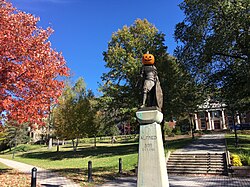
The university's namesake is a subject of historical curiosity. While local tradition holds that the school is named after King Alfred the Great, the Saxon king, the first documented link appeared in 1881—long after the area was already named Alfred. Despite the loss of official state records in a 1911 fire, the university has embraced the king as a symbol of its educational values.
Notable Guests and Social Progress
The campus has served as a forum for diverse voices, hosting figures such as Ralph Waldo Emerson, Frederick Douglass, and Ghostface Killah. In 2000, the university gained national attention when freshman Eric Zuckerman arranged a visit from then-First Lady Hillary Clinton during her Senate campaign.
The community has also been a leader in civil rights. In 1971, the village of Alfred became one of the first four municipalities in the U.S. to ban employment discrimination based on sexuality. This spirit of inclusivity continued in 2002, when the Lambda Chi Alpha fraternity chapter at AU successfully advocated for the international fraternity to ban discrimination based on age, disability, religion, and sexual orientation.
Economic Impact: The Ceramic Corridor
In the 1990s, Alfred University partnered with the State of New York and Corning Incorporated to launch the Ceramic Corridor. This incubator project was designed to foster start-up industries between Corning and Alfred, NY, leveraging the region's expertise in ceramics to create new jobs. The Alfred incubator facility is now a member of The Western New York Incubator Network.
Key Facts
- Founded: 1836 as a non-sectarian select school.
- Distinction: Oldest surviving co-educational college in New York and New England.
- Specialization: Home to the New York State College of Ceramics (part of the SUNY system).
- Innovation: Co-developer of the Ceramic Corridor industrial incubator.
- Rankings (2021): Ranked #45 among Regional Universities North by U.S. News & World Report.
- Admissions (2019): 66% acceptance rate; middle 50% SAT scores 940–1180; ACT scores 20–27.
| Category | Detail |
|---|---|
| Founding Year | 1836 |
| University Charter | March 1857 |
| Key Academic Pillars | Ceramics, Engineering, Art & Design, Business, Liberal Arts & Sciences |
| Affiliations | Private University; New York State College of Ceramics (SUNY) |
| Notable Partnerships | Corning Incorporated, State of New York |
Frequently Asked Questions
Why is Alfred University significant in the history of co-education?
It is the oldest surviving co-educational college in New York and New England and was the first college in the U.S. to admit women to most or all of its programs rather than offering separate, female-specific tracks.
What is the New York State College of Ceramics?
Established in 1900 to support New York's industrial raw materials, it is a specialized college within the SUNY system that integrates ceramics and glass studies into both the School of Engineering and the School of Art and Design.
What is the Ceramic Corridor?
The Ceramic Corridor is an industrial incubator project started in the 1990s by Alfred University, Corning Incorporated, and the State of New York to foster start-up companies and job growth in the ceramics industry.
Is Alfred University the same as Alfred State College?
No. While they share a village and maintain a close relationship, Alfred State College became an autonomous junior college in 1941 and is a member of the State University of New York (SUNY) system.
Who is the statue in the center of the campus quad?
The statue depicts King Alfred the Great, the Saxon king. Although the historical link between the king and the town's naming is not definitively proven in state records, the university uses him as a symbol of its educational values.