Alexander Graham Bell and the History of the Telephone City
The story of the telephone is inextricably linked to Brantford, Ontario. It was here, at the farm known as Melville House, that Alexander Graham Bell conceived the technical foundations of the telephone in July 1874. While the first working prototype was later produced in Boston, Brantford served as the site of critical early breakthroughs, including one of the first successful long-distance voice transmissions on August 4, 1876, sent between the local telegraph office and the Bell family homestead.
The city's role in communication history was further cemented between 1879 and 1881 when James Cowherd established Canada's first telephone factory in the city. This industrial milestone earned Brantford the informal and enduring designation as "The Telephone City."
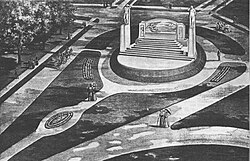
The Bell Telephone Memorial Association
By 1904, local discussions began regarding a monument to honor both Bell and his revolutionary invention. This led to the formal establishment of the Bell Telephone Memorial Association in 1906, incorporated by an Act of the Legislature of Ontario. The association's primary goal was to officially name Bell as the inventor and commemorate the birth of the telephone in Brantford.
In a rare departure from tradition, the monument was dedicated to a living person—an honor typically reserved for imperial leaders. Bell, known for his modesty, accepted the tribute largely because the memorial focused equally on the invention itself.
The project garnered significant high-profile support, including endorsements from George, Prince of Wales (later King George V), the 4th Earl of Minto, and the 4th Earl Grey. The association was led by president William Foster Cockshutt and vice-president Lloyd Harris, with the design committee headed by philanthropist Byron Edmund Walker.
Fundraising and Public Support
The financial effort to build the monument was a massive undertaking for a city of only 30,000 people. Through global donations, the association raised over $65,000, with an additional $10,000 contributed by the Canadian federal government under Prime Minister Sir Wilfrid Laurier.
Designing the Monument
In 1908, the association invited 22 sculptors from Canada, the United States, and Europe to submit models. After reviewing approximately ten submissions, a panel of judges—including Sir Byron Edmund Walker, New York State Senator George Allen Davis, and Sir George Christie Gibbons—unanimously selected Walter Seymour Allward for the commission.
Walker, a prominent banker and arts patron, was instrumental in this choice, emphasizing that the "national character" of the work required the highest possible artistic quality.
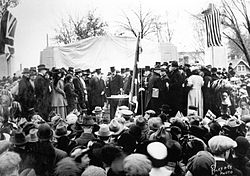
Challenges and Completion
Although the contract was authorized in 1909 with an estimated cost of $25,000 and a target completion date of 1912, the project faced significant delays. Allward was juggling multiple high-profile commissions, including the South African War Memorial in Toronto. He was assisted by sculptor Emanuel Otto Hahn until 1912.
The central bronze casting was intended to be the largest ever created in North America at the time. However, the onset of World War I brought material shortages, transportation hurdles, and a French moulding sand embargo, pushing the final completion date to 1917.
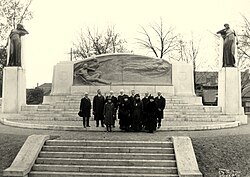
The Grand Unveiling
On October 24, 1917, the memorial was finally unveiled by the Governor General of Canada, Victor Cavendish, 9th Duke of Devonshire. Despite driving rain, thousands gathered to witness the event, which featured a children's chorus, the 125th (Brantford) Battalion band, and the presence of Chief A.R. Hill of the Six Nations Tribes of the Grand River.
During the ceremonies, Alexander Graham Bell reaffirmed the city's legacy, stating that the telephone was "conceived in Brantford in 1874 and born in Boston in 1875." To mark the occasion, Bell presented the Duke with a silver telephone. In a gesture of gratitude to the community, Bell's wife, Mabel Hubbard Bell, donated $500 to the city's support fund for soldiers fighting in Europe.
Key Facts
- Invention Site: Technical aspects were conceived at Melville House, Brantford, in July 1874.
- First Transmission: A notable long-distance voice transmission occurred on August 4, 1876.
- Industrial First: Canada's first telephone factory operated in Brantford from 1879 to 1881.
- Funding: Over $75,000 was raised through global donations and a federal grant.
- The Artist: The monument was sculpted by Walter Seymour Allward.
- Unveiling Date: October 24, 1917.
| Category | Details |
|---|---|
| Lead Sculptor | Walter Seymour Allward |
| Total Funding | Over $75,000 (Donations + Federal Grant) |
| Key Locations | Melville House, Brantford, Ontario |
| Completion Year | 1917 |
| Primary Purpose | Commemorate the invention of the telephone and its inventor |
Frequently Asked Questions
Why is Brantford called "The Telephone City"?
Brantford earned this nickname because Alexander Graham Bell conceived the telephone's technical aspects there in 1874 and the city hosted Canada's first telephone factory from 1879 to 1881.
Who designed the Bell Telephone Memorial?
The memorial was designed by sculptor Walter Seymour Allward, who was selected from a pool of 22 international candidates.
Why did it take so long to complete the monument?
Completion was delayed by Allward's other commissions and the impacts of World War I, which caused material shortages and an embargo on French moulding sand.
Was Alexander Graham Bell present at the unveiling?
Yes, Bell attended the unveiling on October 24, 1917, and delivered addresses at both the monument site and the city's Old Opera House.
What is the significance of Melville House?
Melville House was the homestead of Bell's parents and the location where he first conceived the technical aspects of the telephone in 1874.