Alewife: The Biology and Ecology of the River Herring
The alewife (Alosa pseudoharengus), also known as the river herring, is a versatile species of herring native to North America. As a member of the shad family, it is primarily anadromous—meaning it spends most of its adult life in the ocean but migrates into freshwater rivers and streams to spawn. While most alewives follow this marine-to-freshwater cycle, some populations have become landlocked, living their entire lives in freshwater environments.
From the coastal waters of the northern West Atlantic to the depths of the Great Lakes, the alewife plays a complex role in the aquatic ecosystems it inhabits, serving as both a vital prey source and a formidable competitor.
Key Facts
- Scientific Name: Alosa pseudoharengus
- Conservation Status: Least Concern (IUCN 3.1), though listed as a US National Marine Fisheries Service "Species of Concern."
- Typical Size: Approximately 30 centimeters (12 inches) in standard length.
- Habitat: Northern West Atlantic Ocean, estuaries, and North American freshwater systems.
- Dietary Impact: Significant predator of zooplankton in the Great Lakes.
Physical Characteristics and Identification
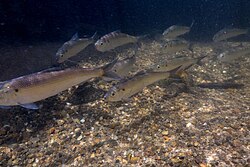
Alewives are characterized by a deep body front and a typical standard length of 30 centimeters, though some can reach up to 40 centimeters. Visually, they possess bronze-colored heads and a dorsum that ranges from grey-blue to greyish green. A humeral spot is frequently visible on their sides.
Distinguishing the alewife from the similar blueback herring (Alosa aestivalis) requires looking at specific internal and anatomical features:
- Peritoneum: The lining of the abdominal cavity is light-colored with spots or dusky in alewives, whereas it is dark in blueback herring.
- Otolith: The ear stone (otolith) of an alewife is shaped like the letter "L," while the blueback herring's is hooked.
- Eye Size: Alewives have larger eyes; the width of the eye often exceeds the length of the snout.
- Tongue: The tongue of the alewife does not have teeth.
Etymology and Regional Names
The common name "alewife" is believed to derive from a comparison to a corpulent female tavernkeeper (an "ale-wife") or from the word aloofe, a term possibly of Native American origin used in the 17th and 18th centuries.
Regional variations in naming are common across Atlantic Canada. In southwestern Nova Scotia, they are called kiacks (or kyacks), and in other parts of Atlantic Canada, they are known as gaspereau. This latter term comes from the Acadian French word gasparot. The fish's influence is so ingrained in the region that three rivers in Nova Scotia and New Brunswick are named the Gaspereau River.
The Alewife in the Great Lakes
The alewife is well-known for its colonization of the Great Lakes. By utilizing the Welland Canal to bypass Niagara Falls, the species spread from Lake Erie into Lake Huron and Lake Michigan via the Detroit River and Lake St. Clair. Their population peaked between the 1950s and 1980s.
This population explosion occurred because the lakes lacked a top predator; lake trout had been decimated by overfishing and the invasion of the sea lamprey. The resulting abundance of alewives led to seasonal die-offs, where fish washed up in large windrows on shorelines. To control the population biologically, Pacific salmon (Coho and Chinook) were introduced. While only partially successful in controlling the alewife, this created a popular sport fishery for anglers.
Despite these efforts, alewives have negatively impacted native species by preying heavily on various zooplankton (tiny aquatic organisms). Research from 1954 to 1966 showed that as alewife populations rose, larger zooplankton species declined, with a rebound occurring only after a major alewife die-off in 1967.
Conservation and Threats
While listed as "Least Concern" globally, alewife populations have declined across much of their range. Key threats include:
- Habitat Loss: Dams and other man-made barriers prevent fish from reaching spawning areas.
- Environmental Degradation: General habitat decline and pollution.
- Predation: Increased pressure from recovering striped bass populations.
- Overfishing: Excessive harvesting in certain regions.
In response, states including Massachusetts, Rhode Island, Connecticut, Virginia, and North Carolina have implemented moratoria on the taking and possession of alewives. In Massachusetts, habitat restoration and the installation of fish ladders in the Mystic River watershed are helping to bring alewives back to the area.
| Feature | Detail |
|---|---|
| Average Length | 30 cm (12 in) |
| Max Length | 40 cm (16 in) |
| Primary Habitat | North West Atlantic / Great Lakes |
| Migration Type | Anadromous (some landlocked) |
| Key Identifier | L-shaped otolith; light-colored peritoneum |
| Conservation Status | Least Concern / US Species of Concern |
Frequently Asked Questions
What is the difference between an alewife and a blueback herring?
The primary differences are internal and anatomical: alewives have a light-colored or spotted peritoneum and an L-shaped otolith, whereas blueback herrings have a dark peritoneum and a hooked otolith. Additionally, alewives generally have larger eyes relative to their snout length.
How did alewives enter the Great Lakes?
Alewives entered the Great Lakes by using the Welland Canal, which allowed them to bypass the natural barrier of Niagara Falls. They then spread from Lake Erie into other lakes via the Detroit River and Lake St. Clair.
Why were Pacific salmon introduced to the Great Lakes?
Pacific salmon, specifically Coho and Chinook, were introduced as a biological control measure to prey upon the overabundant alewife populations that had peaked between the 1950s and 1980s.
What are the main threats to alewife populations?
The main threats include the construction of dams that block access to spawning grounds, habitat degradation, fishing pressure, and increased predation from recovering striped bass populations.
Are alewives used for anything other than ecological roles?
Yes, adult alewives are caught during spring migrations using dip nets. They are commonly used as preferred bait for the spring lobster fishery in Maine and are also consumed by humans, often in smoked form.