Aleppo International Stadium: Syria's Largest Sporting Venue
The Aleppo International Stadium is an Olympic-standard, multi-use sporting facility located in the Salaheddine District of Aleppo, Syria. As the largest stadium in the country, this all-seater, all-covered venue serves as a primary hub for football, acting as the home ground for Al-Ittihad SC and hosting various fixtures for the Syria national football team.
Situated near the al-Hamadaniah Sports City in the southwestern region of the city, the stadium is a massive architectural undertaking designed to support high-capacity crowds and professional athletic events.
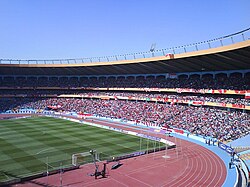
Key Facts
- Capacity: 53,200 seats (Record attendance of 75,000).
- Location: Salaheddine District, Aleppo, Syria.
- Architect: Stanisław Kuś.
- Construction Period: 1980 to 2007.
- Surface: Natural grass field measuring 105 x 68 meters.
- Cost: US$ 30,000,000.
A Long Road to Completion
The history of the Aleppo International Stadium is marked by significant delays. Construction began in 1980 based on designs by Polish constructor Stanisław Kuś. Originally, the project was intended for completion by 1987 to host the Mediterranean Games. However, financial difficulties halted progress for two decades.
Work resumed in 2003, and after a total construction span of 27 years, the venue finally opened on April 3, 2007. The inaugural event was a friendly match between Al-Ittihad SC and Turkey's Fenerbahçe, which ended in a 2–2 draw. This historic opening was attended by Syrian President Bashar Al Assad and Turkish Prime Minister Recep Tayyip Erdoğan.
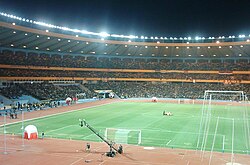
Architectural Design and Facilities
The stadium is a concrete structure occupying 3.5 hectares within a larger 33-hectare sports complex. It is organized into five distinct levels:
- Level 1: The sports ground and its immediate surrounding facilities.
- Level 2: Training halls, support services, and various utility facilities.
- Levels 3, 4, and 5: Spectator seating. The first tier accommodates 25,000 people, while the second and third tiers hold 14,000 each.
A notable feature of the third level is the VIP hall, which is decorated with traditional oriental wood-works. For spectator visibility, the stadium is equipped with two electronic screens, each measuring 7 by 15 meters.
Impact of the Syrian Civil War
The stadium suffered severe damage during the Syrian Civil War, particularly from mortar fire. The facade and many indoor facilities were completely destroyed, and the pitch and tribunes were significantly impacted. Following the Battle of Aleppo (2012–2016), the Syrian government began repairs with assistance from Iran.
More recently, on December 18, 2024, a fire broke out at the stadium under unclear circumstances following the fall of the Assad regime.
Notable Sporting Events
Throughout its operational years, the stadium has hosted several high-profile matches, including AFC club play-offs and international qualifiers.
| Category | Details |
|---|---|
| Primary Tenants | Al-Ittihad SC, Syria national football team |
| Record Attendance | 75,000 (Al-Ittihad v Fenerbahçe, 2007) |
| Notable AFC Match | Al-Ittihad 2–0 Muangthong United (2010) |
| International Result | Syria 3–2 China (2009 AFC Asian Cup qualification) |
| Field Dimensions | 105 x 68 meters |
Frequently Asked Questions
Who designed the Aleppo International Stadium?
The stadium was designed by the Polish constructor Stanisław Kuś.
Why did construction take 27 years?
Construction began in 1980 but was halted for two decades due to financial difficulties, resuming in 2003 and finishing in 2007.
What is the maximum capacity of the stadium?
The official capacity is 53,200 spectators, although a record attendance of 75,000 was reached during the inaugural match against Fenerbahçe.
Which teams have used the stadium as their home ground?
The stadium has served as the home ground for Al-Ittihad SC and has hosted home games for the Syria national football team.
What happened to the stadium during the Syrian Civil War?
The venue was severely damaged by mortar fire, which destroyed the facade, indoor facilities, and caused significant damage to the pitch and tribunes.