Aleksandrów Kujawski: A Historic Border Town in North-Central Poland
Located in the heart of the Kuyavian-Pomeranian Voivodeship, Aleksandrów Kujawski is a town defined by its strategic geography and deep historical ties to the shifting borders of Europe. Situated approximately 18 km southeast of Toruń, this town serves as the seat of Aleksandrów County and the urban gmina of the same name. With a population of 11,536 as of December 2022, it remains a vital point of connection in north-central Poland.
Key Facts
- Location: Kuyavian-Pomeranian Voivodeship, Poland.
- Population: 11,536 (as of December 31, 2022).
- Total Area: 7.23 km².
- Historical Names: Trojanów (until 1879), Aleksandrów Pograniczny (1879–1919).
- Key Infrastructure: Intersection of railway lines 18 and 245; proximity to the A1 motorway.
- Administrative Role: Seat of Aleksandrów County.
The Evolution of a Border Town
The origins of Aleksandrów Kujawski are inextricably linked to the expansion of the railway. The town grew from the nucleus of the Trojanów train station, established during the construction of the rail line connecting Kutno and Toruń between 1859 and 1865. Founded in 1862, the settlement gained significance due to its position on the border between the Russian Empire (Congress Poland) and the Kingdom of Prussia.
A pivotal moment in the town's history occurred in 1879, when Emperor Alexander II of Russia and Emperor William I of Germany met here. To commemorate the event, the town was renamed Aleksandrowo and granted municipal rights, later becoming known as Aleksandrów Pograniczny, which translates to "Aleksandrów on the border."
Following the restoration of Polish independence in 1919, the town adopted its current name. During the interwar period, it was a diverse community; a 1921 census recorded a population of 8,193, consisting of 89.3% Poles and 9.0% Jews. Between 1921 and 1923, the town also served as an internment camp for soldiers of the Ukrainian People's Republic.
War and Occupation
The town suffered significantly during the German occupation of Poland. Between October 1939 and January 1940, numerous Polish citizens were murdered in the nearby Odolion forest. The occupation saw the arrest of five Salesians in October 1939 and the expulsion of 735 Poles in 1940. Their properties were seized and handed to German colonists under the Lebensraum policy (the Nazi ideology of "living space" for the German people).
Geography and Demographics
Aleksandrów Kujawski covers a total area of 7.23 km² (2.79 sq mi), resulting in a population density of 1,595.6 people per square kilometer. The town is divided into several municipal parts, including:
- Centrum
- Osiedle Parkowa I and II
- Piaski (Piachy)
- Halinowo
- Osiedle Południe
| Year | Population | Percentage Change |
|---|---|---|
| 1910 | 11,464 | — |
| 1921 | 8,236 | −28.2% |
| 1931 | 11,554 | +40.3% |
| 1939 | 13,333 | +15.4% |
| 1950 | 8,816 | −33.9% |
| 1960 | 12,179 | +38.1% |
Transport and Connectivity
The town remains a well-connected hub for both road and rail transport. Voivodeship road 266, which connects Konin and Ciechocinek, passes directly through the town. For long-distance travel, the A1 motorway (part of the European route E75) is located approximately 3 km to the east.
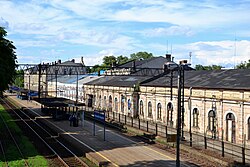
Rail transport continues to be a cornerstone of the town's infrastructure, with railway lines 18 and 245 passing through the local station.
Frequently Asked Questions
What was the original name of Aleksandrów Kujawski?
The town was originally known as Trojanów until 1879.
Why was the town renamed Aleksandrowo in 1879?
It was renamed to honor the meeting between the Russian Emperor Alexander II and the German Emperor William I.
What is the current population of the town?
As of December 31, 2022, the population of Aleksandrów Kujawski was 11,536.
Which major motorway is located near the town?
The A1 motorway, which is part of the European route E75, passes about 3 km to the east of the town.
What happened to the town during the German occupation?
The town experienced mass murders in the Odolion forest, the arrest of local Salesians, and the expulsion of 735 Poles to make room for German colonists under the Lebensraum policy.