Alejandro Gómez: The Life and Political Legacy of Argentina's 25th Vice President
Alejandro Gómez was a distinguished Argentine lawyer, educator, and statesman who served as the 25th Vice President of Argentina. His political journey was marked by a steadfast commitment to economic nationalism and a complex relationship with the shifting tides of Argentine governance during the mid-20th century.
Early Life and Academic Foundations
Born on April 4, 1908, in Rosario, Gómez grew up in a family that moved frequently across the Santa Fe Province due to his father's work as a railway telegraph operator. Eventually settling in rural Berabevú, Gómez began his professional life as a school teacher. His early political convictions were tied to the centrist Unión Cívica Radical (UCR), a party that had first taken power in 1916. However, his vocal support for the UCR led to the loss of his teaching position following the 1930 military coup that ousted President Hipólito Yrigoyen.
Undeterred, Gómez continued his dedication to education by establishing the Workers' Night School in Rosario, operating it clandestinely during the authoritarian Concordance regime. In 1936, he married María Celia Cabos, with whom he had three sons. He furthered his education at the National University of the Littoral (now the National University of Rosario), earning his law degree in 1940.
Political Ascent and the 1958 Election
Gómez's political career evolved through various factions of the UCR. In 1945, he joined the Intransigence and Renewal Front (MIR), a liberal wing of the UCR led by Amadeo Sabattini. The MIR opposed alliances with conservatives and initially endorsed Juan Perón for the 1946 elections. Like many in the MIR, Gómez eventually became disillusioned with Perón and returned to the main UCR body.
A pivotal shift occurred in November 1956 during a fractious convention in Tucumán. Arturo Frondizi split from the UCR to form the Unión Cívica Radical Intransigente (UCRI), opposing the hard-line stance against Peronists held by leader Ricardo Balbín. Frondizi, a friend of Gómez since 1942, selected him as his running mate for the Vice Presidency.
As the political director of the campaign, Gómez was instrumental in maintaining party unity, successfully persuading dissident "Green List" candidates—including future President José María Guido—to rejoin the official UCRI ticket. With a late endorsement from the exiled Juan Perón, the Frondizi-Gómez ticket won the 1958 election by a 17% margin over Balbín's UCRP and were inaugurated on May 1, 1958.
The Oil Dispute and Resignation
The administration's stability was short-lived. In July 1958, President Frondizi announced that Argentina's untapped oil resources would be opened to foreign exploration through contracts with YPF (the state oil company). This decision was a direct reversal of Frondizi's own previous writings in Petróleo y Política (1954) and his campaign promises.
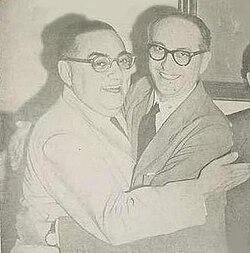
Gómez strongly opposed this shift toward foreign reliance. The tension became a public spectacle when the satirical magazine Tía Vicenta began reporting on Gómez's private meetings with military figures, including Admiral Isaac Rojas and General Domingo Quaranta. The magazine famously mocked the situation with a recurring photo of Gómez and the caption: ¿A mi por que me miran? ("Why are you all looking at me?").
Following a wave of strikes against the oil policy, the UCRI expelled Gómez, leading to his resignation on November 18, 1958. Frondizi accused Gómez of plotting a coup d'état and declared a temporary state of siege. Gómez and his allies denied these claims, maintaining that the accusations were merely a pretext for his removal and asserting their commitment to democratic processes.
Later Years and Intellectual Contributions
After leaving office, Gómez became a prominent critic of developmentalism—the policy of relying on foreign direct investment championed by adviser Rogelio Julio Frigerio—and the austerity measures of Economy Minister Álvaro Alsogaray. He founded two advocacy groups dedicated to economic nationalism: the Movimiento Latinoamericano and the Movimiento Nacional de Defensa del Petróleo y la Energía.
Gómez's contributions were recognized internationally; he was awarded the Order of Merit of Chile by President Eduardo Frei Montalva and named a Grand Officer of the Legion of Honor by French President Charles de Gaulle. He remained an academic, teaching public law at the University of Belgrano until 1988.
In his final book, Un siglo...una vida. De la soberanía a la dependencia, Gómez reflected on his life and argued that the prioritization of foreign interests in energy policy contributed to Argentina's national decline. He passed away from a brain aneurysm on February 6, 2005, in Las Tapias, Córdoba, at the age of 96.
Key Facts
- Role: 25th Vice President of Argentina (May 1, 1958 – November 18, 1958).
- Political Affiliation: UCR and later UCRI.
- Primary Conflict: Resigned due to disputes over foreign oil exploration contracts.
- Education: Law degree from the National University of the Littoral (1940).
- Advocacy: Championed economic nationalism and opposed foreign direct investment in energy.
| Detail | Information |
|---|---|
| Term in Office | May 1, 1958 – November 18, 1958 |
| Presidential Partner | Arturo Frondizi |
| Preceded by | Isaac Rojas |
| Succeeded by | Carlos Perette |
| Reason for Departure | Expulsion from UCRI and resignation over oil policy |
Frequently Asked Questions
Why did Alejandro Gómez resign as Vice President?
Gómez resigned on November 18, 1958, following a severe policy dispute with President Arturo Frondizi. Gómez opposed the decision to open Argentina's oil resources to foreign exploration via YPF, which he viewed as a betrayal of the administration's campaign promises.
What was the UCRI?
The UCRI (Unión Cívica Radical Intransigente) was a political party formed by Arturo Frondizi after splitting from the UCR in 1956. The split was primarily caused by opposition to the UCR's hard-line stance against Peronists.
What was Gómez's stance on economic policy?
Gómez was a proponent of economic nationalism. He vocally opposed "developmentalism" (reliance on foreign direct investment) and austerity measures that led to cuts in essential services, such as the national rail system.
Did Alejandro Gómez attempt a coup?
While President Frondizi accused him of gathering support for a coup d'état to justify his dismissal, Gómez and his allies denied these claims, asserting that they remained committed to democracy.
What were Gómez's professional achievements outside of politics?
Gómez was a lawyer and a dedicated educator. He founded the Workers' Night School in Rosario and taught public law at the University of Belgrano until his retirement in 1988. He also authored several books on sovereignty and national policy.