Albrecht Berblinger: The Tailor of Ulm and the Early Quest for Flight
Long before the Wright brothers or Otto Lilienthal took to the skies, a determined craftsman in Germany sought to conquer the air. Albrecht Ludwig Berblinger, known historically as the "Tailor of Ulm," was a visionary inventor who dared to design a heavier-than-air flying machine. His journey from a humble orphanage to the heights of the Adlerbastei is a testament to human curiosity and the perilous nature of early scientific experimentation.
Early Life and Mechanical Passion
Born on June 24, 1770, in Ulm, Württemberg, Berblinger was the seventh child of a poor family. Following the death of his father when he was 13, he was placed in an orphanage where he was trained as a tailor. While he harbored a deep desire to become a watchmaker, he pursued the tailoring trade, achieving the status of master craftsman by age 21.
Despite his professional obligations, Berblinger's fascination with mechanics never waned. In 1808, he applied his technical skills to medicine by inventing an artificial limb featuring a moveable joint, designed specifically for a soldier who had lost a leg.
The Pursuit of Aviation
Berblinger spent years developing a device that is now recognized as an early hang glider—a non-motorized aircraft that relies on the pilot's weight shift for control. To refine his design, he spent countless hours observing the flight patterns of owls, attempting to mimic nature's efficiency.
His ambition came at a high personal cost. Many of his contemporaries derided his efforts, and he faced threats of exclusion from his professional guild. Because he worked outside the guild's strict regulations, he was forced to pay a substantial fine, and the project drained his personal finances. However, his persistence caught the attention of King Frederick I of Württemberg, who provided financial sponsorship in the form of 20 Louis.
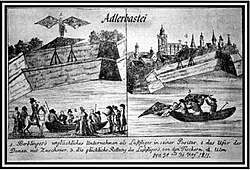
The Flight Attempts of 1811
On May 30, 1811, Berblinger planned a public demonstration of his glider for King Frederick I, the King's three sons, and the crown prince of Bavaria. However, the event was cancelled at the last moment when Berblinger claimed a wing had been damaged.
The following day, he attempted a second launch from a higher vantage point known as the Adlerbastei (Eagles Bastion). While the King had already departed, Duke Heinrich and the princes remained to witness the event. After waiting for a favorable gust of wind, the attempt ended in disaster. Some accounts suggest a policeman gave him a push, while others argue that the temperature differential over the cold waters of the Donau (Danube) prevented the glider from achieving lift.
Berblinger fell into the Danube and was rescued by fishermen. Although he survived, the failure ruined his reputation and stalled his future work. He lived until January 28, 1829, passing away in a hospital at the age of 58.
Legacy and Modern Validation
For decades, Berblinger was remembered more as a cautionary tale than a pioneer. His failed flight became a cultural reference, appearing in 19th-century publications and even inspiring a drawing by Wilhelm Busch in the story "Max and Moritz." It was not until the end of the 19th century that Otto Lilienthal scientifically proved the feasibility of heavier-than-air flight.
In the 20th century, Berblinger's reputation underwent a revival. In 1986, research proved that his glider design was actually capable of sustained flight, although crossing the Danube would have been nearly impossible even with modern equipment.
| Category | Details |
|---|---|
| Lifespan | June 24, 1770 – January 28, 1829 |
| Primary Profession | Master Tailor |
| Key Inventions | Moveable joint artificial limb; early hang glider |
| Famous Launch Site | Adlerbastei (Eagles Bastion), Ulm |
| Sponsor | King Frederick I of Württemberg |
Key Facts
- Berblinger designed his glider by studying the flight of owls.
- He faced severe professional backlash and fines from his guild for his inventions.
- His 1811 flight attempt ended with him falling into the Danube river.
- Modern analysis in 1986 confirmed his glider design was capable of sustained flight.
- Reconstructions of his wings are currently displayed in the Ulm Rathaus and the Fachhochschule Ulm.
Frequently Asked Questions
What was Albrecht Berblinger's profession?
Although he wished to be a watchmaker, Berblinger was a master tailor by trade, which earned him the nickname "The Tailor of Ulm."
Why did Berblinger's flight attempt fail?
Accounts vary; some attribute the fall to a push from a policeman, while others suggest that the temperature difference over the cold Danube river prevented the glider from gaining necessary lift.
Did Berblinger invent anything other than a glider?
Yes, in 1808, he invented an artificial limb with a moveable joint to assist a soldier who had lost a leg.
How is Berblinger honored today?
He is honored through reconstructions of his glider in Ulm, a ballad by Bertolt Brecht, and an annual award for young scientists issued by the European School of Aviation Medicine.
Was his glider design actually functional?
Yes, a 1986 study proved that the glider was capable of sustained flight, though the specific conditions of the Danube crossing were too challenging for the craft.