Al-Muntafiq Emirate
The Al-Muntafiq Emirate was a semi-centralized state and a vast Arab tribal confederation that wielded significant influence across southern Iraq and northern Kuwait from 1530 to 1918. Operating under the suzerainty of the Ottoman Empire, this confederation blended nomadic traditions with sedentary governance, creating a complex sociopolitical entity that shaped the demographics of the region for centuries.
While the confederation's seat of power was located in Al-Shatrah, its influence extended deeply into the Basra region, where it maintained a delicate balance of power with the Ottoman authorities.
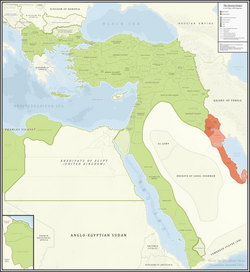
Key Facts
- Duration: 1530–1918.
- Ruling Dynasty: The Al Sadun family.
- Primary Regions: Southern Iraq, northern Kuwait, and historically parts of eastern Saudi Arabia and Qatar.
- Religious Composition: Predominantly Shia Islam, though the ruling Al Sadun clan remained Sunni.
- Major Cities Founded: Nasiriya, Al-Shatrah, and Suq al-Shuyukh.
- Political Structure: A monarchy and tribal confederation under Ottoman suzerainty.
Origins and Lineage
The Al-Muntafiq confederation is not a single homogeneous group but a collection of tribes. Most members trace their genealogy back to the Banu 'Uqayl, a branch of the ancient Banu 'Amir confederation from Najd. However, the leadership—the Al Sadun family—claims a different lineage. They are described as Sharifs from Mecca, descending from the Muhannā dynasty that ruled Medina from approximately 940 until the 16th century.
The confederation's composition also includes the al-Ajwad branch, which is believed to partially originate from the ancient Arab tribe of Tayy. Over time, the Al-Muntafiq faced various rivals, including the Dhufir, Shammar, Al-Sabah, and Ibn Saud, though strategic cooperation occasionally occurred.
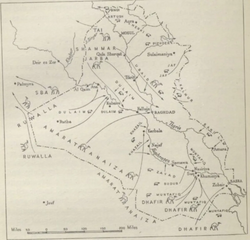
Territorial Expansion and Ottoman Relations
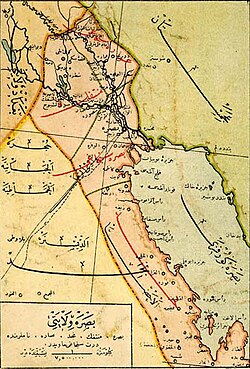
The tribe migrated to Iraq during the early Islamic conquests. By the 16th century, they had established a strong presence in the Basra Eyalet (an administrative division of the Ottoman Empire). Their influence was not limited to Iraq; in 1521 and again during the 19th century, they successfully occupied al-Ahsa and al-Qatif in eastern Saudi Arabia, as well as Qatar, before being expelled by the Banu Khalid.
Under Ottoman rule, the Al-Muntafiq transitioned from a nomadic lifestyle to a sedentary one, focusing on agriculture in southern and western Iraq. This shift was accelerated by the Ottoman government's decision to reroute canals toward Najaf.
Sociopolitical and Religious Evolution
The religious identity of the Al-Muntafiq evolved significantly over time. While the ruling Al Sadun clan remained Sunni, the majority of the confederation converted to Shia Islam by the late 18th or early 19th century. This transition was driven by intermarriage with Shiite populations and the sociopolitical conditions of the region.
The legacy of the emirate is still visible in the geography of Iraq. The city of Nasiriya was named after one of the Al Sadun sheikhs, and the surrounding area was officially known as the "Al-Muntafiq Province" until 1976.
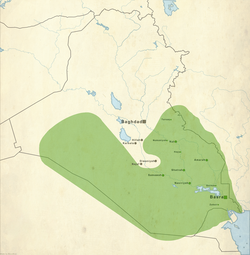
Tribal Structure and Divisions
The Emirate was organized into three primary divisions, each comprising various allied tribes and clans. While the Al Sadun provided nominal leadership, the internal structure was divided as follows:
| Main Division | Associated Tribes/Clans |
|---|---|
| Bani Malik | Albu Salih, Al Ibrahim, Al Jumaiyaan, Al Wadai, Al Majid, Al Diwan, Al Taughiyah |
| Al Ajwad | Al Usoom, Al Shuwailat, Al Humaid, Al Rufai, Al Bdour, Al Juwarin, Al Ghezzi, Al Shuraifat |
| Bani Saeed / Others | Bani Saeed, Bani Huchaim (including Al Dhuwalim, Al Zayyad, Al Jawabur, Al Towba, Al Aajeeb, Al Abas, Al Ghazalat), Bani Salamah, Al Aunan |
The Decline and Modern Legacy
The political existence of the Al-Muntafiq Emirate ended in 1918 with the partitioning of the Ottoman Empire. The subsequent establishment of British rule and a centralized monarchy in Iraq dismantled traditional tribal power structures. Consequently, the political recognition of the confederation ceased.
Today, the Iraqi state recognizes tribal chiefs based on individual tribes rather than their historical affiliation with the Al-Muntafiq confederation. In Kuwait, many stateless individuals, known as bedoons, trace their ancestry back to this confederation.
Frequently Asked Questions
Who led the Al-Muntafiq Emirate?
The emirate was led by the Al Sadun family, a Sunni clan of Sharifs originating from Mecca and descending from the Muhannā dynasty.
What was the religious makeup of the confederation?
Although the ruling Al Sadun family were Sunnis, the majority of the confederation's members became Shia Muslims by the late 18th or early 19th century due to intermarriage and regional sociopolitical factors.
Which modern countries encompass the former Al-Muntafiq territories?
The influence of the Al-Muntafiq extended across areas that are today part of Iraq, Saudi Arabia, Kuwait, and Iran.
Why is the confederation no longer a political entity?
The confederation lost its political recognition following the collapse of the Ottoman Empire in 1918 and the subsequent British efforts to establish a centralized monarchy in Iraq, which ended traditional tribal governance.
What cities are associated with the Al-Muntafiq?
The confederation founded several Iraqi cities, most notably Nasiriya (named after an Al Sadun sheikh), Al-Shatrah, and Suq al-Shuyukh.