African Spiritual Beliefs: From Sawa Water Spirits to Bakongo Cosmology
The diverse landscape of African spirituality encompasses a wide array of beliefs, ranging from the veneration of elemental spirits to complex cosmological systems that explain the origin of the universe. From the coastal regions of Cameroon to the deep philosophical traditions of the Kongo people and the ancestral myths of Namibia, these beliefs provide a framework for understanding life, death, and the interconnectedness of the physical and spiritual realms.
The Water Spirits of the Sawa People
Among the Sawa ethnic groups of Cameroon—including the Duala, Bakweri, Malimba, Batanga, Bakoko, and Oroko—spiritual life is closely tied to the water. Central to these beliefs is the jengu (plural: miengu), powerful water spirits. While the Bakweri refer to them as liengu (plural: maengu) and the Bakoko call them Bisima, these entities share similar characteristics to the Mami Wata spirits found in other regions.
The appearance of the miengu varies between individuals, but they are generally described as beautiful, mermaid-like figures characterized by long hair and distinctive gap-teeth. Residing in the sea and rivers, these spirits are believed to bring good fortune to their worshippers, cure diseases, and serve as vital intermediaries between humans and the spirit world. To facilitate this connection, dedicated Jengu cults are often established for their worship.
Bakongo Cosmology and the Cycle of Existence
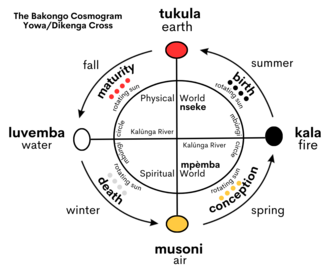
The Bakongo people possess a sophisticated cosmological system centered on the movement of the sun and the concept of perpetual motion. According to researcher Molefi Kete Asante, the "four moments of the sun"—rising, peaking, setting, and absence—serve as the essential pattern for Bakongo religious culture, mirroring the four stages of life: conception, birth, maturity, and death.
This vital cycle is represented by the dikenga (or Yowa), a cosmogram consisting of a circle with an internal cross. The intersection of the cross represents the most powerful point, marking where the individual stands within the cosmic flow.
The Origin of the Universe
Bakongo creation beliefs begin with the mbûngi, a circular void devoid of life. The deity Nzambi Mpungu summoned a spark of fire known as Kalûnga. As Kalûnga grew, it filled the mbûngi and eventually became a massive force of energy, unleashing heated elements across space to form the stars, planets, and the sun. Consequently, Kalûnga is revered as the origin of life and the God of change, reflecting a belief that existence requires constant motion—a concept that has been compared to the scientific Big Bang Theory.
The Dual Worlds and the Kalûnga Line
The expansion of Kalûnga created an invisible boundary that divided the universe into two halves. The top half, Ku Nseke, represents the physical world, while the bottom half, Ku Mpèmba, is the spiritual realm of the ancestors. The Kalûnga Line separates these two domains, acting as a river that carries souls between the physical and spiritual worlds during birth and death.
The Four Cosmic Times
The four corners of the Dikenga cross represent specific eras of creation:
- Musoni Time: When Kalûnga begot the universe.
- Kala Time: The beginning of biological life.
- Tukula Time: The creation of animals on Earth.
- Luvemba Time: The era when Manhûga, the ancestor of all humans, lived on Earth.
The Journey of the Muntu
For a Bakongo person (muntu), these four moments also define personal development. Musoni is the stage of conception in both the spiritual and physical realms; Kala is birth (the rising sun); Tukula is the period of maturity and mastery of life; and Luvemba is physical death and entry into the spiritual world with the ancestors (bakulu). Because humans possess a dual soul-mind (mwèla-ngindu), they can exist in both realms, continuing a full life in Ku Mpèmba while preparing for rebirth during the next Kala time.
Bantu Creation Myths in Namibia
In Namibia, various Bantu myths describe the origins of humanity through nature. Some traditions suggest the first man was born from a plant, such as phragmites reeds or the Omumborombonga tree in Herero mythology. Other accounts describe the first humans emerging from a hole in the ground or a cave.
Notably, these Bantu creation myths often focus on the specific origins of their own people rather than all of humanity. For instance, myths from Bantu groups coexisting with bushmen typically exclude the latter, viewing bushmen and animals as part of the eternal universe rather than part of the specific group's creation narrative.
Key Facts
- Sawa Spirits: The Jengu are mermaid-like water spirits in Cameroon believed to bring luck and healing.
- Bakongo Symbolism: The Dikenga is a circular cosmogram representing the four stages of life and the movement of the sun.
- Cosmic Division: Bakongo belief divides the universe into the physical world (Ku Nseke) and the spiritual world (Ku Mpèmba).
- Kalûnga: Viewed as the spark of fire that created the universe and the deity of change.
- Bantu Origins: Namibian myths include the belief that the first man emerged from plants (like the Omumborombonga tree) or the earth.
| Region/Group | Key Entity/Concept | Primary Focus | Core Belief |
|---|---|---|---|
| Sawa (Cameroon) | Jengu (Miengu) | Water Spirits | Intermediaries who bring fortune and healing. |
| Bakongo (Kongo) | Dikenga / Kalûnga | Cosmology | Life is a perpetual cycle of four stages mirrored by the sun. |
| Bantu (Namibia) | Omumborombonga Tree | Creation | Humanity originated from plants or the earth. |
Frequently Asked Questions
Who are the Jengu spirits?
The Jengu are water spirits venerated by Sawa ethnic groups in Cameroon. They are typically described as beautiful, mermaid-like figures with long hair and gap-teeth who live in rivers and the sea.
What is the Dikenga in Bakongo culture?
The Dikenga is a cosmogram—a circle with a cross inside—that represents the four moments of the sun and the corresponding four stages of life: conception, birth, maturity, and death.
What is the difference between Ku Nseke and Ku Mpèmba?
Ku Nseke is the physical world where living beings reside, while Ku Mpèmba is the spiritual world of the ancestors. They are separated by the Kalûnga Line.
How does the Bakongo view of creation relate to science?
The belief that the universe began with a spark of fire (Kalûnga) that expanded to fill a void (mbûngi) and created the stars and planets has been studied for its similarities to the Big Bang Theory.
How do Namibian Bantu myths describe the first humans?
Some myths state the first man came from phragmites reeds or the Omumborombonga tree, while others suggest humans emerged from caves or holes in the ground.