African American Spirituals: The Sacred Sound of Survival and Freedom
African American spirituals are more than just religious songs; they are the fundamental communal music of Black Americans. Emerging from the intersection of African musical traditions and Christian hymns, these songs served as a vital lifeline for enslaved people in British North America and the United States from the 17th through the 19th centuries. By blending faith with the harsh realities of bondage, spirituals became a powerful tool for endurance, communication, and eventual liberation.
According to music historian Hansonia Caldwell, spirituals functioned as code songs. While they appeared to be religious expressions, they often carried hidden messages. For example, "Steal Away" could announce secret meetings, while "Follow the Drinkin' Gourd" provided directions for those escaping to freedom. Even the song "Go Down Moses" was used as a signal for the arrival of Harriet Tubman, who shared that nickname.
Key Facts
- Origins: A fusion of African music styles, Christian psalms, and secular American forms.
- Dual Purpose: Served as both spiritual sustenance and a coded communication system for the Underground Railroad.
- Evolution: Evolved into the blues in the fields and gospel music in the church.
- Global Impact: Provided the musical foundation for the 20th-century Civil Rights movement and global democracy protests.
- Formalization: Transitioned from oral traditions to concert art songs through the work of composers like Harry T. Burleigh.
Cultural and Stylistic Foundations

The African Connection
The relationship between African and African American music is described by scholar J.H. Kwabena Nketia as an unbroken, dynamic, and interdependent conceptual link. This foundation is evident in the use of call and response—a stylistic hallmark where a leader sings a phrase and a group responds—and the rhythmic complexities brought from the African continent.
Religion and Daily Life
During the Civil War, Colonel Thomas Wentworth Higginson observed the spirituals sung by the 1st South Carolina Volunteers, the first African-American regiment. He noted that the songs were thoroughly religious in tone and typically composed in a minor key, reflecting the deep sorrow and faith of the soldiers.
The Path to Popularization
From the Church to the Concert Hall
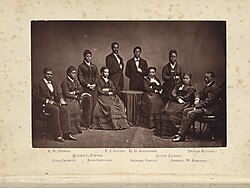
Spirituals moved from private communal settings to public stages through the efforts of several key groups. The Fisk Jubilee Singers were instrumental in popularizing these songs, followed by the Hampton Singers and the Tuskegee Institute Quartet. The latter was organized in 1884 by Booker T. Washington to promote the interests of the Tuskegee Institute, utilizing a modified harmonized style.
The Concert Spiritual Tradition
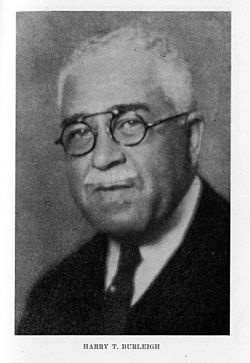
The transition of spirituals into "art songs" was led by Harry T. Burleigh, a classical composer and baritone. In 1929, he published Jubilee Songs of the United States, making spirituals accessible to solo concert singers. Burleigh introduced these works to classically trained artists like Antonín Dvořák, who some believe was inspired by spirituals when composing his Symphony From the New World.
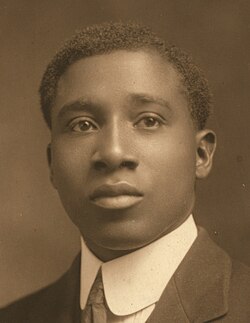
Similarly, R. Nathaniel Dett incorporated European Romantic influences into his arrangements, arguing that the "melodies of an enslaved people" should be presented in choral, operatic, and concerto forms. Dett mentored Edward Boatner, who further bridged the gap between authentic folk collection and polished concert performance.
Evolution into Modern Genres
The Blues and Gospel
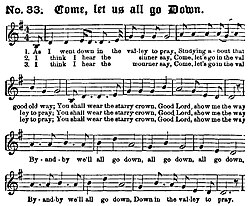
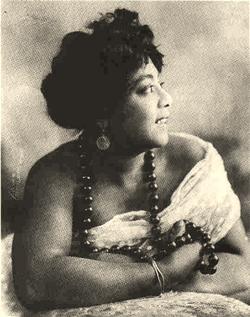
The spiritual is often viewed as an "omnibus term" because it branched into various derivative forms. In the fields, the music evolved into the blues, which Amiri Baraka described as a history of African Americans told through music. In the church, it evolved into gospel music.
Gospel music emerged as a discrete style around 1906 in Deep South Pentecostal churches. While Mahalia Jackson noted that the blues were "songs of despair," she described gospel as "songs of hope." The "Golden Age of Gospel" occurred between 1945 and 1955, with groups like the Golden Gate Quartet introducing sophisticated syncopation and new harmonies.
Freedom Songs and Global Protest
The legacy of spirituals extends into the modern era through freedom songs. During the Civil Rights movement (1954–1968), songs like "Oh, Freedom!" and "Eyes on the Prize" were adapted from early spirituals. The iconic "We Shall Overcome" was a fusion of the gospel hymn "I'll Overcome Someday" and the spiritual "I'll Be All Right." This tradition continues to influence global protest music, including works by Bob Marley and Billy Bragg.
Summary of Musical Evolution
| Original Form | Derivative/Fusion Genre | Primary Context | Emotional Tone |
|---|---|---|---|
| Spirituals | Blues | Field Work / Secular | Despair / Hardship |
| Spirituals | Gospel | Church / Sacred | Hope / Redemption |
| Spirituals | Concert Spirituals | Classical Stage | Artistic / Polished |
| Spirituals | Freedom Songs | Political Protest | Justice / Democracy |
Frequently Asked Questions
What is the difference between a spiritual and a gospel song?
While both are sacred, spirituals originated with enslaved Africans and often contained coded messages of survival and freedom. Gospel music emerged later, specifically as a discrete style in the early 20th century, focusing more on hope and a "cure for what's wrong."
How were spirituals used as "code songs"?
Spirituals often had double meanings. For example, songs like "Follow the Drinkin' Gourd" provided navigational instructions for escaping slaves, and "Go Down Moses" could signal the arrival of Harriet Tubman.
Who were the Fisk Jubilee Singers?
The Fisk Jubilee Singers were a choral group that helped popularize African American spirituals by performing them in a modified, harmonized style for wider audiences, moving the music from oral tradition to formal performance.
How did Harry T. Burleigh influence the genre?
Burleigh was a composer and baritone who arranged spirituals into a classical form, transforming them into "art songs" for solo concert singers and introducing them to classical composers like Antonín Dvořák.
What is the relationship between spirituals and the Civil Rights movement?
Many of the defining songs of the Civil Rights movement, known as freedom songs, were direct adaptations of early spirituals, combining religious faith with the political struggle for democracy and equality.